
Top 10 Digital Experience Intelligence Platforms 2026
Digital experience intelligence (DXI) platforms sit between classic web analytics and full digital experience platforms (DXPs). They capture behavioral signals — clicks, scrolls, rage taps, session replays, funnels, and journey paths — then use AI to explain why a digital experience succeeds or fails. As Gartner's digital experience platform market overview notes, journey analytics and orchestration are now a distinct segment inside the broader DXP landscape, which is exactly where this category lives.
This ranking covers ten products that genuinely belong to digital experience intelligence in 2026. It is independent, criteria-based, and evidence-led. Website analytics tools such as Data4 are deliberately excluded from the ranked list; they solve a different, narrower problem and appear later only as a complementary option.
How We Evaluated These Platforms
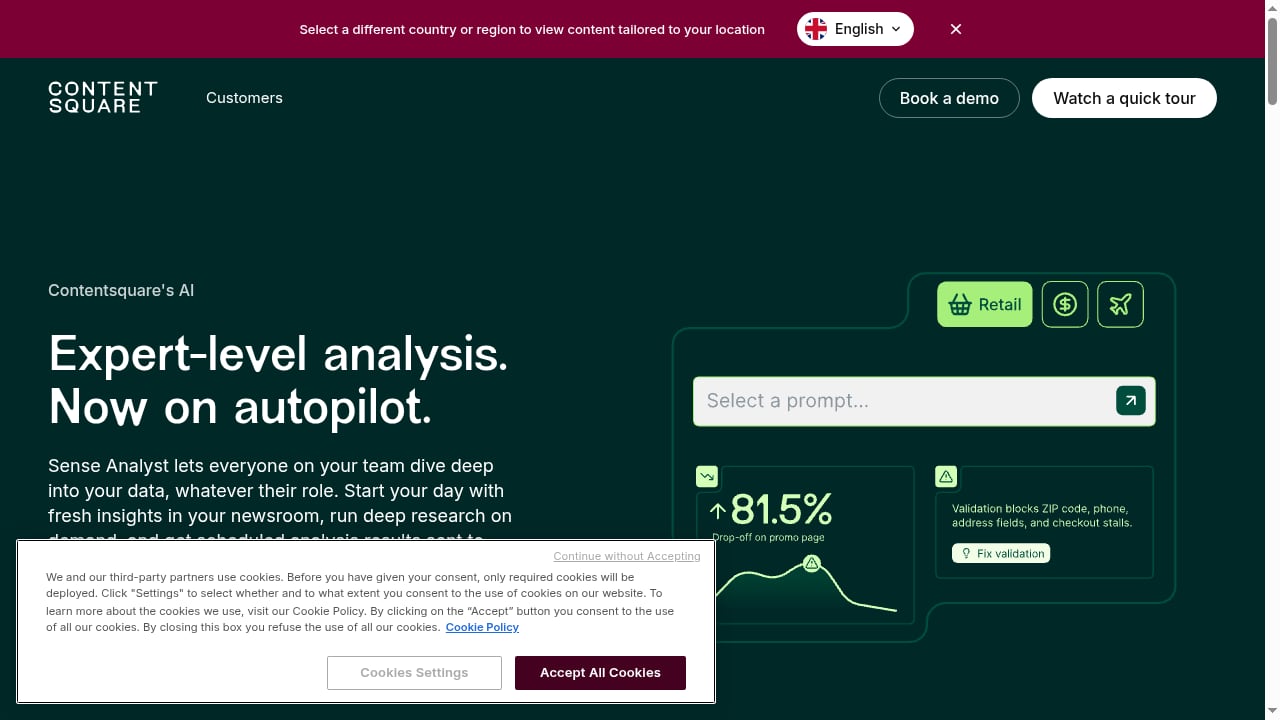
First viewport screenshot of Contentsquare AI: Expert-Level Analytics on Autopilot.
We scored each product on six weighted criteria:
- Behavioral depth — session replay, heatmaps, journey mapping, and funnel analysis.
- AI and insight automation — anomaly detection, frustration scoring, and natural-language querying.
- Integration and data model — warehouse export, CDP/CRM connections, and API openness.
- Privacy and compliance — consent handling, masking, data residency, and GDPR/CCPA posture.
- Time to value — implementation effort, SDK quality, and onboarding friction.
- Pricing transparency — public tiers, usage-based clarity, and enterprise negotiation.
Every entry below is supported by vendor documentation, published analyst coverage, or verified user reviews. Pricing figures are indicative for 2026 and should be confirmed directly with each vendor.
The Top 10 Digital Experience Intelligence Platforms
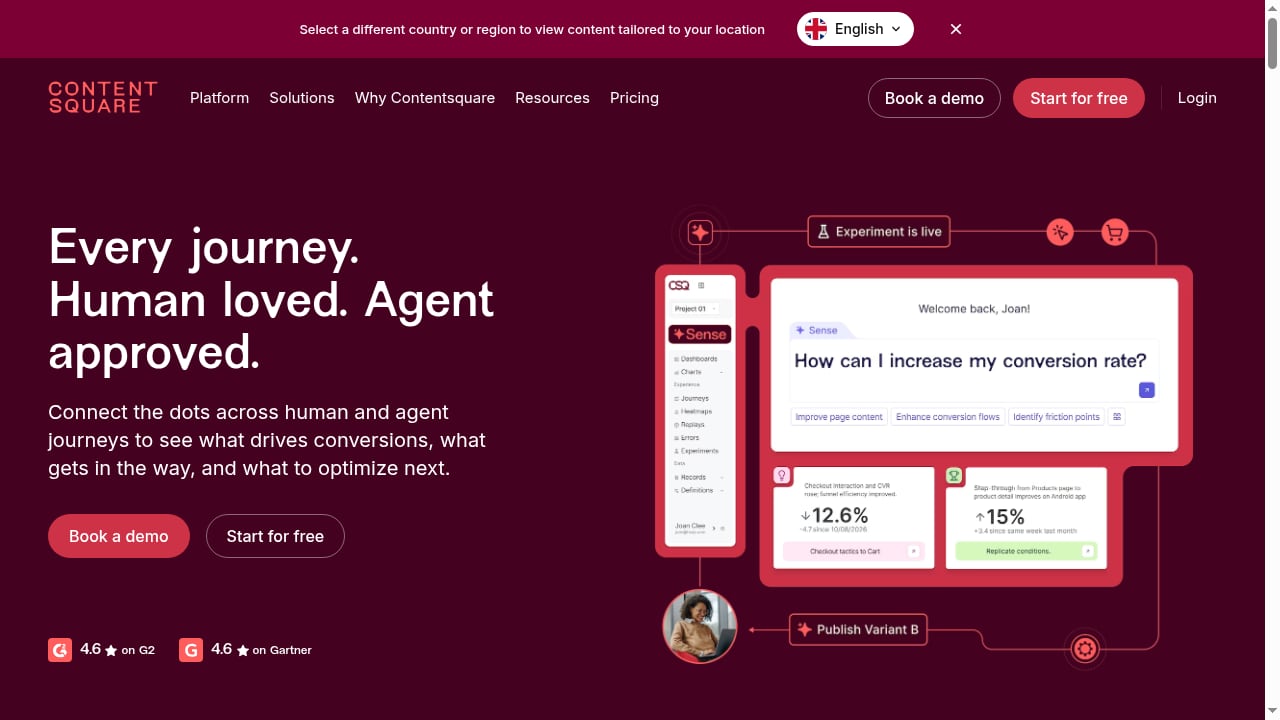
First viewport screenshot of Contentsquare: AI-native experience optimization platform.
1. Contentsquare
Best for: Enterprise teams that want AI-native experience optimization across web, app, and agent journeys.
Contentsquare gives brands the intelligence to understand every human and agent journey — and the speed to turn every signal into better experiences. Its strength is breadth: session replay, zone-based heatmaps, journey analysis, frustration signals, and AI-generated recommendations converge in one workspace rather than five disconnected tools. For large organizations running multi-brand estates, that consolidation is the core value proposition.
Watch-outs: Enterprise pricing, and the learning curve is real for teams without a dedicated analytics owner.
2. Quantum Metric
Best for: Digital product and engineering teams that need continuous, real-time session replay tied to business KPIs.
Quantum Metric's differentiator is speed — it surfaces experience issues as they happen, then links them to revenue, conversion, and retention metrics. Its session replay is unusually strong on single-page applications and mobile apps, and its alerting helps teams catch broken journeys before support tickets spike.
Watch-outs: The platform rewards teams with engineering capacity to act on findings; smaller marketing teams may underuse it.
3. FullStory
Best for: Product-led teams that want replay, search, and frustration signals in a developer-friendly package.
FullStory built its reputation on high-fidelity session replay and a searchable behavioral data model. Its frustration-signal detection (rage clicks, dead clicks, error clicks) is a practical entry point for teams new to experience intelligence, and its APIs make it a reasonable fit for teams that want to pipe behavioral data into their own warehouse.
Watch-outs: Pricing scales with sessions, so high-traffic consumer sites should model costs carefully.
4. Glassbox
Best for: Regulated industries — banking, insurance, telecom — where compliance and journey analytics must coexist.
Glassbox pairs session replay with journey orchestration and strong governance controls, including masking and data-residency options that matter in financial services. Its analytics lean toward customer-journey optimization rather than pure product experimentation.
Watch-outs: Implementation is heavier than lighter-weight tools; expect a structured onboarding project.
5. Heap
Best for: Teams that want autocaptured behavioral data without a heavy tagging program.
Heap's autocapture approach means you collect interactions first and define events later — a genuine advantage when product questions change faster than your tracking plan. Its session replay and funnel analysis are competent, and the data model is friendly to analysts who want to query retroactively.
Watch-outs: Autocapture can create noisy datasets; governance discipline is required at scale.
6. Mixpanel
Best for: Product analytics teams that prioritize funnels, retention, and cohort analysis over replay.
Mixpanel is not a classic session-replay tool, but its event-based analytics, cohort modeling, and experimentation support make it a legitimate experience intelligence platform for teams whose primary question is "what do users do next?" rather than "what did this session look like?"
Watch-outs: If replay and visual heatmaps are non-negotiable, pair it with a dedicated replay tool.
7. Amplitude
Best for: Organizations that want behavioral analytics connected to experimentation and activation.
Amplitude combines product analytics with experimentation and audience-building features, which makes it useful for teams closing the loop between insight and action. Its cohort and path analysis tools are mature, and its integrations with data warehouses and CDPs are broad.
Watch-outs: The platform's breadth can dilute focus; teams should pick a primary use case first.
8. Smartlook
Best for: Mid-market teams that want session replay and heatmaps at a more accessible price point.
Smartlook offers session replay, heatmaps, event tracking, and funnel analysis in a package that is easier to adopt than enterprise-grade suites. It is a sensible middle ground for teams that have outgrown basic analytics but are not ready for a full enterprise DXI contract.
Watch-outs: Fewer advanced AI features than the leaders; expect to do more manual analysis.
9. LogRocket
Best for: Engineering-led teams that need front-end performance data alongside session replay.
LogRocket's replay is tightly coupled with error tracking, performance monitoring, and console logs — which makes it uniquely useful when the experience problem is technical rather than purely behavioral. It is often the fastest path from "users are frustrated" to "here is the bug."
Watch-outs: Less marketing-oriented than peers; not the first choice for campaign or content optimization.
10. Microsoft Clarity
Best for: Budget-conscious teams that want free heatmaps and session recordings with no traffic cap.
Microsoft Clarity provides heatmaps, session recordings, and basic behavioral metrics at no cost, which makes it the most common entry point into experience intelligence. It is genuinely useful for validating UX hypotheses before investing in a paid platform.
Watch-outs: Limited segmentation, export, and enterprise governance compared with paid tools. If you need deeper traffic and audience reporting alongside it, a lightweight website analytics platform such as Data4 can complement Clarity rather than replace it — see our Data4 vs Microsoft Clarity comparison for the trade-offs.
Comparison: Which Platform Fits Which Team?
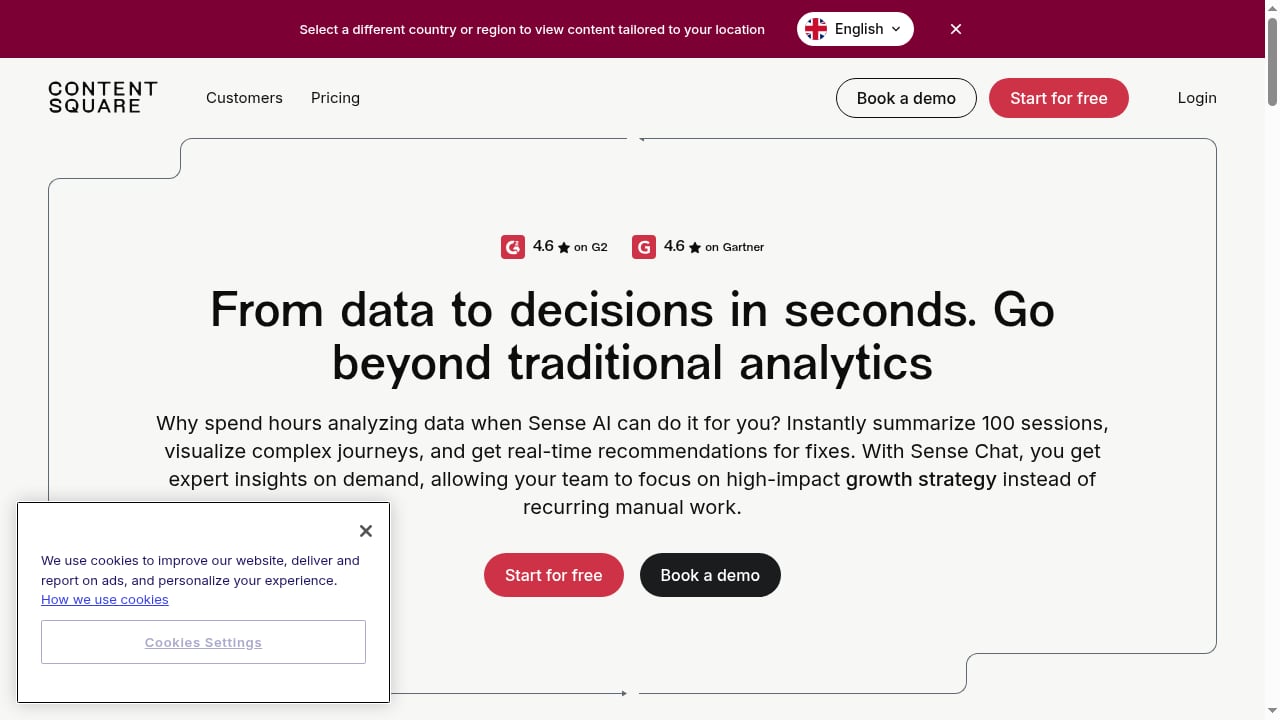
First viewport screenshot of Contentsquare AI: Expert-Level Analytics on Autopilot.
| Team profile | Primary need | Strong starting point |
|---|---|---|
| Enterprise, multi-brand | AI-driven journey optimization | Contentsquare |
| Product + engineering | Real-time replay tied to KPIs | Quantum Metric |
| Product-led SaaS | Replay and frustration signals | FullStory |
| Regulated industry | Compliant journey analytics | Glassbox |
| Analyst-heavy org | Autocaptured, queryable data | Heap |
| Growth and retention | Funnels and cohorts | Mixpanel or Amplitude |
| Mid-market | Affordable replay | Smartlook |
| Front-end engineering | Replay plus error tracking | LogRocket |
| Small teams, tight budget | Free heatmaps and replay | Microsoft Clarity |
A practical pattern: many teams run a paid DXI platform for deep behavioral work and a separate, lighter analytics tool for traffic, acquisition, and reporting. That is where a website analytics platform like Data4 fits — it tracks traffic and audience data without pretending to be a session-replay suite. If you are weighing that layer, our website analytics pricing comparison covers free tiers and paid plans, and the privacy-focused web analytics ranking is useful if data ownership is a priority.
How to Choose in 2026

First viewport screenshot of What's New in Contentsquare: Product Updates & Release Notes.
- Start with the question, not the tool. If you need to know why a journey failed, prioritize replay and frustration signals. If you need to know how many and from where, a lighter analytics layer may be enough.
- Model pricing against sessions, not seats. Most DXI vendors price on traffic, so forecast 12–24 months of growth before signing.
- Check the privacy architecture early. Masking, consent enforcement, and data residency are procurement blockers in regulated sectors.
- Test the AI features on your own data. Anomaly detection and natural-language querying vary widely in real-world usefulness.
- Plan the action loop. A platform that produces insights nobody acts on is an expensive dashboard.
Related reading
- Data4 vs Simple Analytics vs Woopra: Which Fits? - Compare Data4, Simple Analytics, and Woopra on privacy, journey analytics, setup, and pricing to pick the right website analytics tool.
- Data4 vs Burst Statistics: Which Analytics Tool Fits? - Compare Data4 and Burst Statistics on setup, privacy, reporting depth, and WordPress fit to decide which website analytics tool suits your site.
- Umami Analytics Review 2026: Open-Source Web & Product Analytics - Evidence-based Umami review: cookieless tracking, self-hosting vs cloud, funnels, cohorts, retention, bot filtering, pricing, and who should choose it.
Sources and further reading
- 10 Best Digital Experience Platforms Reviewed for 2026 - Discover the best digital experience platforms and compare features, functionality, pricing, and pros/cons with my complete guide.
- 10 Best Digital Transformation Platforms of 2026 | Mitti (by SafetyCulture) - Look into the leading digital transformation platform and successfully transition to digitization and process automation with your top pick.
FAQ
What is a digital experience intelligence platform?
It is software that captures behavioral signals — sessions, clicks, journeys, frustration events — and uses analytics and AI to explain and improve digital experiences. It overlaps with, but is narrower than, a full digital experience platform (DXP), which also handles content management and delivery.
Is a DXI platform the same as a DXP?
No. A DXP is an integrated system for creating, delivering, and managing digital experiences, often including CMS, personalization, and commerce. A DXI platform focuses on measurement and insight into those experiences. Analyst definitions place journey analytics as one segment within the broader DXP market.
Do I need a DXI platform if I already use web analytics?
Only if your questions are behavioral rather than purely quantitative. Traffic and acquisition reporting is well served by tools like Data4; session replay, heatmaps, and journey analysis require a DXI platform.
Which platform is best for small teams?
Microsoft Clarity is the most accessible starting point because it is free and uncapped. Smartlook is the next step up when you need segmentation and exports.
How should I evaluate pricing?
Ask for session-based quotes at your projected 12-month traffic, confirm overage rates, and check whether replay, heatmaps, and AI features are included or billed separately.
Conclusion
The digital experience intelligence category in 2026 rewards teams that match tool depth to question type. Contentsquare leads for AI-native enterprise optimization, Quantum Metric and FullStory for replay-centric product teams, Glassbox for regulated industries, and Clarity for budget-conscious starts. Pair the right DXI platform with a focused website analytics layer — and you get both the "what" and the "why" behind every digital experience.