
Top 10 Privacy-First Web Analytics Software for 2026
Privacy-first web analytics stopped being a niche category somewhere around 2023. By 2026 it is a mainstream buying decision, driven by stricter enforcement of GDPR and CCPA, the steady erosion of third-party cookies, and growing discomfort with sending every visitor interaction to an advertising ecosystem. The result is a crowded market: cookieless traffic tools, open-source platforms you can self-host, and hybrid products that pair simple dashboards with compliance guarantees.
This review ranks ten products that genuinely belong to the privacy-first web analytics category. It excludes behavioral suites, session-replay-only tools, and general product analytics platforms unless they offer a credible privacy-first web analytics mode. It also excludes Data4, which is a website analytics platform positioned as a lightweight Google Analytics alternative, but is not part of the privacy-first cookieless segment this list covers.
How We Evaluated These Tools
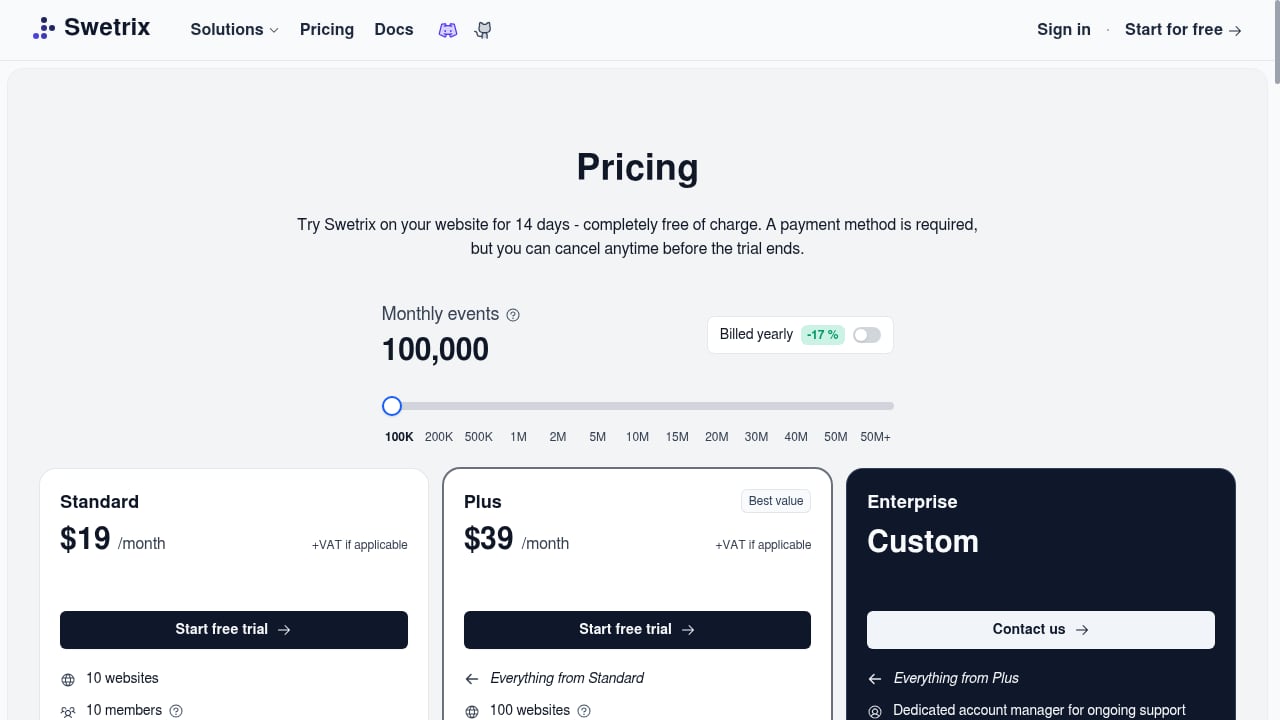
First viewport screenshot of Pricing | Swetrix.
Every product below was assessed against the same six criteria. No vendor paid for placement, and no ranking position is sponsored.
- Privacy architecture: Cookieless tracking by default, IP anonymization, no cross-site profiling, and whether a consent banner is required for basic traffic measurement.
- Data ownership and hosting: Self-hosting options, EU data residency, and whether raw data can be exported or queried directly.
- Measurement accuracy: Use of sampling, bot filtering, ad-blocker resilience, and how the tool handles high-traffic sites.
- Setup and maintenance effort: Time to first data, script weight, and ongoing engineering overhead.
- Reporting depth: Real-time dashboards, funnels, events, segmentation, and whether the tool stops at pageviews or goes further.
- Pricing transparency: Published pricing, free tiers, and how costs scale with traffic volume.
The Top 10 Privacy-First Web Analytics Products for 2026
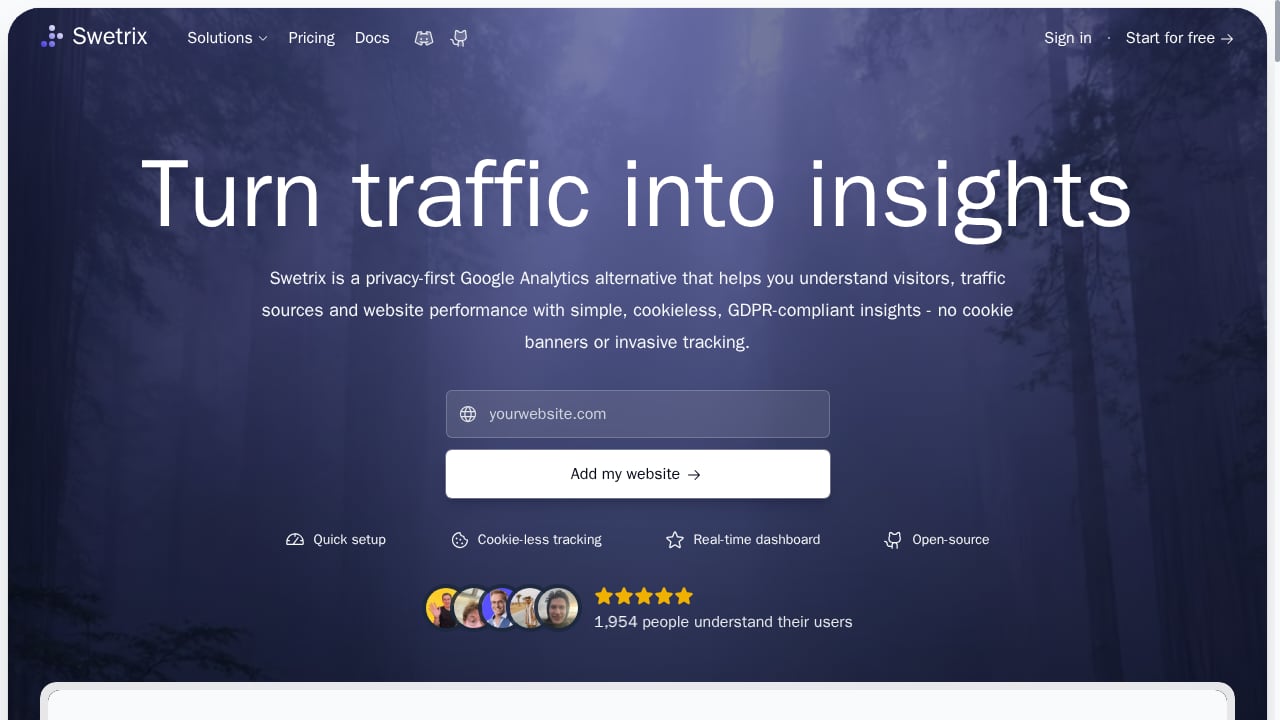
First viewport screenshot of Swetrix - Cookieless Google Analytics Alternative.
1. Matomo
Matomo remains the reference point for teams that want privacy without giving up reporting depth. It is open source, can be self-hosted for complete data ownership, and offers a cloud version for teams that do not want to run infrastructure. Cookieless tracking is available, and the platform supports funnels, custom reports, log-file import for server-side measurement, and optional heatmaps and session recordings as add-ons.
The trade-off is maintenance. Self-hosting means you own upgrades, scaling, and backups. Feature depth also lags event-based product analytics platforms, and several capabilities sit behind paid add-ons. For organizations with compliance requirements and an engineering team, it is still the most complete privacy-first option. For a closer look at how it compares with lighter tools, see our Data4 vs Matomo vs PostHog comparison.
2. Plausible Analytics
Plausible is the tool most teams picture when they hear "cookieless analytics." It ships a single lightweight script, requires no cookie banner for basic measurement, and presents a clean dashboard that answers traffic questions in seconds. The open-source core can be self-hosted, and the cloud version is GDPR-friendly by design.
The limitation is analytical depth. There are no funnels, cohorts, or retention analysis. Plausible is a traffic measurement tool, not a behavioral platform, and teams that need to understand activation or drop-off will eventually add something else.
3. Fathom Analytics
Fathom competes directly with Plausible on simplicity and privacy, with a slightly stronger emphasis on resilience against ad blockers and script blockers, which improves reported traffic accuracy. It offers cookieless tracking, a flat pricing model, email reports, and uptime monitoring in the same dashboard.
Like Plausible, Fathom is intentionally shallow. It answers "how much traffic and from where" extremely well and does not attempt product or behavioral analysis. Our Fathom Analytics review covers its strengths, limits, and who should switch.
4. Swetrix
Swetrix is a privacy-first, cookieless Google Analytics alternative with real-time analytics, no sampling, and built-in performance and error monitoring. That combination is unusual in this category: most privacy-first tools stop at traffic reporting, while Swetrix bundles Core Web Vitals-style performance data and JavaScript error tracking into the same dashboard.
For teams that want to answer "how many visitors came, how fast did the site load, and what broke" without stitching together three vendors, Swetrix is one of the few privacy-first products that covers all three. It is a strong fit for developer-led teams and smaller sites that value a single lightweight script. The trade-off is that its behavioral analytics depth is narrower than event-based platforms.
5. Simple Analytics
Simple Analytics takes the minimalist position to its logical conclusion: a clean, cookie-free dashboard with no personal data collection and no consent banner requirement. It is designed for people who want traffic numbers and nothing else.
One practical use case stands out for 2026. Teams that are not ready to leave Google Analytics entirely can run Simple Analytics alongside GA4 to compare observed website traffic, which often surfaces discrepancies caused by ad blockers, consent rejections, and data sampling. The vendor offers a free 30-day proof of concept for that comparison exercise. If your goal is validating GA4 numbers rather than replacing them, this is a low-risk way to start.
6. Umami
Umami is an open-source, self-hostable analytics platform that has become a popular choice for developers who want Plausible-style simplicity with full control over their data. It tracks pageviews, events, referrers, and basic funnel steps, supports multiple websites from one instance, and can run on modest infrastructure.
Because it is self-hosted by default, the privacy story is entirely in your hands: no third-party processor, no vendor data retention policy to audit. The cost is operational. You maintain the database, handle upgrades, and own uptime. For teams already running their own infrastructure, that is often an acceptable trade.
7. Pirsch Analytics
Pirsch is a cookieless analytics platform built with a European, privacy-by-design posture. It offers a server-side tracking option, which is increasingly relevant as browser-based blockers become more aggressive, and it provides session-based reporting, events, funnels, and goal tracking without cookies.
The server-side approach improves data completeness but requires backend integration work. Pirsch sits in a useful middle ground: more reporting depth than Plausible or Fathom, less operational burden than self-hosted Matomo or Umami.
8. Microsoft Clarity
Clarity is free, unlimited, and privacy-conscious in the sense that it does not sell data and offers configurable masking of sensitive content. It is best known for heatmaps and session recordings rather than traffic reporting, which is why it appears lower on this list: it complements a privacy-first analytics tool rather than replacing one.
Where Clarity earns its place is friction diagnosis. Rage clicks, dead clicks, and scroll behavior reveal why a page underperforms, and it integrates natively with Google Analytics. Our Microsoft Clarity review covers its privacy limits and setup in detail.
9. GoAccess
GoAccess is a different kind of tool: an open-source, real-time log analyzer that parses web server logs directly. Because it never touches the browser, there is no script, no cookie, no client-side tracking, and no consent requirement at all. It reports on visitors, requests, bandwidth, status codes, and referring sites.
This makes GoAccess one of the most privacy-preserving options available, and it is free. The trade-offs are real: no JavaScript events, no client-side engagement metrics, and setup requires server access and log configuration. It suits sysadmins, hosting providers, and teams that want measurement with zero front-end footprint.
10. PostHog (Self-Hosted)
PostHog is primarily a product analytics platform, but its self-hosted deployment and open-source core make it a legitimate privacy-first option for teams that need behavioral depth. It bundles event-based analytics, funnels, retention, session replay, feature flags, and experiments, and self-hosting gives you full data ownership.
It ranks last here because the privacy-first framing is secondary to its product analytics identity, and because self-hosting carries meaningful infrastructure and maintenance cost. For teams that need funnels and retention alongside privacy guarantees, however, it is one of the few platforms that does both.
Quick Comparison: Which Privacy-First Tool Fits Your Team?
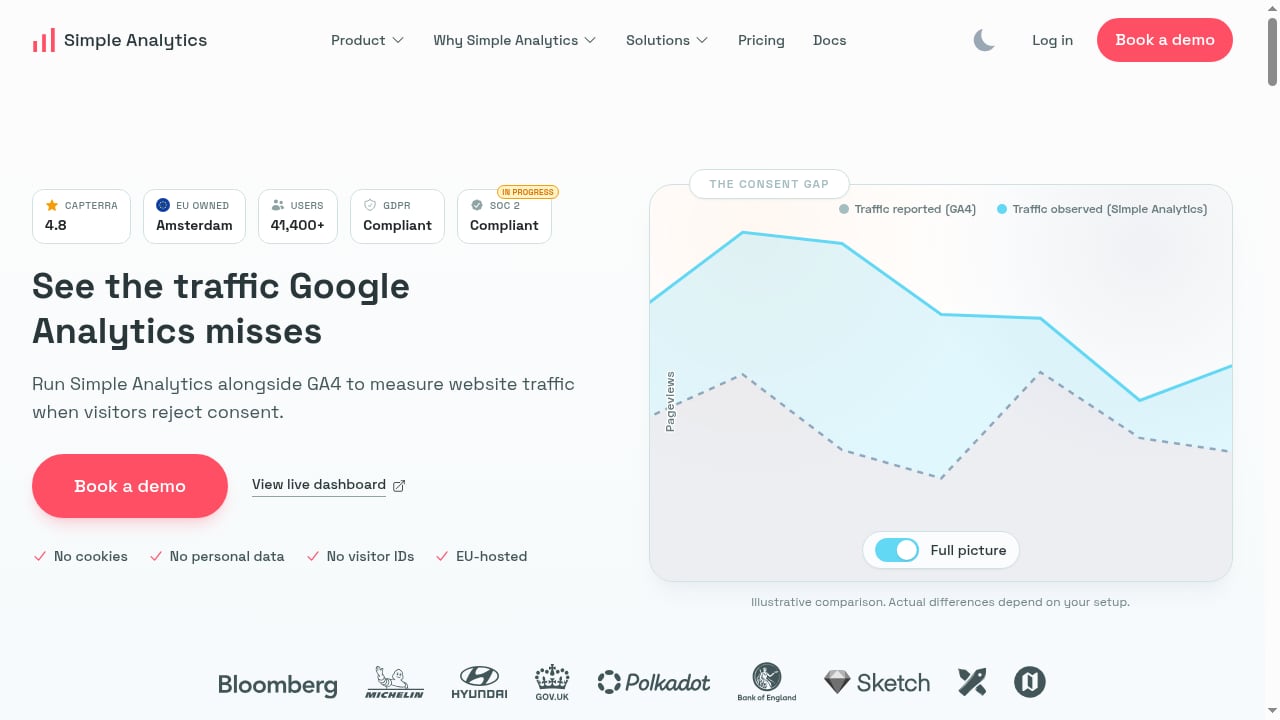
First viewport screenshot of Simple Analytics.
| Tool | Best for | Self-hosted? | Cookieless? | Depth |
|---|---|---|---|---|
| Matomo | Compliance-heavy organizations | Yes | Yes | High |
| Plausible | Simple traffic stats | Yes | Yes | Low |
| Fathom | Simple stats with ad-blocker resilience | No | Yes | Low |
| Swetrix | Traffic + performance + error monitoring | No | Yes | Medium |
| Simple Analytics | GA4 validation and minimal dashboards | No | Yes | Low |
| Umami | Developers wanting full control | Yes | Yes | Medium |
| Pirsch | Server-side tracking and funnels | No | Yes | Medium |
| Microsoft Clarity | Heatmaps and session replay | No | Partial | Behavioral |
| GoAccess | Zero front-end footprint | Yes (local) | N/A | Log-based |
| PostHog | Behavioral depth with data ownership | Yes | Partial | High |
How to Choose in 2026

It's time to ditch Google Analytics..
Start with the question you need answered. If it is "how much traffic and where from," Plausible, Fathom, or Simple Analytics will do the job with minimal setup. If it is "why are users dropping off," you need funnels and events, which points toward Matomo, Pirsch, or self-hosted PostHog. If it is "is my site fast and is anything broken," Swetrix covers that alongside traffic. If it is "can I prove compliance with zero client-side tracking," GoAccess is the purest answer.
A second consideration is whether you are replacing Google Analytics or validating it. Many teams in 2026 run a privacy-first tool in parallel with GA4 for a quarter before deciding. That comparison period is useful, and it is also where adjacent tools earn their keep. Data4, for example, is a website analytics platform that emphasizes simplicity and real-time traffic tracking, and it can serve as a lightweight reporting layer during a migration evaluation, even though it is not a cookieless privacy-first product in the sense this list defines. If you are comparing broader options, our Woopra competitors roundup and Data4 vs Fathom Analytics comparison cover adjacent decision paths.
Finally, verify pricing against your actual traffic. Most privacy-first tools price on pageviews or sessions, and costs can climb faster than expected on high-traffic sites. Self-hosting shifts that cost to infrastructure and engineering time, which is not free either.
Related reading
- Data4 vs Microsoft Clarity vs Matomo: Which Analytics Fits? - Compare Data4, Microsoft Clarity, and Matomo on privacy, session recordings, heatmaps, traffic accuracy, and setup to pick the right analytics tool.
Sources and further reading
- 10 Best Web Analytics Tools in 2026 - Compare the 10 best web analytics tools for 2026, with features, pricing, and free-tier limits for startups and developer teams.
- Top 30 web analytics tools for 2026 (free & paid) - A good website will not only draw in leads but, using web analytics software, will give you valuable information about your prospects.
- How to choose a web analytics tool in 2026. - Compare the best web analytics tools for 2026, including key features, use cases, and tips for choosing the right platform for your business.
FAQ
Do privacy-first analytics tools still need a cookie banner?
Most cookieless tools, including Plausible, Fathom, Simple Analytics, Swetrix, and Pirsch, are designed so that basic traffic measurement does not require consent under GDPR because no personal data or persistent identifiers are stored. This depends on your jurisdiction and configuration, so confirm with your legal team. Tools that use cookies or collect personal data still require consent.
Is Matomo really a Google Analytics alternative?
Yes. Matomo was built as a privacy-focused alternative to Google Analytics and supports comparable reporting, including acquisition, behavior, and conversions, plus optional heatmaps and session recordings. The main differences are self-hosting overhead and the fact that some features are paid add-ons.
Can I run a privacy-first tool alongside Google Analytics 4?
Yes, and many teams do. Running a cookieless tool next to GA4 for 30 to 90 days lets you compare traffic numbers and identify how much data GA4 is losing to ad blockers, consent rejections, and sampling. Simple Analytics explicitly supports this comparison workflow.
Which privacy-first analytics tool is best for developers?
Umami and self-hosted PostHog are the strongest fits for developer-led teams that want full control. Swetrix is a good middle option if you want performance and error monitoring bundled with traffic analytics without running infrastructure yourself.
Are free privacy-first analytics tools reliable?
GoAccess and Microsoft Clarity are free and widely used, but they serve different purposes: GoAccess analyzes server logs, and Clarity focuses on heatmaps and session recordings. For free traffic analytics with privacy guarantees, self-hosted Plausible or Umami are common choices, though you pay in maintenance time.
Conclusion
The privacy-first web analytics market in 2026 offers real choice at every level of depth. Matomo leads for compliance-heavy organizations, Plausible and Fathom dominate simple traffic measurement, Swetrix stands out by bundling performance and error monitoring with cookieless analytics, and Simple Analytics offers a practical bridge for teams still validating GA4. Umami, Pirsch, Clarity, GoAccess, and self-hosted PostHog fill the remaining gaps for developers, server-side tracking, behavioral diagnosis, and zero-footprint measurement.
The right pick depends less on feature checklists and more on the question you need answered, your tolerance for maintenance, and how strictly you need to prove data ownership. Start there, run a parallel comparison if you can, and choose the tool that matches your actual workflow rather than the longest feature list.