
Top 10 User Behavior Analytics Software Products 2026
User behavior analytics software helps you see what people actually do on your site or in your app: where they click, scroll, hesitate, and drop off. In 2026, the category has split into distinct camps — session replay and heatmap tools, event-based product analytics platforms, and digital experience intelligence suites. This guide ranks ten products that genuinely belong to the user behavior analytics category, explains how we evaluated them, and helps you match a tool to your team's workflow.
How We Evaluated These Tools
First viewport screenshot of Success stories from Clarity users.
We scored each product on six criteria: depth of behavioral tracking (clicks, scrolls, rage clicks, funnels), segmentation and cohort analysis, ease of setup, privacy and compliance controls, pricing transparency, and ecosystem fit (integrations, exports, APIs). We prioritized tools with publicly verifiable feature documentation and pricing signals, and we excluded pure website traffic analytics platforms that do not provide behavioral interaction data. Every product below is supported by vendor documentation or credible third-party reviews.
The Top 10 User Behavior Analytics Software Products for 2026
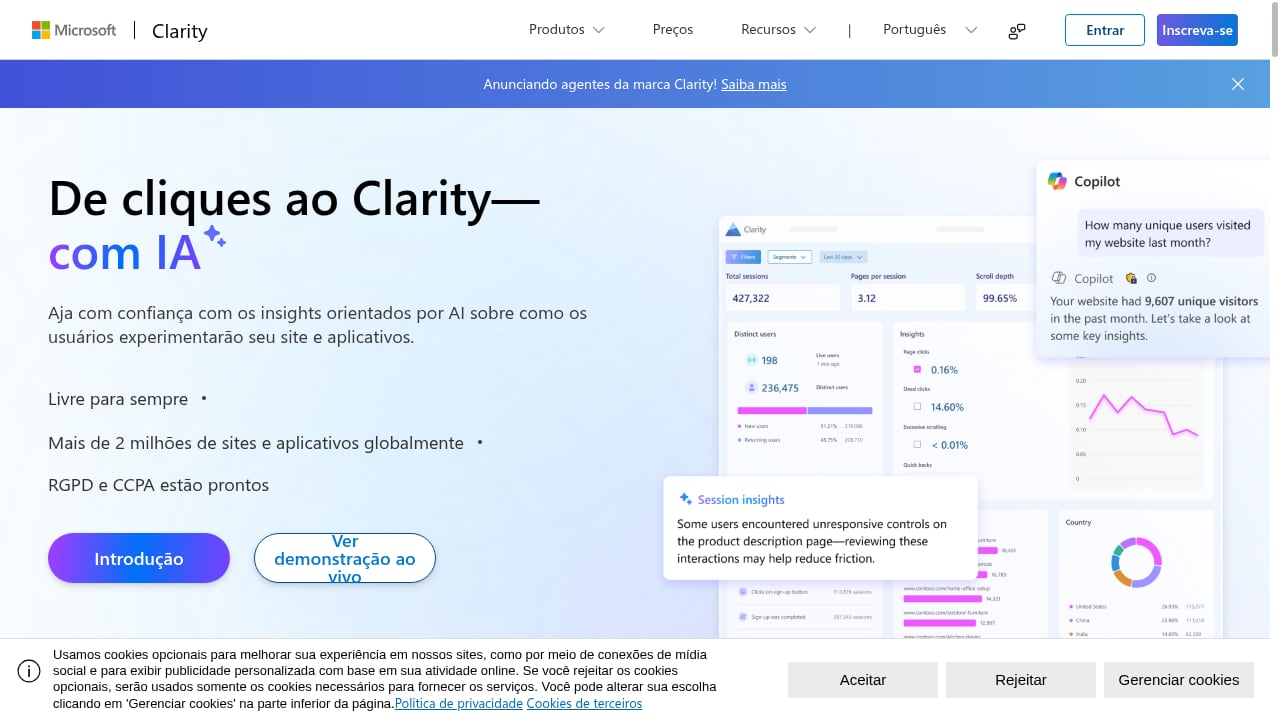
First viewport screenshot of Microsoft Clarity - Free Heatmaps & Session Recordings.
1. Microsoft Clarity
Microsoft Clarity is a free user behavior analytics tool that combines session replays, heatmaps, and click analytics. It captures rage clicks, dead clicks, and excessive scrolling, then surfaces them in dashboards you can filter by device, browser, or traffic source. Because it is free with no traffic caps, it is the lowest-friction entry point into behavioral analytics and a common first tool for teams that have never used session replay. The trade-off is depth: Clarity is strong on qualitative interaction data but lighter on event-based funnels, behavioral cohorts, and revenue attribution than product analytics platforms. It works well as a complement to a website analytics platform — for example, pairing Clarity-style replays with a simpler traffic tool such as Data4 for website analytics gives you both the "what" and the "why."
2. Hotjar
Hotjar bundles heatmaps, session recordings, funnels, surveys, and feedback widgets in one platform. Its strength is combining qualitative feedback with behavioral data: you can watch a recording, then trigger a survey to ask why a user hesitated. Hotjar's pricing is modular — Observe, Ask, and Engage plans are billed separately — which lets teams start small. Limitations include cross-domain tracking quirks with some JavaScript frameworks and support that is primarily email-based. It suits marketing and UX teams that want an all-in-one behavior and feedback toolkit without enterprise complexity.
3. FullStory
FullStory is a digital experience intelligence platform built around high-fidelity session replay with autocapture. It automatically records every interaction without manual event tagging, so you can retroactively analyze behavior you did not plan to track. Funnels, trends, heatmaps, and friction signals layer quantitative data on top of qualitative replays. It is enterprise-ready, with robust privacy controls and mobile SDKs, but most pricing is sales-led and can be premium at scale. FullStory fits product, engineering, and support teams that need pixel-perfect diagnosis of bugs and friction.
4. Contentsquare
Contentsquare provides heatmaps, session replays, customer journey mapping, and funnel analysis with a strong focus on enterprise digital experience. It excels at zone-based heatmaps that show attention and hesitation on specific page elements, and it connects behavioral data to business metrics like conversion and revenue. Pricing is custom and typically enterprise-oriented. Contentsquare is a good fit for large organizations that need journey-level behavioral insight across web and mobile.
5. Glassbox
Glassbox combines session replay, heatmaps, mobile app analytics, performance analytics, and funnel analysis in a single platform aimed at regulated industries. Its differentiator is capturing and analyzing sessions while masking sensitive data, which matters for financial services and healthcare. Pricing is custom. Glassbox suits enterprises that need behavioral analytics with strong compliance and performance monitoring in one vendor.
6. Amplitude
Amplitude is an event-based product analytics platform that goes beyond page views to connect user actions with business outcomes. It is strong at behavioral cohorts, retention analysis, conversion funnels, and user paths, and it now includes session replay, A/B testing, and feature management. Its free tier is generous for startups, but pricing based on monthly tracked users can become complex to forecast, and advanced features sit behind higher tiers. Amplitude fits product and growth teams that want deep, queryable behavioral data.
7. Mixpanel
Mixpanel is an event-based analytics platform known for fast ad-hoc analysis of funnels, flows, retention, and behavioral cohorts. It offers guided AI answers and data governance features, and its event-based pricing model is often more predictable for high-traffic products than user-based models. Advanced features like data pipelines and SSO are gated to higher plans. Mixpanel is a strong choice for product-led growth teams that need real-time answers to "why" questions. For a closer look at how it differs from simpler website analytics, see Data4 vs Mixpanel.
8. Heap
Heap, now part of Contentsquare, popularized autocapture: it collects every click, swipe, and form fill from the moment the tracking snippet is installed, so you can define events retroactively without engineering work. It offers journeys, funnels, an engagement matrix, and strong B2B account-level analytics. Pricing above the free tier is opaque and sales-led, and autocaptured data can feel overwhelming to organize. Heap suits product and marketing teams that want to move fast without tracking dependencies.
9. Smartlook
Smartlook provides session recordings, heatmaps, and funnel analysis with a focus on mobile and web apps. It is known for reliable mobile session replay and event-based filtering, making it a practical choice for app teams that need qualitative and quantitative behavior data without enterprise overhead. Pricing starts at a mid-range monthly tier, and it integrates with common product and analytics stacks. Smartlook fits teams that want replay-first behavior analytics with straightforward setup.
10. Crazy Egg
Crazy Egg offers website heatmaps (click, scroll, confetti, overlay, and list maps), session recordings, traffic analytics, surveys, and conversion tracking. It is easy to deploy and understand, making it a good fit for marketers and smaller teams focused on landing page and funnel optimization. Pricing starts at a higher monthly tier than some competitors, and it is less suited to deep in-app event analysis. Crazy Egg works well when your primary goal is visual, page-level behavior insight.
How to Choose the Right Tool
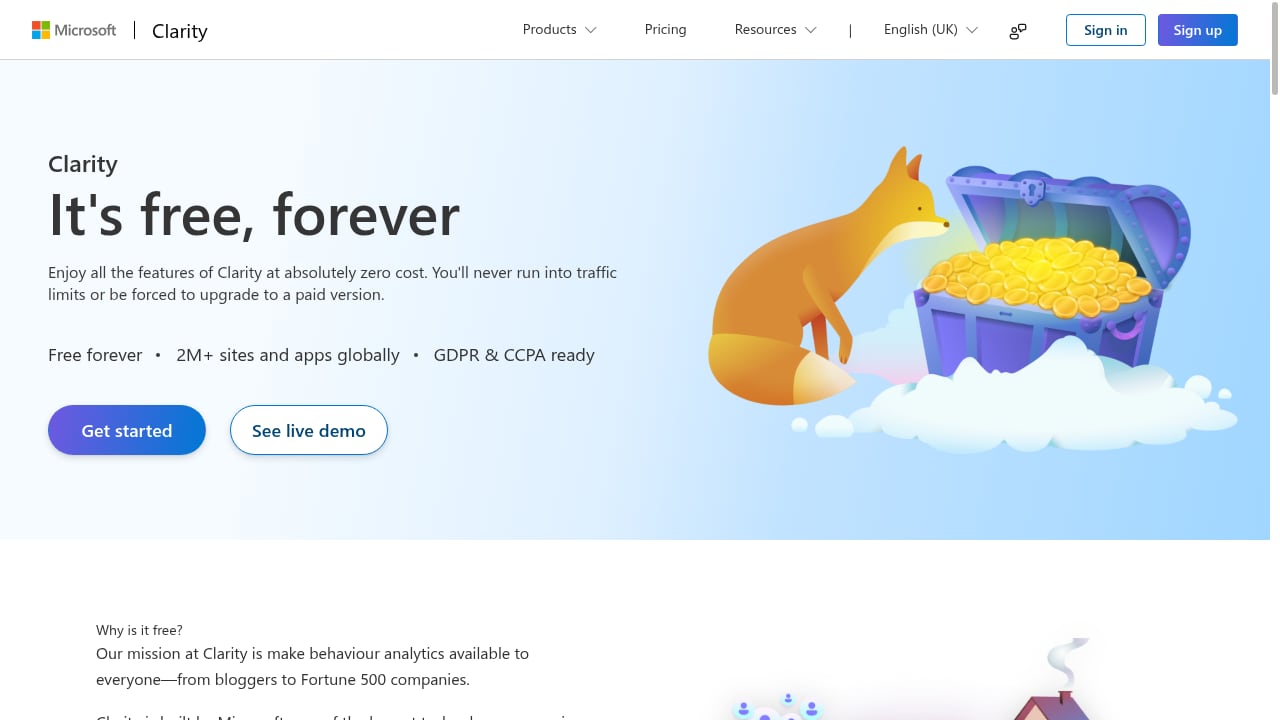
First viewport screenshot of Pricing - Clarity.
Start with the question you need answered. If you need to see how users interact with pages, prioritize session replay and heatmap tools like Clarity, Hotjar, or Crazy Egg. If you need to understand why users convert or churn across product features, prioritize event-based platforms like Amplitude, Mixpanel, or Heap. If you need enterprise-grade compliance and journey analysis, look at FullStory, Contentsquare, or Glassbox.
Budget and team structure matter too. Free tools like Microsoft Clarity lower the barrier to entry, while event-based platforms often scale pricing with tracked users or events. Many teams combine a lightweight website analytics platform for traffic context with a dedicated behavior tool for interaction depth. If you are weighing a simple analytics platform against a behavior suite, comparisons like Data4 vs Heap vs Fathom Analytics can clarify where each fits.
Related reading
- Data4 vs Heap: Which Analytics Tool Fits Your Team? - Data4 vs Heap compared: website analytics simplicity versus digital insights depth. See which tool fits your team, use case, and data needs.
- Matomo Review 2026: Privacy-First Analytics You Can Trust - An evidence-based Matomo review covering ideal users, use cases, setup, pricing signals, strengths, limitations, and how it compares to GA4.
Sources and further reading
- Best UEBA Software: Top 7 Options in 2026 - UEBA (User and Entity Behavior Analytics) software is a cybersecurity solution that uses machine learning and behavioral analytics to detect threats, including insider threats and account takeovers, by establishing a baseline of normal user and entity behavior and then flagging deviations.
- 10 Best Behavior Analytics Tools for 2026: With Expert Insights to Choose the Perfect Fit - Explore 10 top behavior analytics tools for 2026 with real user reviews. Compare features, pricing, pros & cons to choose the ideal solution.
- 12 Best In-App User Behavior Analytics Tools for 2026 - Comparing in-app user behavior analytics tools like Mixpanel, Amplitude, Pendo, and FullStory. See features, pricing, and when to use each in 2026.
Frequently Asked Questions
What is user behavior analytics software?
It is software that captures and analyzes how users interact with a website or app — clicks, scrolls, session replays, funnels, and cohorts — to explain why users act the way they do, not just what they did.
Is Microsoft Clarity really free?
Yes. Microsoft Clarity is free with no traffic limits, making it a common starting point for session replay and heatmaps. It is lighter on event-based product analytics than paid platforms.
What is the difference between behavior analytics and website analytics?
Website analytics platforms track traffic, sources, and page views. Behavior analytics tools go deeper into interaction data such as rage clicks, scroll depth, and session recordings. Many teams use both.
Which tool is best for mobile apps?
Smartlook, Glassbox, and FullStory offer strong mobile session replay and app analytics. Amplitude and Mixpanel are strong for event-based mobile product analysis.
How much do these tools cost in 2026?
Microsoft Clarity is free. Hotjar, Smartlook, and Crazy Egg start in the $30–$99 per month range. Amplitude, Mixpanel, Heap, FullStory, Contentsquare, and Glassbox often use usage-based or custom enterprise pricing.
Conclusion
The best user behavior analytics software for 2026 depends on whether you need qualitative interaction insight, event-based product analysis, or enterprise-grade experience intelligence. Microsoft Clarity leads for free, low-friction replay and heatmaps. Hotjar and Crazy Egg suit UX and marketing teams. Amplitude, Mixpanel, and Heap serve product-led teams that need cohorts and funnels. FullStory, Contentsquare, and Glassbox fit enterprises with compliance and journey-mapping needs. Pair your behavior tool with a clear traffic analytics layer, and you get both the what and the why behind user actions.