
Contentsquare AI-First Experience Platform Review
Contentsquare has long been known for behavioral analytics, heatmaps, and session replay. In late 2026, it repositioned itself as an AI-first experience platform that understands both human and AI-agent journeys. This review examines what that shift means in practice: the new Sense AI layer, LLM and chatbot analytics, agentic experimentation, pricing signals, setup considerations, and where the platform still falls short.
If you are evaluating whether Contentsquare fits your stack, this evidence-based review will help you decide.
What Contentsquare is today
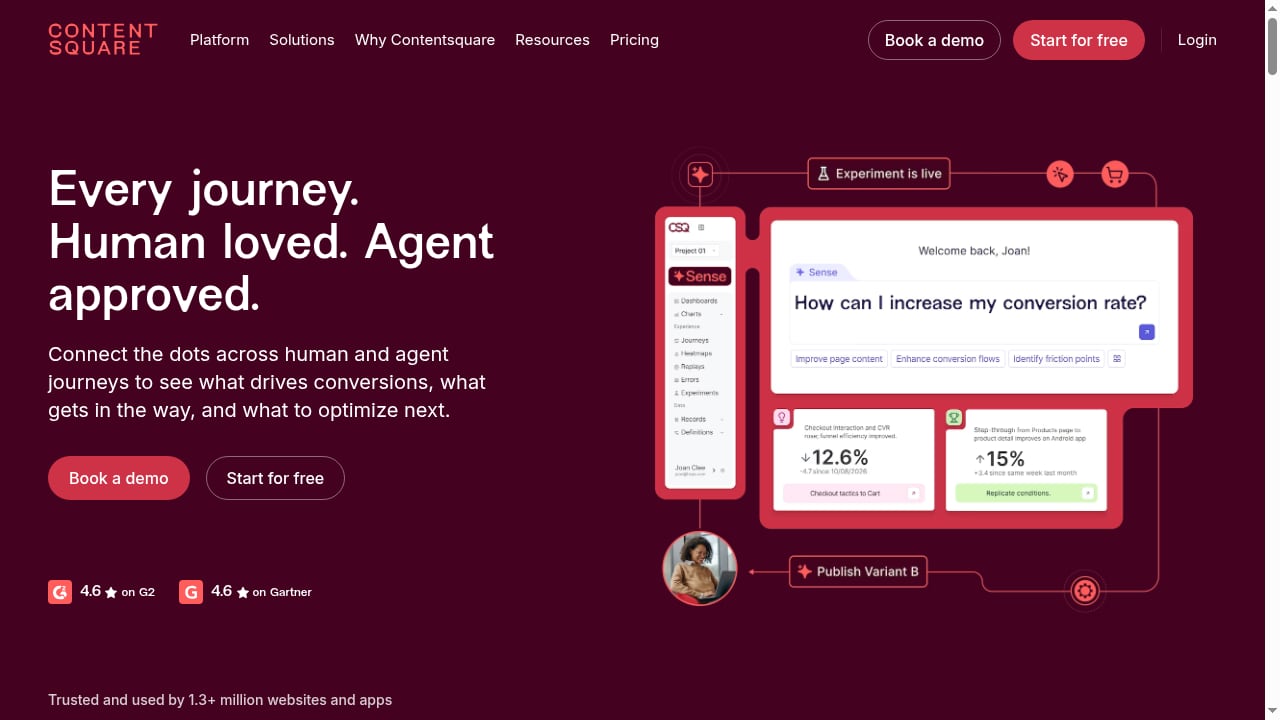
First viewport screenshot of contentsquare.com.
Contentsquare is a digital experience intelligence platform that unifies signals from web, mobile, conversations, LLMs, and autonomous agents into a single view. Its core promise is to turn every signal into intelligence and every insight into better experiences — quickly and automatically.
The platform is used by more than 1.3 million websites worldwide, according to the company. Its customer base skews toward larger organizations with dedicated UX, product, ecommerce, and analytics teams.
The 2026 relaunch introduced several capabilities that distinguish it from traditional analytics tools:
- Human, LLM, and agent interaction analytics that separate AI-referred traffic from human sessions.
- Conversation intelligence and chatbot analytics that link voice and text interactions to on-site friction.
- Multi-session journey analysis across devices and channels.
- Multi-touch attribution that includes LLM and AI-referred traffic.
- Sense, an agentic AI layer that identifies friction, quantifies financial impact, and writes tickets or notifications into existing workflows.
- Benchmarks built on ten years of zone-level data to compare features and flows against industry peers.
- Agentic experimentation that can form hypotheses, design tests, launch them, and validate revenue impact — with human approval.
- MCP extension that brings experience data into tools like Claude, Microsoft Copilot, ChatGPT, Figma, Cursor, and VS Code Copilot.
Who Contentsquare is for

First viewport screenshot of contentsquare.com.
Contentsquare is not a lightweight web analytics tool. It is built for teams that need deep behavioral insight and can invest in onboarding and analysis.
Ideal users
- Enterprise UX and product teams that need to diagnose friction across complex funnels and multi-session journeys.
- Ecommerce and conversion teams that want to connect behavioral signals to revenue impact.
- Analytics and digital intelligence teams that need to measure AI-referred traffic and agent interactions alongside human behavior.
- Organizations with dedicated testing and personalization programs that can benefit from agentic experimentation and integrations with tools like Dynamic Yield, Optimizely, and Kameleoon.
Less ideal users
- Small businesses or solo marketers looking for a simple, low-cost analytics dashboard.
- Teams that need extensive historical reporting — some users report short historical data windows and limited comparison options.
- Organizations without dedicated analysts — the platform's depth can become a barrier if no one owns the analysis.
Key use cases and practical examples
1. Diagnosing friction across multi-session journeys
A retail customer might browse on a phone, add to cart on a laptop, and complete the purchase after a chatbot interaction. Contentsquare's multi-session journey analysis tracks that full path across sessions, channels, and devices. Teams can see where the journey breaks down and prioritize fixes.
2. Measuring AI-referred traffic and agent interactions
As LLMs and autonomous agents increasingly act on behalf of customers, traditional analytics miss them. Contentsquare separates LLM and agent traffic from human sessions, so brands can optimize for agentic commerce and LLM referrals. This is a genuine differentiator for forward-looking digital teams.
3. Linking conversations to on-site friction
Conversation intelligence brings voice, text, and chatbot interactions into the journey as events. If a chatbot conversation correlates with a drop-off on a checkout page, teams can investigate the connection rather than treating support and web analytics as separate silos.
4. Agentic experimentation with Sense
Sense can form hypotheses, design and code tests, launch them, and validate revenue impact — with human approval. This reduces the manual loop between insight and testing, which is often where analytics programs stall.
5. Benchmarking against industry peers
Feature-level benchmarking compares specific elements and flows against industry peers, showing whether differences actually lead to better performance. This helps teams prioritize changes with evidence rather than intuition.
Strengths
- Depth of behavioral data. Contentsquare captures heatmaps, session replays, zone-level analytics, and journey analysis in one platform.
- AI-first positioning with practical features. Sense is not just a chatbot bolted onto analytics; it identifies friction, quantifies impact, and writes into workflows like Slack and Microsoft Teams.
- Agent and LLM analytics. Few platforms separate AI-agent traffic from human sessions, making Contentsquare early here.
- Strong customer support. Reviewers on G2 and Capterra consistently praise attentive support, training, and an approachable interface despite the platform's depth.
- Extensibility via MCP. Bringing experience data into tools teams already use (Claude, ChatGPT, Figma, Cursor) reduces context switching.
- Benchmarks and attribution. Multi-touch attribution including AI-referred traffic and zone-level benchmarks add decision-making confidence.
Limitations and trade-offs
- Complexity. Some users find data visualization setup complex and note that intricate analysis setups — such as displaying correct views and metrics for A/B tests — require repetition to master.
- Historical data constraints. Reviewers mention short historical data windows and limited comparison options, which can frustrate teams needing long-term trend analysis.
- Pricing opacity. Contentsquare does not publish public pricing. Enterprise pricing is typically custom and can be significant, making it less accessible for smaller teams.
- Onboarding investment. The platform rewards teams with dedicated analysts; without them, features may go underused.
- Beta availability. The new AI-first platform capabilities are in beta, with broader access rolling out in phases. Teams should confirm availability and roadmap timing before committing.
- Not a survey tool. Capterra notes that Contentsquare includes feedback management and reporting/analytics but does not include surveys and feedback as a native feature, which may require integration with other tools.
Pricing signals
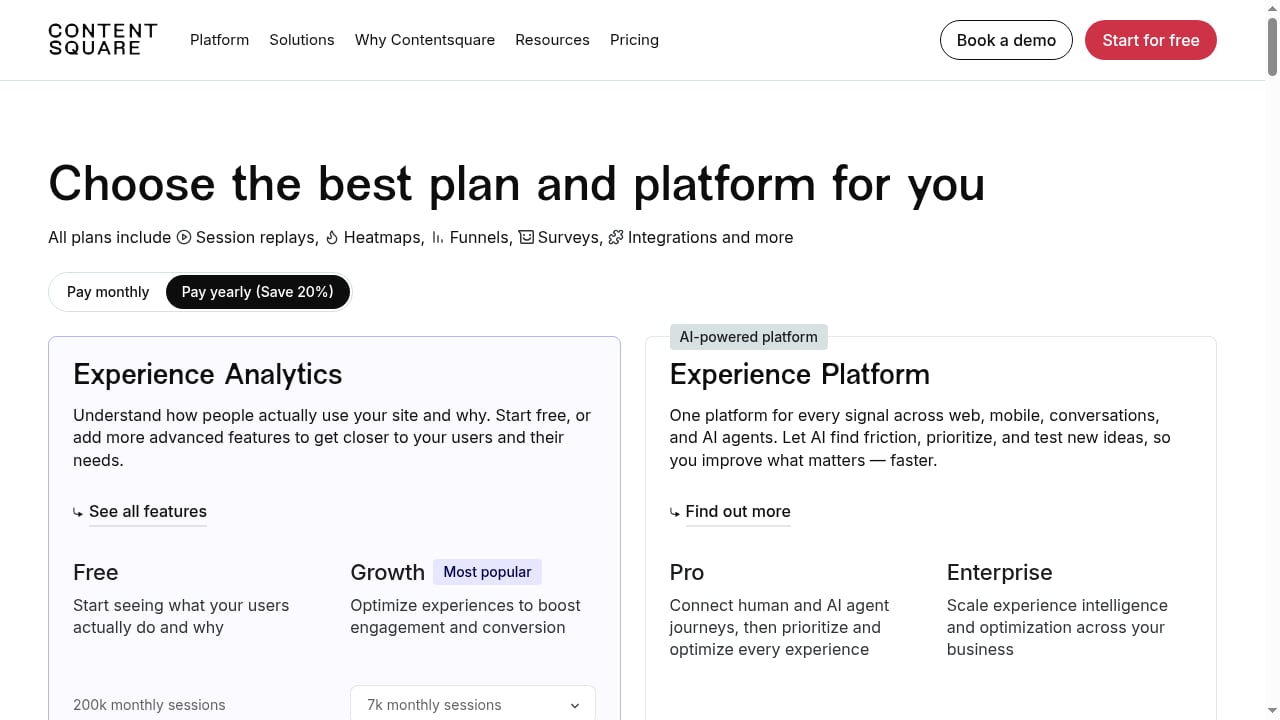
First viewport screenshot of contentsquare.com.
Contentsquare does not publish list pricing. Based on market signals and reviewer commentary:
- Pricing is custom and enterprise-oriented, typically scaled by traffic, modules, and seats.
- Smaller teams often find it cost-prohibitive compared with lightweight analytics tools.
- The platform's value is highest when multiple teams use it — UX, product, ecommerce, and analytics — which affects total cost of ownership.
- Buyers should ask about historical data retention, module add-ons (such as Sense or benchmarking), and integration costs during negotiation.
For teams comparing privacy-friendly or lower-cost alternatives, our Top 10 privacy-friendly web analytics software 2026 ranking provides a useful contrast.
Setup and onboarding
Contentsquare is not a plug-and-play tool. Setup typically involves:
- Tagging and implementation — deploying the tracking script across web and mobile properties.
- Zone and event configuration — defining the elements, flows, and events that matter for analysis.
- Module enablement — activating heatmaps, session replay, journey analysis, and Sense based on your contract.
- Team training — reviewers consistently mention thorough training and support, but also note that mastery takes repetition.
- Integration — connecting Slack, Microsoft Teams, testing platforms, and MCP-compatible tools.
Expect a structured onboarding period rather than a same-day launch. Teams with clear analysis owners will get more value faster.
How Contentsquare compares to alternatives

First viewport screenshot of contentsquare.com.
Contentsquare sits in the digital experience intelligence category alongside platforms like Mixpanel, which focuses more on product analytics and experimentation. For a detailed comparison, see our Mixpanel review 2026.
If your priority is privacy-friendly, simpler web analytics, tools like Visitors offer realtime streaming and visitor journeys without the enterprise overhead. For a broader category view, our Top 10 digital experience intelligence platforms 2026 ranking compares behavioral analytics, session replay, AI insight, and privacy.
Decision criteria
| Consideration | Contentsquare fit |
|---|---|
| Enterprise UX and product teams | Strong |
| AI-agent and LLM traffic analysis | Strong (early mover) |
| Simple, low-cost analytics | Weak |
| Long historical reporting | Check constraints |
| Dedicated analyst available | Recommended |
| Survey/feedback native | Limited |
Related reading
- Similarweb Review 2026: AI Digital Intelligence Tested - Hands-on Similarweb review: AI-powered traffic, competitor and Gen AI visibility data, pricing signals, accuracy limits, setup, and who should buy it in 2026.
- Data4 vs Visitors vs Fathom: Privacy Analytics Compared - Compare Data4, Visitors, and Fathom Analytics on privacy, real-time tracking, reporting, and setup to choose the right Google Analytics alternative.
Sources and further reading
- Contentsquare Pros and Cons | User Likes & Dislikes - G2 - I love the platform's interactivity. It helps marketers review their data and better understand customer journeys and the issues along the way, so we can spot ...
- Contentsquare Announces New AI-First Experience Platform to Optimize Every Human and Agent Journey - The platform unifies every signal across web, mobile, conversations, LLMs, and agents — turning them into predictions that drive action across the full workflow, from design to testing to deployment. New capabilities include LLM and chatbot analytics, ...
- Contentsquare Software Pricing, Alternatives & More 2026 | Capterra - With the help of Capterra, learn about Contentsquare Software - reviews, pricing plans, popular comparisons to other Customer Experience products and more.
FAQ
Is Contentsquare an AI-first platform?
Yes. Contentsquare relaunched in 2026 as an AI-first experience platform, with Sense AI, agentic experimentation, and LLM/agent analytics as core capabilities. Some features are in beta with phased rollout.
What is Sense in Contentsquare?
Sense is Contentsquare's agentic AI layer. It identifies friction and performance opportunities, quantifies financial impact, and writes emails, tickets, and notifications into tools like Slack and Microsoft Teams. It also supports agentic experimentation.
Does Contentsquare track AI agents and LLM traffic?
Yes. The platform separates LLM and agent traffic from human sessions and includes multi-touch attribution for AI-referred traffic. It also monitors autonomous agent activity via automated WebMCP monitoring.
How much does Contentsquare cost?
Contentsquare does not publish pricing. It is enterprise-oriented with custom quotes based on traffic, modules, and seats. Smaller teams often find it cost-prohibitive.
What are the main limitations of Contentsquare?
Common limitations include complexity of setup and analysis, short historical data windows, limited comparison options, pricing opacity, and the need for dedicated analysts to unlock value.
Who should choose Contentsquare?
Large organizations with UX, product, ecommerce, and analytics teams that need deep behavioral insight, AI-agent analytics, and experimentation support. Teams wanting simple, affordable analytics should look elsewhere.
Conclusion
Contentsquare's AI-first repositioning is more than marketing. The platform genuinely extends behavioral analytics into LLM and agent journeys, adds an agentic AI layer in Sense, and supports experimentation with human approval. For enterprises with dedicated analytics teams, it is one of the most comprehensive experience intelligence platforms available.
The trade-offs are real: complexity, historical data constraints, opaque pricing, and a beta-heavy roadmap. Buyers should validate feature availability, negotiate data retention terms, and ensure they have the analytical capacity to use the platform well. If those conditions are met, Contentsquare is a strong candidate for organizations serious about understanding every human and agent journey.
For teams weighing privacy-first or simpler alternatives, explore our privacy-conscious website owner analytics guide before committing to an enterprise contract.