
Plausible Analytics Review 2026: Privacy, Pricing, and Limits
Plausible Analytics has positioned itself as the go-to privacy-friendly alternative to Google Analytics since 2018. It promises essential website insights without cookies, consent banners, or personal data collection — all wrapped in a dashboard you can understand at a glance. But after years of price changes, feature splits between the open-source and hosted versions, and growing competition from tools like Umami and PostHog, the question in 2026 is whether Plausible still earns its place in your stack.
This review breaks down what Plausible actually does well, where it falls short, what it costs, and who should choose it over the alternatives.
What Is Plausible Analytics?
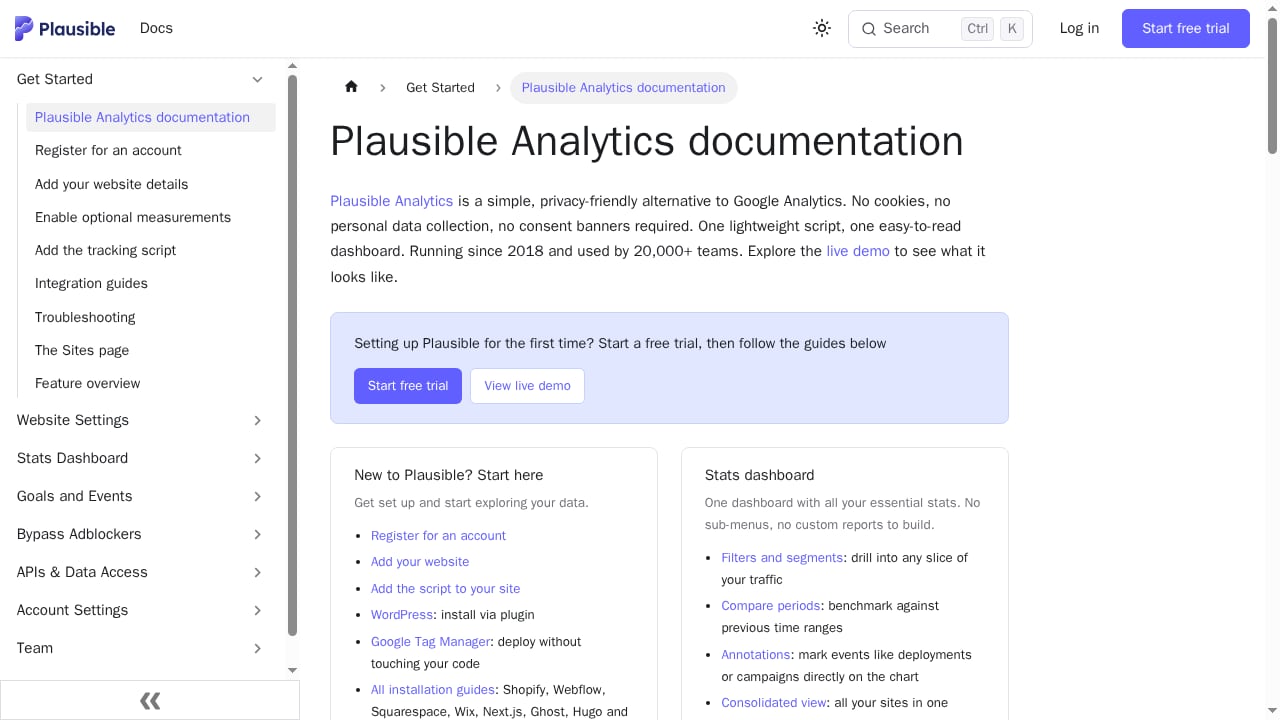
First viewport screenshot of Plausible Analytics documentation | Plausible docs.
Plausible is a lightweight, open-source web analytics platform built as a direct response to the complexity and privacy problems of Google Analytics. The tracking script weighs less than 1 KB, which keeps page load times fast and minimizes the performance hit that heavier analytics suites impose.
The core selling point is simple: you get pageviews, unique visitors, traffic sources, top pages, and goal conversions without collecting personal data or requiring cookie consent banners. Plausible is hosted in the EU on European-owned infrastructure, which matters for GDPR compliance and data sovereignty.
More than 20,000 teams use Plausible, including notable open-source and developer-focused companies like Ghost and Sentry. The platform offers a 30-day free trial without requiring a credit card.
Who Plausible Is For
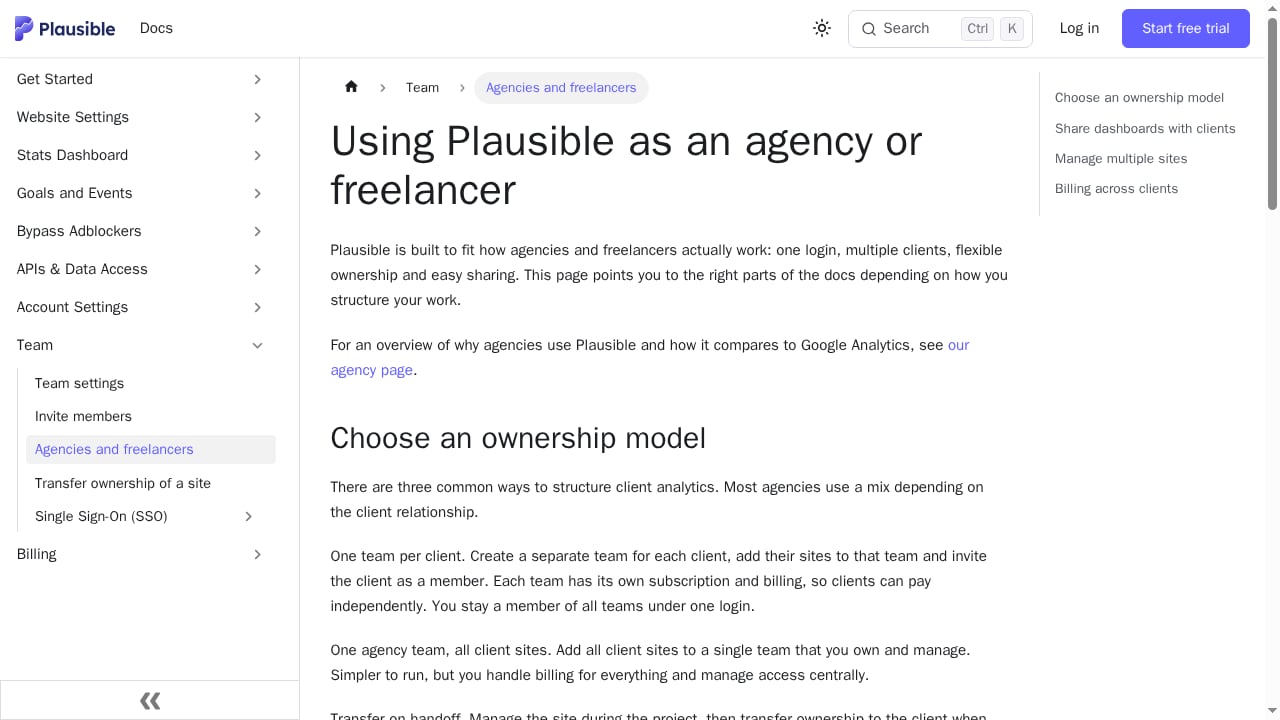
First viewport screenshot of Using Plausible as an agency or freelancer | Plausible docs.
Plausible works best for a specific set of users:
- Website owners and bloggers who want basic traffic data without the GA4 learning curve
- Marketers and freelancers tracking campaign performance through UTM parameters
- Agencies managing multiple client sites through flexible team structures
- Privacy-conscious developers who need analytics that align with GDPR and cookieless principles
- Teams monitoring AI-driven traffic from tools like ChatGPT, which Plausible surfaces as a distinct traffic source
If you fit one of these profiles and value simplicity over deep behavioral analysis, Plausible is a strong candidate. If you need session recordings, heatmaps, funnel analysis, or cohort tracking, you will quickly hit the platform's limits.
Core Strengths
A Dashboard You Can Actually Read
Plausible's interface is its most consistent advantage. The dashboard shows key metrics — unique visitors, pageviews, bounce rate, visit duration — in a clean, single-page layout. There is no multi-level menu system to navigate or report builder to configure. For a solo site owner who checks analytics once a week, this is a genuine time saver.
One independent reviewer who switched away from Plausible still acknowledged this strength: "The dashboard is cleaner and more modern, and it really nails the glance-at-it-and-know-what's-going-on experience." That polish matters when you compare Plausible to self-hosted alternatives with more utilitarian interfaces.
Google Search Console Integration
Plausible integrates directly with Google Search Console, so you can see which search queries drive traffic to your site without leaving the analytics dashboard. This is a meaningful differentiator. Many privacy-focused competitors, including Umami, lack this integration entirely — Umami has had an open feature request for it since 2021.
For content sites and SEO-focused businesses, having search query data alongside traffic metrics in one place removes a workflow friction point.
Scroll Depth Tracking
Plausible automatically tracks scroll depth per page, which is useful for long-form content. You can see how far readers actually scroll, which helps you evaluate whether your content holds attention or where engagement drops off. This is another feature that some competitors, including Umami, do not offer.
Data Import
If you are migrating from Google Analytics or another tool, Plausible supports data import from Google Analytics and via CSV files. This means you do not start with a blank slate after switching. For businesses with historical data they want to preserve, this is a practical advantage that not all privacy-first tools offer.
Strong Hosted Bot Filtering
The hosted version of Plausible includes bot filtering that independent reviewers describe as genuinely good — "nothing in the open source self-hosted analytics space comes close to that." This matters because bot traffic inflates visitor counts and distorts the metrics you use to make decisions.
Key Limitations
The Open-Source Feature Split
Plausible's biggest criticism in 2026 is the gap between its Community Edition and the paid cloud version. Premium features like funnels, revenue tracking, and advanced bot filtering are locked away from the self-hosted open-source release. This is a deliberate business decision, but it frustrates users who chose Plausible specifically because of its open-source positioning.
By contrast, Umami's self-hosted version is the full product. There is no feature split between free and paid tiers — if you want managed hosting, you pay for it, but the self-hosted version does not hold anything back. For developers who value true open-source principles, this distinction is significant.
No Individual Session Details
Plausible shows aggregate statistics but gives you no way to inspect individual visits. You cannot see which pages a specific visitor viewed or which events they triggered in sequence. Tools like Umami offer individual session details and visitor journey visualization, which provide a deeper understanding of how people actually navigate your site.
No Retention or Cohort Reports
Plausible has no equivalent to retention reports or cohort analysis. You cannot track how many visitors come back over time or group users based on specific actions and follow that group's behavior. Plausible does offer audience segmentation through filters, but there is no way to define and follow a fixed cohort.
Limited Device Data
Plausible only shows device categories — desktop, mobile, tablet. It does not show specific screen resolutions like 1920x1080 or 390x844. For design decisions that depend on knowing exactly what screen sizes your visitors use, this level of granularity is insufficient.
Self-Hosted Bot Filtering Weakness
While the hosted version has strong bot filtering, the self-hosted Community Edition relies on the same user-agent-based detection that most open-source tools use. This catches obvious crawlers but misses anything pretending to be a regular browser. One reviewer who self-hosted Plausible reported "similarly inflated visitor numbers" after switching to Umami, because neither tool's self-hosted version handles bots well without server-side infrastructure like data center IP blocking and behavioral analysis.
Pricing Signals
Plausible's pricing is subscription-based with pageview-based tiers and no per-seat fees. The current structure charges approximately $19 per month for up to 100k events and $69 per month for up to 1 million events.
For comparison, Umami's managed hosting is free up to 100k events per month and $20 per month for a million events. That is a substantial price difference at both tiers.
Plausible's value proposition at these price points depends on how much you value the polished dashboard, Search Console integration, scroll depth tracking, and superior hosted bot filtering. If those features matter to you, the premium over Umami may be justified. If you primarily need basic pageview and traffic source data, the price difference is harder to defend.
The 30-day free trial without a credit card requirement lowers the barrier to testing the product. You can evaluate the dashboard, setup process, and data quality before committing.
Setup and Getting Started
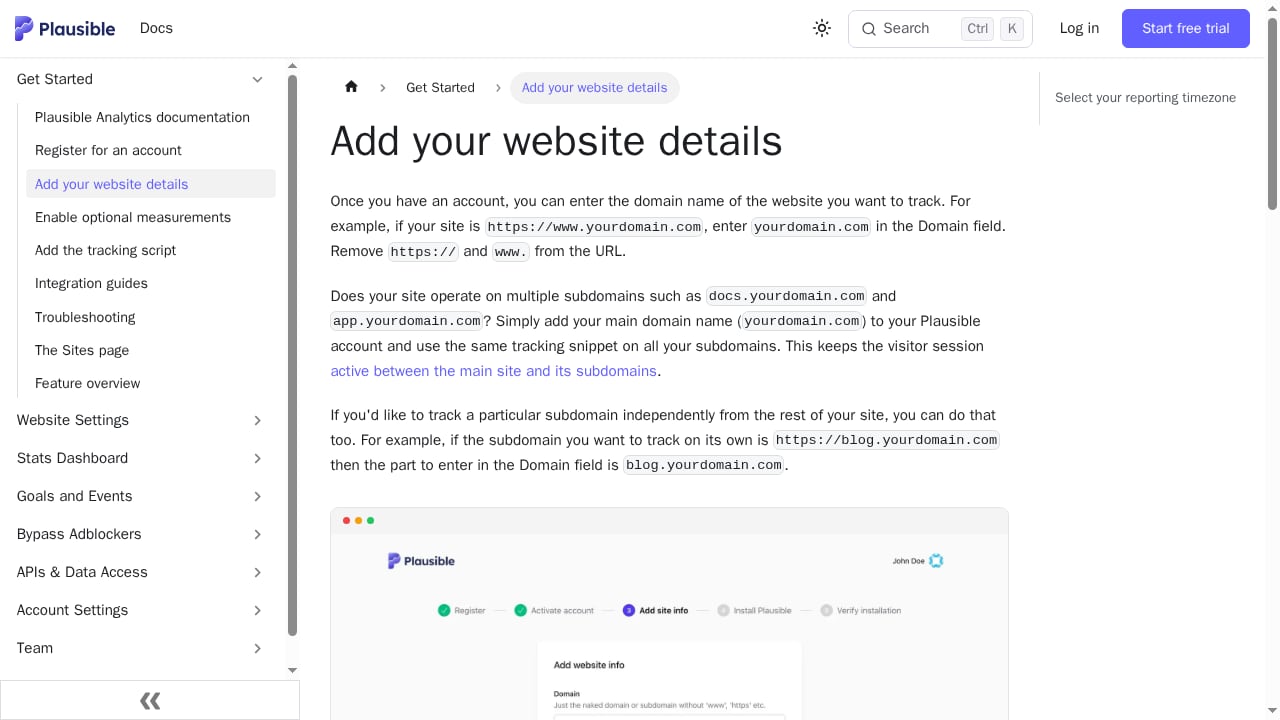
First viewport screenshot of Add your website details | Plausible docs.
Plausible's setup is designed to be approachable for non-technical users. The process involves:
- Creating an account and starting the free trial
- Adding your website and copying the tracking script
- Pasting the script into your site's header or using a platform-specific integration
Plausible offers integrations for popular platforms including WordPress, Ghost, Webflow, and many others. For developers, there are also official plugins and wrappers for frameworks like Next.js.
One practical consideration: adblockers can block Plausible's tracking script when it loads from the default domain. Some users proxy the script through their own domain to bypass this, though that requires additional server configuration. This is not unique to Plausible — it affects most client-side analytics tools — but it is worth knowing if accurate visitor counts matter to you.
For a broader look at how tracking works across tools and methods, see this website tracking guide.
Plausible vs. the Alternatives
First viewport screenshot of Enable two-factor authentication (2FA) | Plausible docs.
Plausible vs. Google Analytics
Plausible's primary competitor is still Google Analytics, specifically GA4. The case for Plausible rests on three pillars: privacy compliance without consent banners, a dramatically simpler interface, and lighter page weight. Independent research by Andy Crestodina at Orbit Media found GA4 traffic data to be significantly less accurate than Plausible across a large dataset, which challenges the assumption that Google's free tool provides better data quality.
Sentry documented their switch from GA4 to Plausible as part of going fully cookieless in 2023, and confirmed two years later that they had not put a single cookie back. Ghost recommends Plausible because it is "privacy-focused, provides more reliable data compared to Google Analytics, and it's extremely lightweight."
The tradeoff is depth. GA4 offers far more advanced reporting, audience building, and integration with Google's advertising ecosystem. If your business depends on Google Ads audience targeting, Plausible cannot replace GA4 for that purpose.
Plausible vs. Umami
The most direct open-source competitor is Umami. Based on independent comparisons, Umami wins on price, data access, and open-source principles. It offers individual session details, visitor journeys, retention reports, cohorts, and specific screen resolutions — none of which Plausible provides. Umami also uses PostgreSQL, which is easier to back up than Plausible's ClickHouse database.
Plausible wins on dashboard polish, Google Search Console integration, scroll depth tracking, data import, and hosted bot filtering. The choice comes down to whether you value convenience and integrations over data depth and open-source alignment.
For a deeper comparison of privacy-first analytics tools, see this Simple Analytics review or explore how Data4 compares to Pirsch and Clicky.
Plausible vs. PostHog
PostHog is a product analytics platform that includes session recordings, heatmaps, feature flags, and A/B testing alongside web analytics. It is a fundamentally different tool aimed at product teams that need behavioral analysis, not just traffic metrics. Plausible is simpler and more focused; PostHog is more powerful but significantly more complex to configure and use.
If you are building a SaaS product and need to understand user behavior in depth, PostHog is the better fit. If you run a content site or marketing site and need clean traffic data, Plausible is more appropriate.
Decision Criteria
Choose Plausible if:
- You need GDPR-compliant analytics without consent banners
- You value a clean, fast-loading dashboard over deep behavioral analysis
- You want Google Search Console data integrated into your analytics
- You are migrating from GA4 and want to import historical data
- You are willing to pay for the hosted version and its superior bot filtering
Look elsewhere if:
- You need session recordings, heatmaps, or funnel analysis
- You want individual session details or visitor journey visualization
- You require retention reports or cohort analysis
- You plan to self-host and expect the full feature set
- You are price-sensitive at the lower pageview tiers
Related reading
- Data4 vs KISSmetrics: Which Analytics Tool Fits You? - Compare Data4 and KISSmetrics for website and behavioral analytics. See use cases, key differences, pricing, and which tool fits your team in 2026.
Sources and further reading
- Umami vs Plausible: why I switched - After leaving Plausible I moved to Umami. Here's what's better, how I set up proxying to bypass adblockers, and the one problem neither tool can solve.
- Plausible Analytics reviews and in media | Plausible docs - Plausible Analytics reviews, independent research and media coverage. See what users, publications and researchers say about switching from Google Analytics.
- Why would you use Plausible or PostHog over Google Analytics for ... - Mar 20, 2025 ... TLDR: Umami wins on price, data quality, data access, ease of use and unique features. I suggest you make your own comparison or at least give ...
Frequently Asked Questions
Is Plausible Analytics really GDPR compliant?
Plausible is designed to be GDPR compliant without requiring cookie consent banners. It does not use cookies, does not collect personal data, and does not track users across sites. The service is hosted in the EU on European-owned infrastructure. However, compliance also depends on how you configure and use the tool on your site. For a detailed breakdown of GDPR requirements for analytics, see this GDPR analytics compliance guide.
How much does Plausible Analytics cost?
Plausible charges approximately $19 per month for up to 100k events and $69 per month for up to 1 million events. There are no per-seat fees, and the 30-day free trial does not require a credit card. Pricing is pageview-based, so costs scale with traffic volume.
Does Plausible offer a free tier?
No. Plausible offers a 30-day free trial but does not have a permanent free tier. The self-hosted Community Edition is free to run on your own infrastructure, but it lacks premium features like funnels, revenue tracking, and advanced bot filtering.
Can Plausible replace Google Analytics?
For most content sites, blogs, and small-to-medium businesses, yes. Plausible provides the essential traffic metrics — pageviews, unique visitors, traffic sources, top pages, and conversions — in a much simpler interface. What it cannot replace is GA4's advanced audience building and integration with Google Ads. If your marketing strategy depends on those features, you may need to run both tools or choose a different solution.
Does Plausible track AI traffic?
Yes. Plausible surfaces traffic from AI tools like ChatGPT as a distinct traffic source, which helps you understand how AI-driven referral traffic is impacting your site. This is increasingly important as AI search and chat interfaces become a larger share of web traffic.
Is the self-hosted version worth using?
It depends on your priorities. The self-hosted Community Edition is free and gives you full data ownership, but it lacks premium features and its bot filtering is weaker than the hosted version. If you value data sovereignty and are comfortable managing infrastructure, it is viable. If you want the full feature set, you will need the paid cloud version.
Conclusion
Plausible Analytics remains one of the best privacy-friendly analytics tools in 2026 for users who prioritize simplicity, compliance, and data ownership over deep behavioral analysis. Its dashboard is genuinely pleasant to use, the Search Console integration is a meaningful differentiator, and the hosted bot filtering is best-in-class among open-source alternatives.
The platform's weaknesses are equally clear. The open-source feature split alienates users who came for the open-source ethos. The lack of session details, retention reports, and cohort analysis limits its usefulness for product teams. And the pricing, while reasonable for what it offers, is no longer the cheapest option in the privacy-first analytics space.
If you run a content site, blog, or marketing site and want clean traffic data without the privacy baggage of Google Analytics, Plausible is an excellent choice. If you need behavioral depth or want a self-hosted tool with the full feature set, Umami or PostHog may serve you better. The right answer depends on what you actually need to measure — and how much complexity you are willing to accept to measure it.