
Product Manager Analytics: A Practical 2026 Guide
Product managers sit between what users say and what users actually do. Analytics is how you close that gap. This guide explains what product manager analytics covers, how it differs from web analytics and business intelligence, which metrics matter, and how to pick tools that fit your team in 2026.
What product manager analytics actually means
Product Manager Analytics: A Practical 2026 Guide - What product manager analytics actually means.
Product manager analytics is the practice of using behavioral data to make product decisions. It tracks discrete user actions—events—and turns them into answers about experience, feature adoption, retention, and conversion.
A simple example: web analytics tells you 1,000 people visited your pricing page last month. Product analytics tells you that users who visit the pricing page after completing your onboarding tutorial convert at 3.4x the rate of users who go there straight after signup—and that tutorial completion has been falling for three weeks. That second insight is what changes your roadmap.
The role is not just about reading dashboards. It is about framing questions, choosing metrics, and connecting behavior to outcomes. As one industry guide puts it, analytics product managers bridge the gap between data and business outcomes by driving action at every layer of the data-to-wisdom pyramid. In practice, that means you are the person who turns raw events into decisions.
How product analytics differs from web analytics and BI

Product Manager Analytics: A Practical 2026 Guide - How product analytics differs from web analytics and BI.
These three disciplines answer different questions. Confusing them leads to the wrong tool for the job.
| Discipline | Focus | Primary question | Typical users |
|---|---|---|---|
| Web analytics | Traffic and acquisition | Where did users come from? | Marketing teams |
| Product analytics | In-product behavior | What are users doing inside the product? | Product and growth teams |
| Business intelligence | Business outcomes | How is the business performing? | Finance, operations, leadership |
Web analytics measures sessions, pageviews, bounce rate, and source/medium. Product analytics measures events, funnels, retention curves, and cohort behavior. BI measures revenue, costs, pipeline, and margins.
A PM needs all three perspectives, but not always from three separate platforms. Many teams start with a website analytics tool to understand acquisition, then layer in event tracking for in-product behavior. If you are evaluating privacy-first options, the Top 10 Privacy-Friendly Web Analytics Products 2026 review compares cookieless tracking, data ownership, and depth across leading tools.
Core metrics every PM should track
Product Manager Analytics: A Practical 2026 Guide - Core metrics every PM should track.
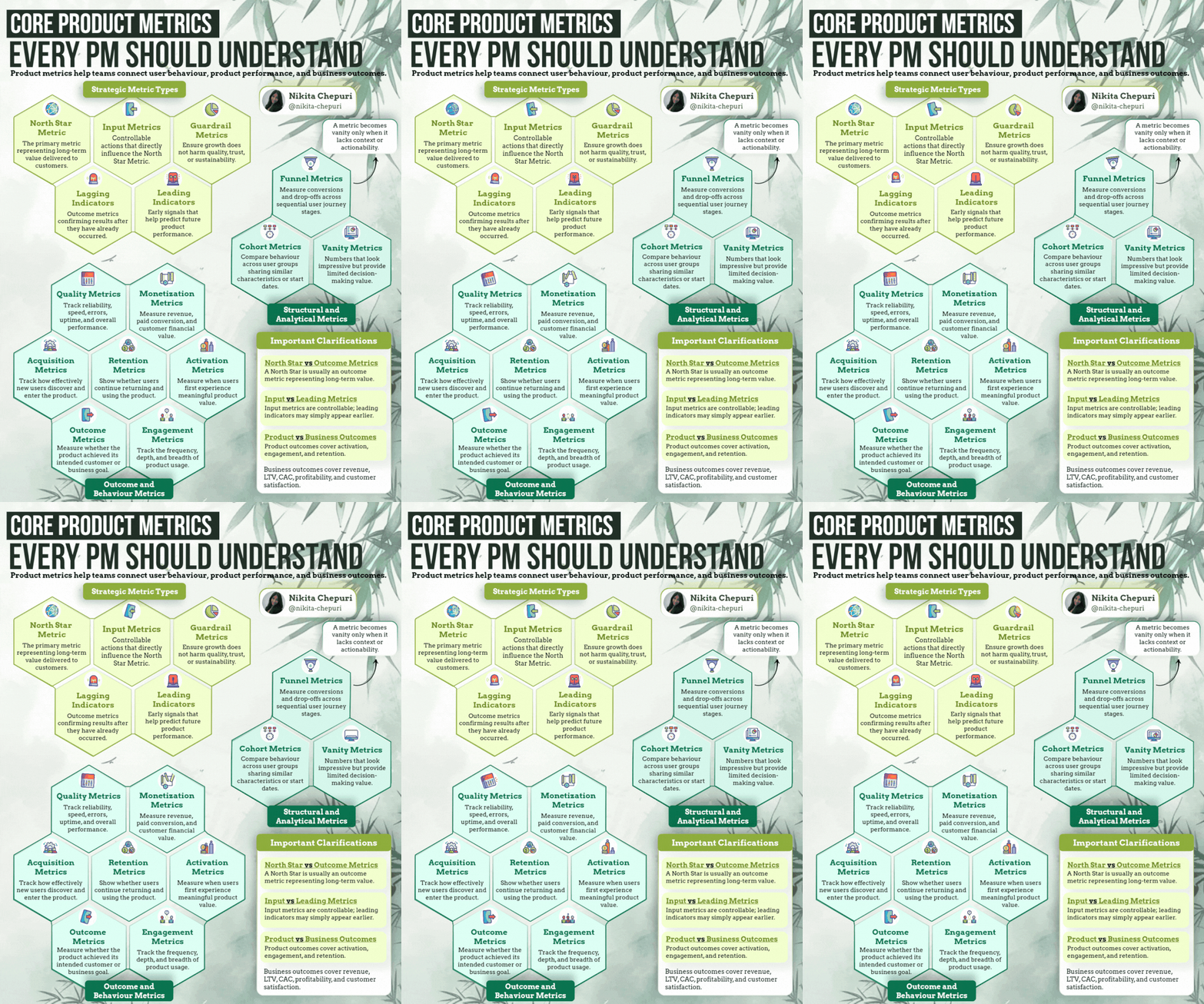
Before you analyze behavior, decide what to measure. Start with a North Star metric—the single number that best captures the value your product delivers—then break it into component behaviors.
Engagement
Engagement metrics track how actively users interact over time: daily active users (DAU), weekly active users (WAU), monthly active users (MAU), session depth, actions per user, and time in product. Stickiness (DAU/MAU) is a common composite. A DAU/MAU ratio above 20% often signals strong habitual use.
Retention
Retention measures the percentage of users who return. Retention curves—day 1, 7, 14, 30—are among the most reliable signals of product-market fit. A curve that flattens above zero means some segment found lasting value. A curve that keeps declining means you have not crossed that threshold yet.
Feature adoption
Track how many users use a feature, how often, and whether usage correlates with retention. A feature that is used once and never again is a different problem than one that is never discovered.
Conversion
Funnels show where users drop off. For example, if 60% of users start onboarding but only 20% finish, the problem is in the middle, not at the top.
Qualitative signals
Numbers tell you what happened; they rarely tell you why. Pair quantitative data with customer interviews, surveys, and concept testing. As Atlassian's guide to product analytics puts it, combining analytics with qualitative feedback gives a more complete picture of user needs.
Building an event tracking plan

Product Manager Analytics: A Practical 2026 Guide - Building an event tracking plan.
The foundation of product analytics is event-based. An event captures three things: what happened (the action), when it happened (the timestamp), and who did it (the user identifier).
A practical tracking plan includes:
- Event name: Use a consistent convention, such as
button.clickoronboarding.completed. - Properties: Add context like plan type, device, or entry point.
- Owner: Assign each event to a team or person.
- Question it answers: Every event should map to a decision you want to make.
A common anti-pattern is running an experiment and realizing afterward that you did not capture the events you need. Test your tracking with dummy data before launch.
How to choose the right analytics stack
There is no single best stack. The right choice depends on your team size, technical resources, and privacy requirements.
Start with website analytics
If your primary need is understanding traffic sources, page performance, and visitor behavior, a website analytics platform is the right starting point. Data4 is a website analytics platform designed for simplicity and efficiency, with support for multiple languages including English, Chinese, and Japanese. It is positioned as a Google Analytics alternative for marketers, website owners, and analysts who want actionable insights without the complexity of traditional tools.
Add product analytics when behavior gets complex
When you need funnels, retention curves, and cohort analysis, you will likely need a dedicated product analytics tool. Some teams use warehouse-native approaches; others use a dedicated platform with warehouse integration. Both have valid use cases.
Consider privacy and compliance early
If you operate in multiple regions or handle sensitive data, privacy-first analytics matters. The Top 10 Privacy-Focused Web Analytics Products 2026 guide ranks tools by cookieless tracking, data ownership, and compliance.
Compare specific tools
If you are deciding between platforms, a direct comparison helps. The Data4 vs Matomo: Which Privacy-First Analytics Fits? article compares setup, privacy, data ownership, and usability. For a broader view, the Data4 vs KISSmetrics vs Mixpanel: Which Analytics Fits? comparison covers use cases, tracking depth, ease of use, and pricing.
Practical example: using analytics to fix onboarding
Imagine your onboarding completion rate has dropped from 45% to 30% over six weeks. Here is how a PM might approach it:
- Check the funnel: Identify which step has the biggest drop-off.
- Segment the data: Is the drop consistent across devices, plans, or acquisition channels?
- Form a hypothesis: For example, "The new step 3 is confusing on mobile."
- Run an experiment: Test a simplified version with a subset of users.
- Measure: Use event tracking to compare completion rates.
- Decide: Roll out, iterate, or revert based on results.
This process—hypothesis, test, measure, decide—is the core loop of data-informed product management.
Related reading
- How to Use Data4 with UserFeedback: Complete Guide - Combine Data4 website analytics with UserFeedback surveys to learn what visitors do and why. Setup steps, workflow, and practical examples inside.
Sources and further reading
- What is an Analytics Product Manager? - In today’s data-driven world, an Analytics Product Manager plays a pivotal role in bridging the gap between data and business outcomes. This role drives the transformation of raw data into actionable insights that empower organizations to make informed decisions, optimize strategies, and achieve their goals. To better understand this dynamic role, we’ll explore:
- Product analytics | Atlassian - Product analytics helps us analyze how users engage with a product so you can best meet customer needs. Read here for everything you need to know.
- What is product analytics? A complete guide for 2026 - What is product analytics, how it’s different from web analytics and BI, which metrics matter, and how to choose the right platform in 2026.
FAQ
What is the difference between a product manager and an analytics product manager?
A product manager owns a product's direction and outcomes. An analytics product manager applies the same discipline to data and analytics products—dashboards, reporting systems, or data products—and often works closely with data engineers, analysts, and data scientists.
Do I need a dedicated product analytics tool if I already use web analytics?
Not always. Web analytics covers traffic and acquisition well. If you need funnels, retention curves, and cohort analysis, a dedicated product analytics tool is usually necessary. Many teams start with web analytics and add product analytics as they grow.
What skills does a product manager need for analytics?
Data literacy is essential: comfort with SQL, data visualization, and basic statistics. Business acumen matters too—you need to translate technical insights into business impact. Communication and prioritization are equally important.
How do I avoid "empathy debt"?
Empathy debt is the gap between what you assume about users and what they actually experience. Pay it off by combining quantitative analytics with qualitative research: customer interviews, surveys, and usability testing.
What metrics should I track first?
Start with one North Star metric, then track retention and activation as leading indicators. Add engagement and feature adoption metrics as your product matures.
Conclusion
Product manager analytics is not about collecting more data. It is about asking better questions and using the answers to make decisions. Start with a clear North Star, build a tracking plan that maps to real decisions, and combine quantitative data with qualitative feedback. Whether you use a simple website analytics platform like Data4 or a full product analytics suite, the goal is the same: understand what users do, why they do it, and what to build next.