
Top 10 Privacy-Focused Analytics and Tag Management Platforms 2026
Marketing teams now operate under a dual constraint: they need granular behavioral data to optimize campaigns, yet they must collect it without violating GDPR, HIPAA, CCPA, or the growing patchwork of state and national privacy laws. That tension has pushed privacy-focused analytics and tag management platforms from a niche preference to a core infrastructure decision. This review ranks ten platforms that genuinely combine analytics and tag management with privacy as an architectural principle, not an afterthought. Each entry includes evaluation evidence, best-fit scenarios, and practical limitations.
How We Evaluated These Platforms
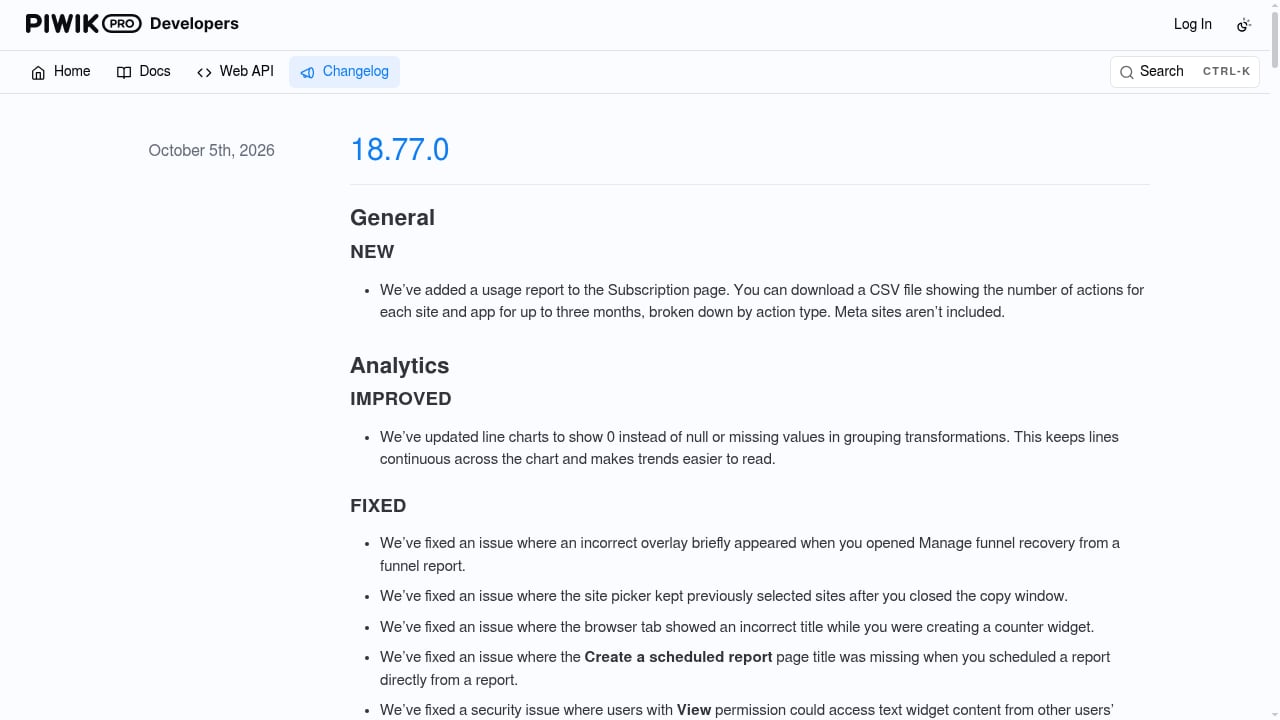
First viewport screenshot of Changelog.
We assessed each platform against six criteria, weighting them by how often they appear in real procurement decisions:
- Data ownership and architecture: Where does data live, who controls it, and can it be self-hosted or processed server-side?
- Compliance coverage: Which regulations are explicitly supported (GDPR, HIPAA, CCPA, PECR, sector-specific rules)?
- Tag management depth: Does the platform include a native tag manager, consent-aware triggering, and version control?
- Analytics capability: Reports, funnels, attribution, content performance, and cross-property tracking.
- Integration ecosystem: Native connectors for ad platforms, search consoles, CRMs, and data warehouses.
- Operational fit: Setup effort, pricing transparency, support model, and update cadence.
We excluded general-purpose data privacy software (such as consent-only or identity-verification tools) and platforms that offer tag management without meaningful privacy controls. We also excluded tools that are primarily marketing data pipelines rather than analytics-plus-tag-management platforms.
The Top 10 Privacy-Focused Analytics and Tag Management Platforms for 2026
First viewport screenshot of Homepage.
1. Piwik PRO
Piwik PRO is a privacy-focused analytics and tag management platform built for regulated industries. It combines analytics, a tag manager, consent management, and customer data activation in one integrated suite. The platform is designed for organizations that need HIPAA support alongside GDPR and CCPA compliance, and it emphasizes full data control with privacy-by-design architecture.
Key capabilities: Website journey analysis, drop-off identification, campaign effectiveness measurement, conversion path optimization, content performance reporting, and cross-property tracking. It ships with ready-made dashboards and integrates with Google Search Console, Google Ads, and other marketing tools. Frequent release cycles add features across analytics, consent, tag management, and CDP functions.
Best for: Highly regulated industries (healthcare, finance, government, education) that need analytics and tag management under one compliance umbrella.
Watch-outs: The integrated suite can be more than a small team needs; pricing scales with traffic and feature tier.
2. Matomo
Matomo is the most established open-source analytics platform with a native tag manager. Because it can be self-hosted, all visitor data stays on your infrastructure, which makes it a common choice for GDPR-heavy markets and organizations with strict data residency rules. The Matomo Tag Manager supports consent-aware triggering, version control, and preview/debug modes.
Key capabilities: Full analytics suite, heatmaps, session recordings, A/B testing, and a tag manager that can replace Google Tag Manager for privacy-conscious stacks.
Best for: Teams that want open-source control, self-hosting, and a mature plugin ecosystem.
Watch-outs: Self-hosting shifts maintenance, security patching, and scaling to your team; cloud pricing differs from the free self-hosted edition.
3. Tealium
Tealium combines enterprise tag management with a customer data hub. Its server-side processing model lets organizations filter, enrich, and route event data before it reaches third-party vendors, which improves both data quality and privacy governance. Tealium is frequently cited as a leading enterprise alternative when Google Tag Manager's client-side architecture creates compliance or reliability gaps.
Key capabilities: Universal Data Hub, vendor governance, over a thousand pre-built server-side integrations, and audience segmentation.
Best for: Large enterprises with complex martech stacks that need centralized governance and server-side control.
Watch-outs: Enterprise pricing and implementation complexity; overkill for small teams.
4. Adobe Experience Platform Launch (Tags)
Adobe's tag management offering, now part of Adobe Experience Platform, provides enterprise-grade governance, security, and integration with Adobe Analytics and Adobe Experience Cloud. It supports server-side event forwarding and detailed audit trails, which matter for compliance documentation.
Key capabilities: Rule-based tag deployment, extensions marketplace, environment-based publishing workflows, and tight coupling with Adobe's analytics and CDP products.
Best for: Organizations already invested in Adobe Experience Cloud that need unified tagging and analytics governance.
Watch-outs: Strongest value inside the Adobe ecosystem; standalone use is less common.
5. Snowplow
Snowplow is an open-source, composable data collection platform that emphasizes full ownership of tracking data and schemas. It is often used as a privacy-first alternative to tag-based collection because it lets teams define exactly what data is collected and where it is stored, including in their own cloud infrastructure.
Key capabilities: Custom event tracking, data modeling, real-time pipelines, and portable schemas that reduce vendor lock-in.
Best for: Data engineering-led teams building long-term, portable analytics infrastructure.
Watch-outs: Requires engineering resources; not a turnkey marketing analytics dashboard.
6. Usercentrics
Usercentrics is a consent management platform that integrates with tag management workflows to block non-essential tags until consent is granted. While it is not a full analytics suite, it is a critical component of privacy-focused tag management and is frequently paired with analytics platforms in regulated stacks.
Key capabilities: Consent collection, cookie banners, tag blocking, audit trails, and compliance documentation for GDPR and CCPA.
Best for: Teams that need robust consent enforcement layered over an existing analytics and tag management setup.
Watch-outs: Consent-only; you still need an analytics platform for reporting.
7. Segment
Segment is a customer data platform with tag-like event collection and no-code integration configuration. It lets marketers route data to destinations without deploying separate tags for each vendor, which reduces tag sprawl and centralizes data governance.
Key capabilities: Event tracking, destination routing, data filtering, and privacy controls for what gets forwarded to third parties.
Best for: Teams that want to eliminate per-vendor tags and centralize customer data routing.
Watch-outs: Pricing scales with event volume; it complements rather than replaces a dedicated analytics reporting tool.
8. Fathom Analytics
Fathom Analytics is a lightweight, cookieless analytics platform that emphasizes simplicity and privacy. It does not include a full tag manager, but it is often used alongside privacy-focused tag management for teams that need clean, compliant traffic reporting without complex setup.
Key capabilities: Cookieless tracking, GDPR/CCPA/PECR compliance, simple dashboards, and fast setup.
Best for: Small to mid-sized sites that want privacy-first analytics with minimal operational overhead.
Watch-outs: Limited tag management and advanced attribution features.
9. Plausible Analytics
Plausible is an open-source, cookieless analytics platform designed for privacy compliance and ease of use. Like Fathom, it is not a tag manager, but it fits into privacy-focused stacks where tag management is handled separately or where tag complexity is intentionally minimized.
Key capabilities: Cookieless tracking, self-hosting option, GDPR/CCPA compliance, and a clean, fast dashboard.
Best for: Teams that prioritize simplicity, open-source values, and low maintenance.
Watch-outs: No native tag manager; advanced funnel and attribution depth is limited compared to enterprise suites.
10. Burst Statistics
Burst Statistics is a privacy-first analytics plugin for WordPress. It provides cookieless tracking, WooCommerce support, and a straightforward setup for site owners who want compliant analytics without leaving the WordPress admin.
Key capabilities: Cookieless tracking, WordPress-native dashboard, e-commerce tracking, and a free tier with a Pro upgrade.
Best for: WordPress site owners who need privacy-compliant analytics with minimal configuration.
Watch-outs: WordPress-specific; not suitable for multi-platform enterprise stacks.
Comparison: Which Platform Fits Your Situation?
First viewport screenshot of Changelog.
| Platform | Native Tag Manager | Self-Hosting | HIPAA Support | Best Fit |
|---|---|---|---|---|
| Piwik PRO | Yes | Enterprise option | Yes | Regulated industries |
| Matomo | Yes | Yes | Via configuration | Open-source control |
| Tealium | Yes | Server-side processing | Enterprise governance | Large enterprises |
| Adobe Launch | Yes | No | Enterprise governance | Adobe ecosystem |
| Snowplow | Composable | Yes | Custom | Data engineering teams |
| Usercentrics | Consent layer | No | Consent-focused | Consent enforcement |
| Segment | Event collection | No | Data routing controls | CDP-led stacks |
| Fathom | No | No | Cookieless compliance | Simple privacy analytics |
| Plausible | No | Yes | Cookieless compliance | Open-source simplicity |
| Burst Statistics | No | No | WordPress privacy | WordPress sites |
How to Choose Without Overbuying
First viewport screenshot of Changelog.
Start with your compliance constraint. If you operate in healthcare or another HIPAA-regulated sector, prioritize platforms with explicit HIPAA support and server-side or self-hosted data control, such as Piwik PRO or Matomo. If your primary risk is consent enforcement across many tags, a consent management platform like Usercentrics layered over your existing stack may be more efficient than replacing everything.
Next, decide whether you need a tag manager at all. Teams with fewer than ten marketing tags often get more value from simplifying their stack than from adding a tag management layer. If you do need tag management, check whether the platform's tag manager supports consent-aware triggering, version control, and preview modes, since these are the features that prevent compliance incidents and broken tracking.
Finally, consider the adjacent workflow. If your goal is to feed website behavior into a broader customer profile, a lightweight analytics tool can serve as the behavioral layer. For example, Data4 is a website analytics platform that tracks traffic and audience behavior without complexity, and it is sometimes used alongside privacy-focused tag management when teams need simple reporting rather than a full enterprise suite. It is not a tag management platform, but it can complement one. For a deeper comparison of privacy analytics options, see our Data4 vs Pirsch vs Woopra privacy analytics comparison.
If you are building a unified customer view from website data, our guide to building a customer 360 view with website analytics data explains how the behavioral layer fits into a broader profile. And if you are evaluating open-source alternatives specifically, the Data4 vs GoatCounter open-source web analytics comparison covers setup, privacy, and reporting depth.
Related reading
- KISSmetrics Review: Behavioral Analytics Platform in 2026 - Evidence-based KISSmetrics review: people-based tracking, funnels, cohorts, pricing signals, setup effort, limits, and who should choose it in 2026.
Sources and further reading
- Top 7 Alternatives to Google Tag Manager for Marketing Teams in 2026 - Compare the top 7 alternatives to Google Tag Manager for enterprise marketing teams. Find the right tag management solution for your tracking needs in 2026.
- Best Data Privacy Software Products for 2026 - G2 - Top 5 Best Data Privacy Software Products: · IBM Guardium Data Protection · iDenfy · Ondato · Veriff · Usercentrics ...
- 10 best tag management software to consider in 2026 - Guideflow Blog - Tag management tools let you add, edit, and control tracking tags from one dashboard without writing code. Compare the 10 best platforms available in 2026.
FAQ
What is the difference between privacy-focused analytics and tag management?
Privacy-focused analytics platforms collect and report on visitor behavior while minimizing data collection and respecting consent. Tag management platforms deploy and control the tracking tags that send data to analytics and marketing tools. Some platforms, such as Piwik PRO and Matomo, combine both in one suite.
Do I need a tag manager if I use a privacy-focused analytics platform?
Not always. If you only run a handful of tags, direct implementation may be simpler. A tag manager becomes valuable when you have many tags, need consent-aware triggering, or want version control and audit trails for compliance.
Which platforms support HIPAA compliance?
Piwik PRO explicitly supports HIPAA alongside GDPR and CCPA. Other platforms may support HIPAA through self-hosting and configuration, but you should verify business associate agreements and data processing terms directly with each vendor.
Can I self-host a privacy-focused analytics platform?
Yes. Matomo, Plausible, and Snowplow offer self-hosting or self-managed deployment options. Self-hosting gives you full data ownership but shifts maintenance, security, and scaling responsibilities to your team.
How do server-side tag managers improve privacy?
Server-side tag managers process events on your infrastructure before forwarding them to vendors. This lets you filter or enrich data, reduce what third parties receive, and avoid some client-side tracking limitations caused by ad blockers and browser restrictions.
Are cookieless analytics platforms automatically GDPR compliant?
No. Cookieless tracking reduces reliance on consent for cookies, but GDPR compliance also depends on legal basis, data minimization, retention policies, and vendor agreements. Cookieless is a helpful architectural choice, not a complete compliance guarantee.
Conclusion
The privacy-focused analytics and tag management market in 2026 rewards teams that treat data control as infrastructure rather than a feature checkbox. Piwik PRO leads this list for regulated industries because it combines analytics, tag management, consent, and data activation under explicit HIPAA and GDPR support. Matomo remains the strongest open-source option for full data ownership. Tealium and Adobe serve enterprises that need server-side governance at scale. Fathom, Plausible, and Burst Statistics cover simpler needs without tag management complexity.
Choose based on your compliance constraint first, your tag volume second, and your reporting depth third. That order prevents overbuying and keeps your stack defensible when regulators or auditors ask how visitor data is collected, stored, and used.