
Top 10 Privacy-Friendly Web Analytics Products 2026
Privacy-friendly web analytics stopped being a niche compromise years ago. In 2026, the practical question is no longer whether you can measure traffic without cookies, but which cookieless tool matches your reporting depth, hosting preferences, and compliance posture. This review ranks ten products that genuinely belong to the privacy-friendly web analytics category, explains how each was evaluated, and helps you pick the right one for your site.
How We Evaluated These Tools
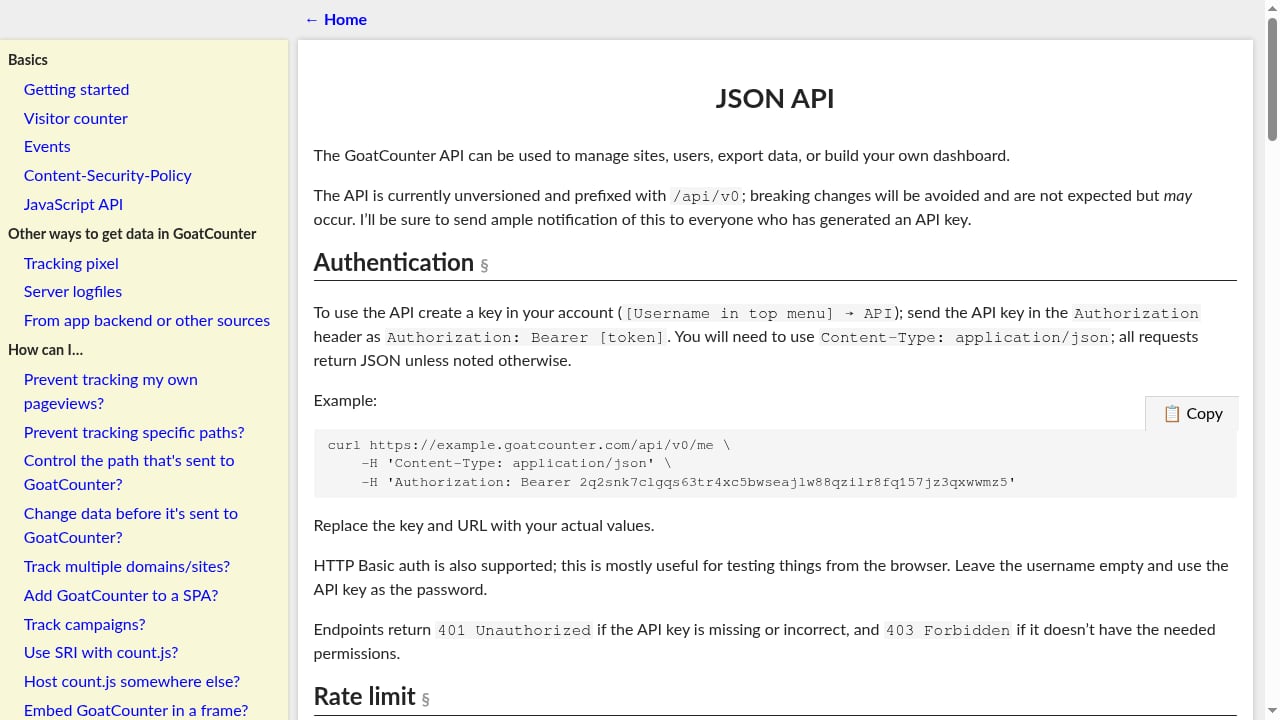
First viewport screenshot of GoatCounter documentation.
Every product below was assessed against the same public criteria:
- Tracking method: Does it work without cookies or cross-site identifiers, and does it avoid building visitor profiles?
- Data ownership and hosting: Can you self-host, choose an EU region, or otherwise keep data out of an advertising ecosystem?
- Compliance posture: Does the default configuration reduce or remove consent-banner obligations under GDPR and similar regimes?
- Reporting depth: Does it cover the metrics you actually use — visitors, referrers, pages, goals, funnels, events?
- Pricing and funding model: Is the product paid for with money rather than with visitor data, and is there a free or self-hosted path?
- Usability and maintenance: How long does setup take, and how much ongoing effort does the tool demand?
Rankings weigh depth and ownership more heavily than raw popularity. Tools that only add a privacy toggle to an ad-driven data pipeline were excluded.
The Top 10 Privacy-Friendly Web Analytics Products for 2026
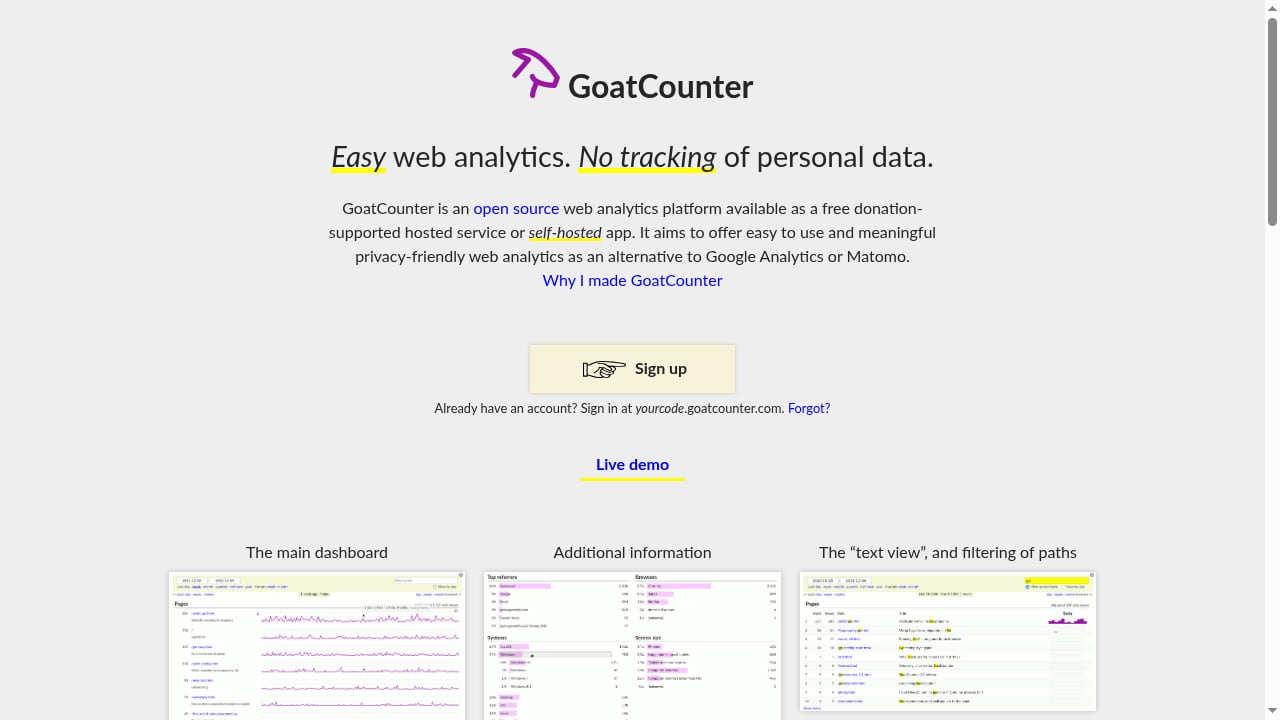
First viewport screenshot of GoatCounter – open source web analytics.
1. Matomo
Matomo remains the most complete Google Analytics replacement in the privacy-first space. It can be self-hosted or run on Matomo Cloud, supports a cookieless configuration, and gives you full ownership of raw data without sampling. Beyond traffic reporting, it covers goals, funnels, custom reports, and optional heatmaps and session recordings as add-ons.
Best for: Organizations that need depth and data ownership, and are willing to run or pay for infrastructure.
Trade-off: Heavier than lightweight trackers, and the self-hosted route requires maintenance.
If you are weighing it against a simpler commercial option, our Data4 vs Matomo comparison breaks down setup, privacy, and usability differences.
2. Plausible Analytics
Plausible is the reference point for lightweight, cookie-free analytics. The script is small, the dashboard fits on one screen, and the EU-hosted cloud keeps data out of ad ecosystems. Goal and event tracking, campaign attribution, and referrer reporting cover the needs of most marketing and content sites.
Best for: Marketing teams, startups, and publishers that want clean numbers without a consent banner.
Trade-off: Deliberately limited depth — no session replay or advanced segmentation.
3. Fathom Analytics
Fathom competes directly with Plausible on simplicity, with a strong emphasis on compliance features such as EU isolation and long-term data retention. Cookieless tracking is the default, and the interface is built for people who do not want to learn an analytics platform.
Best for: Businesses that want minimal setup and straightforward traffic, campaign, and event reporting.
Trade-off: Less flexible for product analytics or complex funnels.
4. Umami
Umami is an MIT-licensed, open-source analytics tool with a clean dashboard, event tracking, and anonymized data collection. It can be self-hosted or used through a generous free cloud tier, which makes it one of the easiest open-source options to trial.
Best for: Developers and small teams that want control without a large operational burden.
Trade-off: Feature depth is closer to Plausible than to Matomo.
5. GoatCounter
GoatCounter is deliberately minimal: a single Go binary, cookie-free counting, and a free hosted tier for non-commercial sites. It was created explicitly as an easy-to-use, privacy-friendly alternative to Google Analytics and Matomo, and it excels at answering basic questions fast.
Best for: Blogs, documentation sites, and personal projects that need visitor counts, referrers, and top pages.
Trade-off: Not built for funnels, cohorts, or marketing attribution.
6. Simple Analytics
Simple Analytics focuses on essential traffic reporting with EU-hosted, encrypted data handling. The dashboard is intentionally plain, and campaign and referrer insights are included without the complexity of a full analytics suite.
Best for: Teams that want a clean, privacy-first dashboard and nothing more.
Trade-off: Limited event and funnel capabilities compared with heavier platforms.
7. PostHog
PostHog combines web and product analytics with privacy controls, event autocapture, funnel analysis, and retention reporting. It is a different class of tool: less a traffic counter, more a behavioral analytics platform that happens to be deployable in ways that keep data under your control.
Best for: Product and engineering teams that need behavioral depth alongside web metrics.
Trade-off: More configuration and a steeper learning curve than lightweight trackers. For a closer look at its newer semantic layer, see our PostHog context layer review.
8. Usermaven
Usermaven pairs cookieless tracking with automatic event capture, funnels, cohorts, and multi-touch attribution, positioning itself as a marketing attribution platform with privacy-compliant analytics. It supports GDPR and CCPA workflows and targets SaaS and growth teams.
Best for: SaaS and growth teams that need attribution and journey analysis, not just pageviews.
Trade-off: More product surface area than a small site needs.
9. Piwik PRO
Piwik PRO is a privacy-focused analytics suite with strong consent-management and compliance tooling, available in cloud and on-premises deployments. It suits organizations that need enterprise governance around analytics data.
Best for: Regulated organizations and enterprises with formal data-governance requirements.
Trade-off: Pricing and complexity put it out of reach for small sites. Our Data4 vs Fathom vs Piwik PRO comparison covers the trade-offs in more detail.
10. Vercel Web Analytics
Vercel Web Analytics is a built-in, privacy-oriented traffic and event tool for teams already deploying on Vercel. Setup is effectively zero, and reporting covers pageviews, visitors, and custom events inside the Vercel workflow.
Best for: Teams on Vercel that want basic analytics without adding a third-party script.
Trade-off: Tied to the Vercel ecosystem and limited outside it.
Quick Comparison: Which Tool Fits Which Job
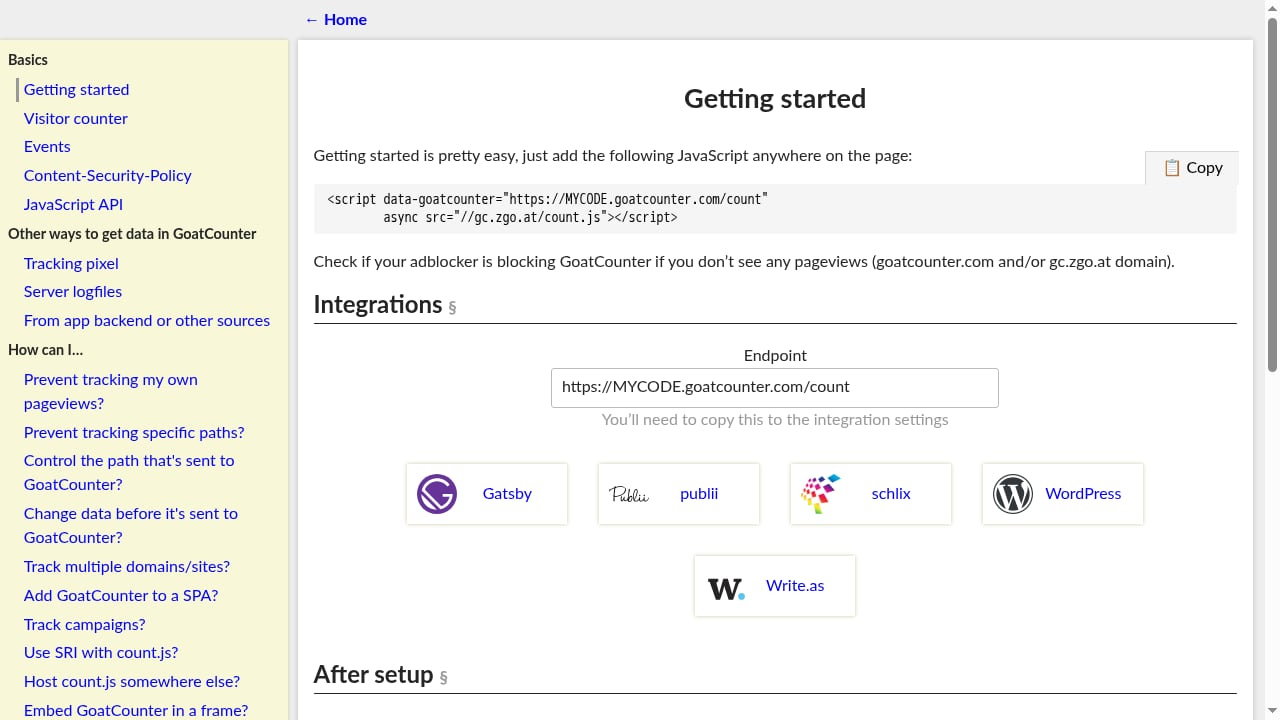
First viewport screenshot of GoatCounter documentation.
| Need | Strongest fit |
|---|---|
| Maximum depth with full data ownership | Matomo, Piwik PRO |
| Lightweight traffic reporting, no consent banner | Plausible, Fathom, Simple Analytics |
| Open source with self-hosting | Umami, GoatCounter, Matomo |
| Product and behavioral analytics | PostHog, Usermaven |
| Zero-setup for an existing platform | Vercel Web Analytics |
How to Choose in Practice
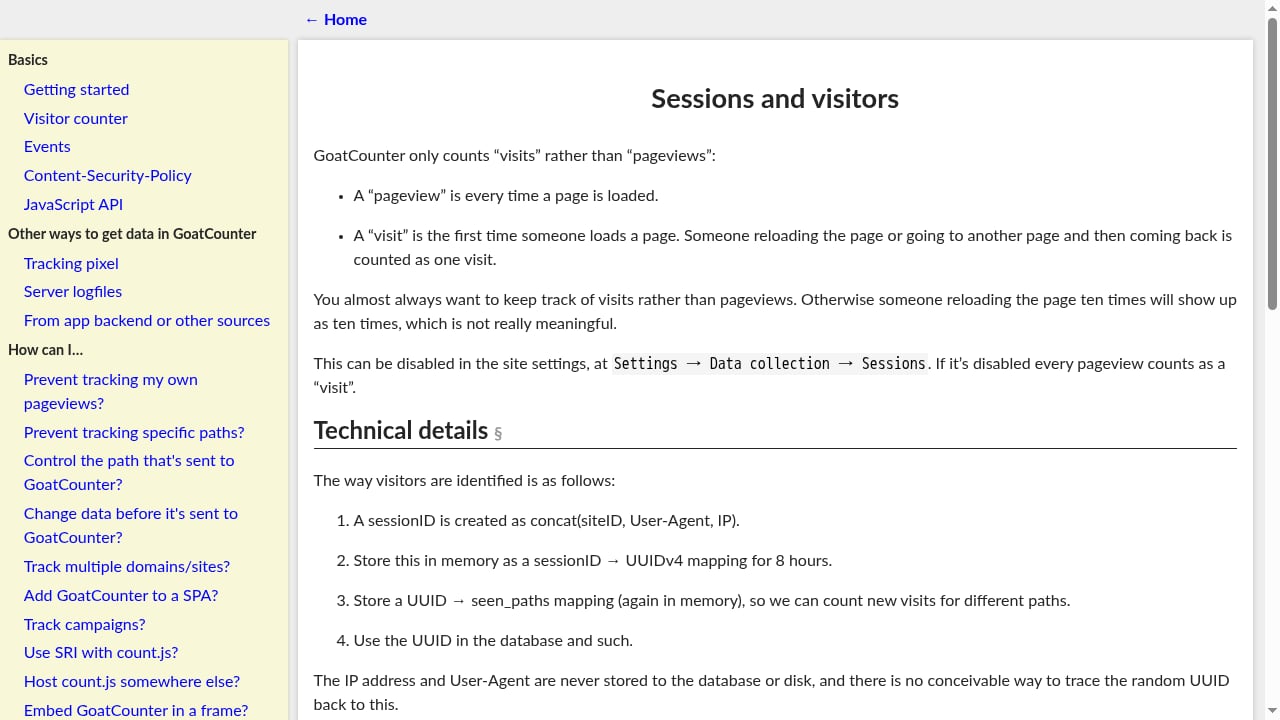
First viewport screenshot of GoatCounter documentation.
Start with the reporting question, not the privacy badge. A blog needs visitor counts, referrers, and top pages — GoatCounter, Plausible, or Umami will do the job for years. A marketing site with campaigns and conversion goals needs event tracking and attribution, which points toward Plausible, Fathom, or Usermaven. A product team analyzing retention and funnels should look at PostHog or Matomo rather than a lightweight counter.
Then decide where the data lives. Self-hosting keeps everything under your control but costs maintenance time. EU-hosted cloud plans trade some control for zero upkeep and still keep data out of advertising systems. Finally, confirm the funding model: a tool paid for by subscriptions has no incentive to monetize your visitors, which is the structural problem with ad-supported analytics.
Switching is usually a one-line change in your site template. Most tools let you run in parallel with your old setup for a few weeks, so you can validate the numbers before removing the previous snippet.
Where Adjacent Tools Fit
Not every analytics decision is a replacement decision. Some teams keep a privacy-friendly tracker for traffic measurement and add a separate platform for deeper website analysis or survey-based feedback. Data4, for example, is a website analytics platform positioned as a simple Google Analytics alternative for tracking traffic and deriving visitor insights across international markets — it sits adjacent to this category rather than inside it, and it can complement a privacy-first tracker when you need broader traffic analysis or localized reporting. Similarly, combining behavioral data with qualitative feedback is a common pattern; our guide to using Data4 with UserFeedback walks through that workflow.
Related reading
- Data4 vs KISSmetrics vs Mixpanel: Which Analytics Fits? - Compare Data4, KISSmetrics, and Mixpanel across use cases, tracking depth, ease of use, and pricing to choose the right analytics platform.
Sources and further reading
- Best Privacy-Friendly Analytics in 2026 - Web analytics that measure your traffic without cookies, consent banners, or shipping your visitors to Google. Private alternatives to Google Analytics, vetted since 2015.
- 10 privacy-first analytics tools worth exploring in 2026 - This article explains what privacy-first analytics tools are, why they matter as privacy regulations and browser restrictions evolve, and how they differ from traditional analytics. It compares ten privacy-first analytics platforms by primary use case, then outlines practical criteria for choosing a tool based on reporting needs, privacy approach, data durability, and ease of use.
- Top 30 web analytics tools for 2026 (free & paid) - A good website will not only draw in leads but, using web analytics software, will give you valuable information about your prospects.
FAQ
Do privacy-friendly analytics tools require a cookie consent banner?
In most cases, no. Tools that measure traffic without cookies or persistent identifiers generally have nothing to consent to, so the banner can be removed. Confirm your specific legal position, but the design goal of these tools is to avoid the banner rather than manage it.
Will I lose the data I rely on if I leave Google Analytics?
You keep the metrics most site owners actually read: visitors, top pages, referrers, countries, and goal conversions. What you give up is the ad-targeting layer and per-visitor profiles. If your work depends on deep segmentation, choose a heavier tool like Matomo that keeps that depth on your own infrastructure.
Are cookieless analytics less accurate?
Often they are more accurate for trend analysis. Consent gates cause traditional analytics to miss every visitor who declines, while cookieless tools count visits consistently. Totals will not match Google's number for number because the counting method differs, but the trend you act on is cleaner.
Can I self-host instead of paying for a service?
Yes. Matomo, Umami, GoatCounter, and PostHog all support self-hosting. You keep data on infrastructure you control and remove subscription costs, at the price of running and updating the software yourself.
How do these companies make money without selling visitor data?
Hosted services charge subscriptions, and open-source tools are free to self-host because you supply the server. Either way, your traffic is not resold to advertisers — the opposite of the ad-supported model these tools replace.
Conclusion
The 2026 privacy-friendly analytics market has matured into clear tiers: minimal counters like GoatCounter and Simple Analytics, balanced trackers like Plausible, Fathom, and Umami, and full platforms like Matomo, PostHog, and Piwik PRO. Pick the lightest tool that answers your actual reporting questions, confirm where the data lives, and check how the vendor is funded. Do that, and you get useful measurement without the consent banner, the data transfer, or the surveillance.