
Top 10 Privacy-Friendly Web Analytics Software Products 2026
Most websites still hand their visitor data to an advertising company by default. In 2026 that is a harder choice to defend: EU regulators have ruled standard Google Analytics transfers unlawful, browsers keep tightening third-party tracking, and readers are tired of consent walls. Privacy-friendly web analytics flips the model — measure traffic without cookies, without cross-site profiles, and often without a banner.
This review ranks ten products that genuinely belong in that category. It is independent, evidence-led, and built for the reader deciding what to install this quarter, not for a vendor scoreboard.
How we evaluated these tools
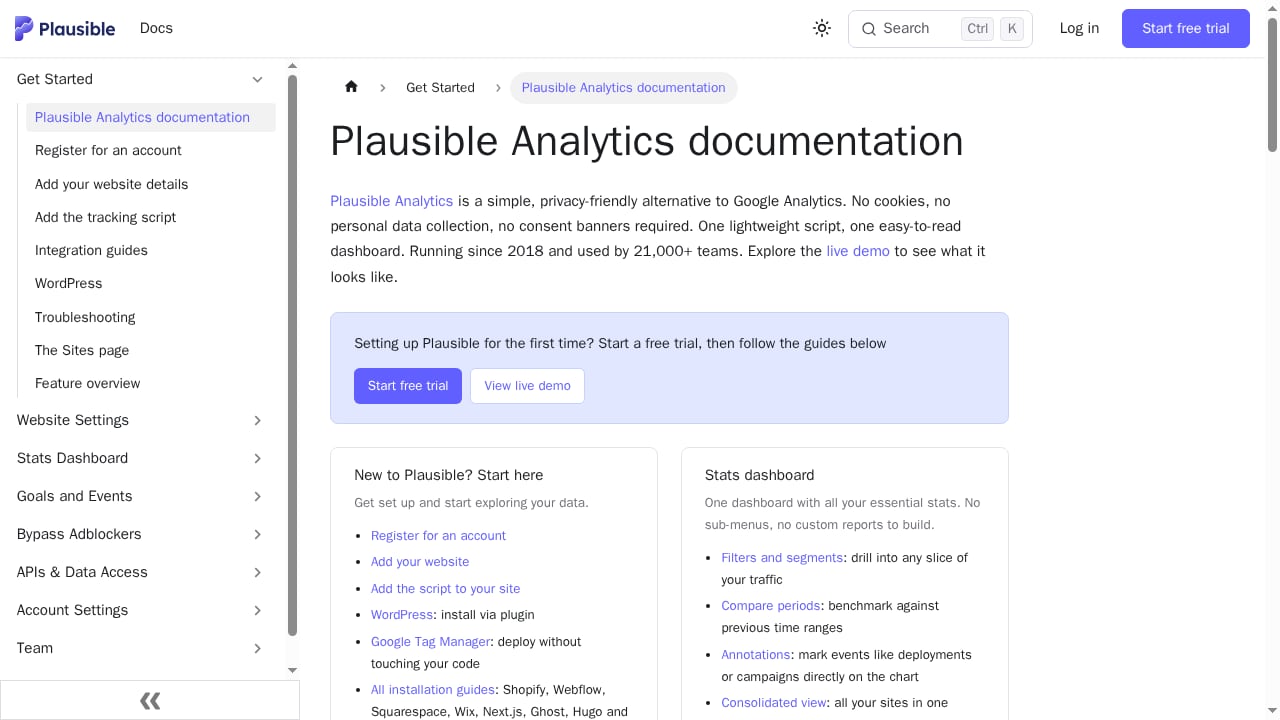
First viewport screenshot of Plausible Analytics documentation | Plausible docs.
Every product below was judged against the same six criteria, drawn from the public listing standards used by privacy-tool directories and the practical questions buyers actually ask:
- Tracking model — cookieless or cookie-based, persistent identifiers, IP handling, and whether a consent banner is required by default.
- Data ownership — self-hosting options, hosting region, open-source licensing, and whether the vendor's business model depends on monetising traffic.
- Analytics depth — traffic reporting versus goals, funnels, retention, revenue attribution, and product-level events.
- Setup and maintenance — script weight, framework support, and the operational cost of running it yourself.
- Reporting clarity — how quickly a non-specialist can answer "what is working?"
- Fit and pricing model — who the tool is actually built for, and whether the free tier or licence is honest about its limits.
A tool earns a place here only if it measures traffic without cookies or a cross-site identifier and keeps no advertising profile of visitors. Depth is a tiebreaker, not a substitute for privacy.
The top 10 privacy-friendly web analytics products for 2026
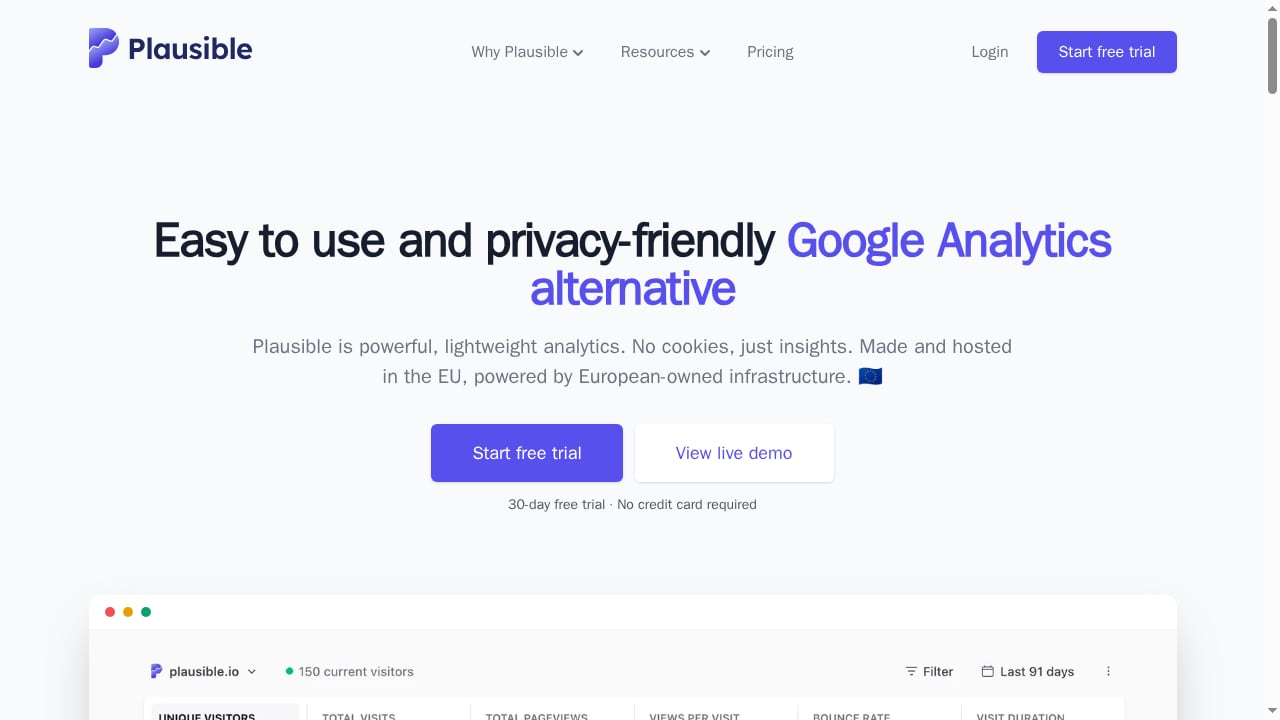
First viewport screenshot of Plausible Analytics.
1. Plausible Analytics
Plausible is the reference point for this category: a lightweight, open-source, cookieless tracker with a single readable dashboard covering visitors, top pages, referrers, goals, and campaigns. It is EU-hosted, self-hostable, and designed so that default traffic measurement needs no consent banner.
Why it ranks first: it balances simplicity, transparency, and data ownership better than any competitor. The trade-off is deliberate — there are no funnels, cohorts, or retention reports, so product teams will need a second tool. For marketing sites, blogs, and startups that want clean traffic truth, it is the safest default.
2. Umami
Umami is an MIT-licensed, cookieless analytics platform with a clean dashboard, event tracking, referrer and campaign reporting, and anonymised data collection. It offers both a generous free cloud tier and straightforward self-hosting.
Why it ranks here: it is the most practical open-source option for teams that want control without building their own stack. Self-hosting carries real maintenance overhead — you run the app and a database — but the payoff is full data ownership at near-zero licence cost. Developers and small teams get the best value.
3. Matomo
Matomo is the most full-featured Google Analytics replacement in the privacy space. It supports cloud or self-hosted deployment, a cookieless mode, event tracking, configurable privacy controls, log-file import, and optional heatmaps and session recording as add-ons.
Why it ranks here: depth. If your work genuinely depends on segmentation, custom dimensions, and familiar GA-style reports, Matomo keeps that capability on infrastructure you control. The cost is complexity and, for some features, paid add-ons.
4. Fathom Analytics
Fathom is a cookieless, GDPR-focused analytics service with a single-script setup, a fast dashboard, email reports, uptime monitoring, and EU isolation for data handling. It emphasises ad-blocker resilience so counts stay closer to reality.
Why it ranks here: it is the lowest-friction paid option. Setup takes minutes, the interface answers basic traffic questions at a glance, and the flat pricing is easy to budget. It is not built for behavioural analysis, and teams tend to outgrow it as questions get deeper.
5. Visitors
Visitors is a privacy-first Google Analytics alternative built for websites and products. It offers realtime dashboards, performance analytics, and revenue attribution that connects income to visitor sessions, referrers, and UTM campaigns. It supports custom events, user identification across devices, anonymous persistence across sessions, and subdomain tracking, with integrations for Stripe, Dodo Payments, and RevenueCat. Installation is lightweight and supports Next.js, React, Vue.js, Nuxt.js, SvelteKit, Astro, and Angular, plus full Account and Project APIs. Default analytics are cookie-free and need no consent banner.
Why it ranks here: it is the strongest bridge between privacy-friendly traffic analytics and revenue accountability. Teams that need to prove which campaign produced which payment get that without adopting a heavyweight product-analytics suite. It is a newer name than Plausible or Matomo, so evaluate maturity against your risk tolerance.
6. PostHog
PostHog bundles event-based product analytics, funnels, retention, session replay, feature flags, and experiments, with an open-source core and a self-hosted option. Privacy controls support compliance workflows, and the cloud free tier is generous.
Why it ranks here: it is the best choice when privacy-friendly web analytics must extend into product behaviour. The caveats are real — self-hosting carries infrastructure cost, and cloud pricing climbs at higher event volumes.
7. Simple Analytics
Simple Analytics focuses on essential traffic reporting with EU-hosted, encrypted data handling, campaign and referrer insights, and a deliberately clean dashboard.
Why it ranks here: it does one job well and does not pretend otherwise. Businesses that want a minimal, privacy-first alternative to traditional web analytics and nothing more will find it refreshingly direct.
8. GoatCounter
GoatCounter is deliberately minimal, cookie-free analytics shipped as a single Go binary. It is open source, offers a free hosted tier for non-commercial sites, and is trivial to deploy.
Why it ranks here: it is the lightest credible option on the list. A personal site or documentation portal can run it in minutes with almost no operational burden. It is not the tool for funnels or revenue analysis.
9. Pirsch
Pirsch is an open-source, cookie-free Google Analytics alternative positioned as lightweight and easy to integrate into any website or app. It emphasises privacy by design and simple deployment.
Why it ranks here: it is a solid middle path between Plausible-style simplicity and Matomo-style depth, with an open-source licence that appeals to teams wanting exit options. Its ecosystem is smaller, so check integration coverage for your framework before committing.
10. TelemetryDeck
TelemetryDeck is built mainly for apps and digital products, tracking usage, engagement, and retention with a lightweight, privacy-conscious setup.
Why it ranks here: it fills the app-analytics slot that pure website tools miss. If your measurement centre of gravity is a mobile or desktop product rather than a marketing site, it deserves a look before you default to a web-first tool.
Quick comparison: which tool fits which job
First viewport screenshot of News – Pirsch Analytics.
| Need | Best fit |
|---|---|
| Simple, credible traffic stats with no banner | Plausible, Fathom, Simple Analytics |
| Self-hosted open source with a clean UI | Umami, GoatCounter |
| GA-style depth on your own infrastructure | Matomo |
| Revenue and campaign attribution | Visitors |
| Product behaviour, funnels, replay | PostHog |
| App usage and retention | TelemetryDeck |
A useful rule: pick the simplest tool that answers the questions your team actually asks. A blog needs visitor counts and referrers; a SaaS marketing site may need goals and attribution; a product team needs events and retention. Buying depth you never use adds cost and maintenance without insight.
What to check before you switch
First viewport screenshot of What’s New.
- Consent position. Cookieless tools usually remove the banner for default analytics, but confirm your own legal position and any regional rules that apply to you.
- Data location and funding. A tool paid for by subscription has no incentive to monetise your visitors. Ask where data is stored and who can access it.
- Migration path. Switching is typically a one-line change: remove the old snippet, add the new one. Run both in parallel briefly so you can trust the new numbers before you rely on them.
- Expect different totals. Cookieless counting includes visitors who would have declined a Google banner, so figures will not match Google's number for number. Trends stay clean.
- Adjacent workflows. If your stack also needs broader website data analysis or a lightweight reporting layer alongside a dedicated privacy tracker, platforms such as Data4 can complement the setup — but they are a different category and are not ranked here.
For a deeper walkthrough of building a compliant stack, see our guide to analytics for the privacy-conscious website owner. If you are weighing specific shortlists, the comparison of Data4 vs Visitors vs Fathom and the Umami review go deeper on trade-offs.
Related reading
- Data4 vs Umami: Open-Source Web & Product Analytics Compared - Compare Data4 and Umami for web and product analytics. See how they differ on privacy, ease of use, reporting, and self-hosting to pick the right tool.
- Mixpanel Review 2026: Product Intelligence for the AI Era - Evidence-based Mixpanel review: AI-powered insights, session replay, experiments, feature flags, pricing signals, setup, and who it fits in 2026.
Sources and further reading
- 10 Best Web Analytics Tools in 2026 - Compare the 10 best web analytics tools for 2026, with features, pricing, and free-tier limits for startups and developer teams.
FAQ
Do privacy-friendly analytics tools need a cookie consent banner?
Usually not. Tools that measure traffic without cookies or persistent identifiers leave nothing to consent to in the common case, so the banner can come down. Confirm your own legal position, but avoiding the banner is the design goal, not an afterthought.
Will I lose the data I rely on if I leave Google Analytics?
You keep the numbers most owners actually read: visitors, top pages, sources, countries, and goal conversions. What you drop is the ad-targeting layer and per-visitor profiling. If your work depends on deep segmentation, choose a heavier tool such as Matomo that keeps that depth under your control.
Are cookieless analytics less accurate?
Often they are more accurate for trend reading. Consent gates cause Google Analytics to miss everyone who declines, while a cookieless tool counts every visit the same way. Totals will differ from Google's, but the trend you act on is not full of holes.
Can I self-host instead of paying a subscription?
Yes. Most tools on this list are built for it, which keeps data on infrastructure you control and removes the subscription. The cost is your time: you run and update the software, and usually a database.
How do these companies make money without selling visitor data?
By charging for the product. Hosted services run on subscriptions; open-source tools are free to self-host because you supply the server. Either way, nobody is reselling your traffic to advertisers.
Conclusion
Privacy-friendly web analytics has matured from a niche protest into a practical default. Plausible leads on balance, Umami and Matomo cover self-hosting and depth, and Visitors is the standout for teams that need to tie traffic to revenue without cookies. The right pick depends on the questions you ask, not the length of a feature list. Start with the simplest tool that answers them, verify the privacy claims against the criteria above, and switch — it is a one-line change.
For further reading, see the privacy-first analytics roundup and the vetted privacy tools directory.