
Data4 vs Amplitude vs Woopra: Which Analytics Fits?
Choosing an analytics tool usually comes down to one question: what are you actually trying to understand? If you mainly need to know how many people visit your website and where they come from, a lightweight website analytics platform is enough. If you need to know why users drop off inside a product, you need something deeper. Data4, Amplitude, and Woopra sit at different points on that spectrum. This comparison breaks down what each does well, where each falls short, and how to decide without overspending.
Quick comparison at a glance

Data4 vs Amplitude vs Woopra: Which Analytics Fits? - Quick comparison at a glance.
| Criterion | Data4 | Amplitude | Woopra |
|---|---|---|---|
| Primary focus | Website traffic and performance | Product and behavioral analytics | Customer journey intelligence |
| Typical users | Website owners, marketers, analysts | Product managers, engineers, data analysts | Product, marketing, sales, and support teams |
| Setup effort | Low | Higher; requires event instrumentation | Moderate; custom tracking plus 50+ integrations |
| Real-time traffic tracking | Yes | Yes, event-based | Yes |
| Privacy and compliance | Multi-language, multi-domain support | Enterprise-grade governance options | Data unification across touchpoints |
| Best for | Straightforward website reporting | Deep funnels, retention, and cohort analysis | End-to-end journey mapping and engagement |
Data4: straightforward website analytics

Data4 vs Amplitude vs Woopra: Which Analytics Fits? - Data4: straightforward website analytics.
Data4 is a website analytics platform for tracking and analyzing traffic and performance. It positions itself as a simple, efficient, globally applicable Google Analytics alternative, emphasizing ease of use and actionable insights over a steep learning curve.
Its core use cases are practical: monitoring website performance, optimizing marketing campaigns, and improving user experience through data-driven decisions. The feature set covers real-time traffic tracking, audience segmentation, conversion analysis, and customizable dashboards.
Where Data4 stands out is its international orientation. The platform is available in Chinese, English, and Japanese, with domain-specific localization — useful if you run sites for audiences in different regions and want reporting that does not assume a single market. If you mainly need a reliable, uncomplicated Google Analytics replacement that works across multiple domains and languages, Data4 is built for that.
Amplitude: depth for product teams
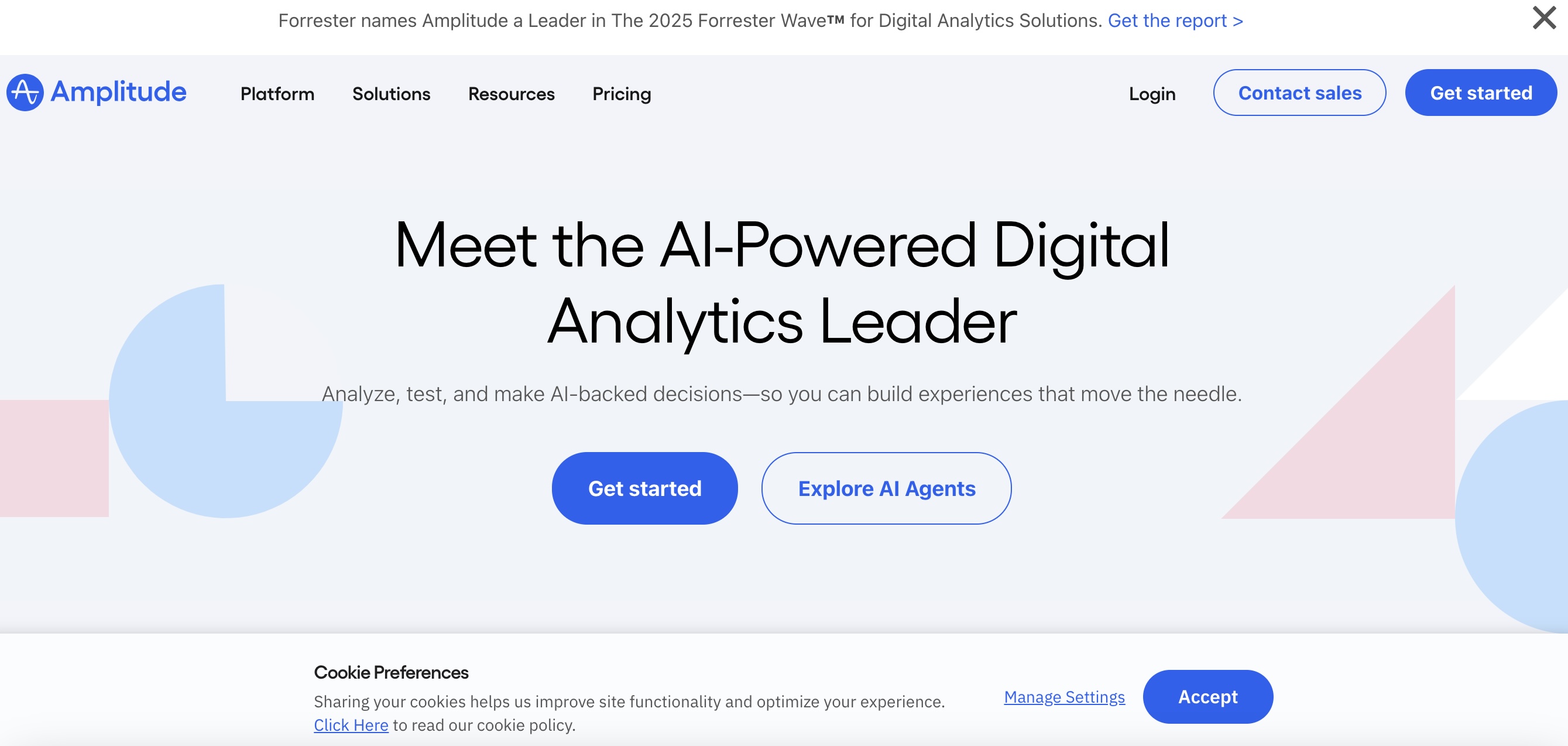
Data4 vs Amplitude vs Woopra: Which Analytics Fits? - Amplitude: depth for product teams.
Amplitude is a comprehensive digital analytics platform focused on understanding user behavior, optimizing experiences, and driving growth. It serves product managers, engineers, and data analysts who need to know what users do inside a product, not just how many arrived.
Its core capabilities include behavioral analytics, cohort analysis, funnel analysis, retention analysis, and A/B testing, plus session replay and data activation. Amplitude also invests heavily in AI: Global Agent and Custom Agents allow natural language querying and cross-tool actions, and MCP connectors integrate with tools like Slack, Jira, and GitHub so teams can act on insights without leaving their workflow.
The trade-off is complexity. Amplitude requires event instrumentation, which means planning a tracking schema, implementing it, and maintaining it over time. That effort pays off when you are optimizing onboarding flows, measuring retention curves, or running experiments. If you only need pageviews and traffic source breakdowns, it is overkill.
Woopra: journey intelligence across touchpoints

Data4 vs Amplitude vs Woopra: Which Analytics Fits? - Woopra: journey intelligence across touchpoints.
Woopra is an end-to-end customer journey intelligence platform powered by AI. It tracks, analyzes, and engages users across every touchpoint, unifying data from product, marketing, sales, and support channels through custom tracking and over 50 integrations. The result is a single view of the customer journey rather than a pile of disconnected reports.
Core capabilities include journey mapping, trend analysis, retention and segmentation reporting, and real-time engagement triggers. Woopra serves product, marketing, sales, and support teams, helping them acquire and retain customers by understanding behavior, personalizing experiences, and taking action on insights. It offers solutions tailored to industries such as automotive, ecommerce, finance, gaming, media, mobile apps, SaaS, and travel.
Woopra positions itself as a customer journey analytics tool with AI features like Copilot, AI suggestions, predictions, and an Audience Agent. It is trusted by over 160,000 customers worldwide, including companies like RedHat, HPE, and HTC Vive. Pricing starts at $999/month for the Pro plan, with an Enterprise plan offering advanced AI, data warehouse sync, SSO, and dedicated support. A free 30-day trial is available.
How to choose between them
The decision mostly depends on the questions you need to answer.
- Choose Data4 if you want a direct website analytics platform covering traffic, sources, engagement, and conversions, and you value multi-domain and multi-language support. It suits teams that want Google Analytics-style reporting without the complexity.
- Choose Amplitude if you are optimizing a product and need cohorts, funnels, retention analysis, experimentation, and AI-assisted workflows. Budget for implementation time, not just the subscription cost.
- Choose Woopra if you need to unify customer data across marketing, product, sales, and support, and want journey mapping plus real-time engagement triggers. The Pro plan starts at $999/month, so it fits teams with a clear cross-functional use case.
A useful check: list the three reports you actually open every week. If they are all traffic and conversion summaries, a lightweight tool wins. If any of them involve user segments, sequences, or retention over time, you need product analytics depth. If they span multiple departments and touchpoints, journey intelligence is the right category.
Setup and maintenance effort
Setup effort is where these tools differ most visibly.
Data4 is low-effort, focused on ease of use and fast insights across domains. Amplitude requires the most upfront work, because event tracking must be defined and instrumented before the data becomes useful. Woopra sits in between: custom tracking plus integrations, with more configuration than a simple traffic tool but less schema planning than a full product analytics implementation.
Maintenance matters too. Traffic analytics tools generally need little ongoing attention. Product analytics platforms need someone accountable for the tracking plan, or events drift, definitions diverge, and reports quietly become unreliable. Journey platforms need integration hygiene so that data from different systems stays consistent.
Privacy and data governance
Data4's differentiation here is coverage rather than a privacy claim: multi-domain and multi-language support makes it practical for organizations running sites across regions and languages. Amplitude operates at enterprise scale and offers governance features suited to large organizations with formal data policies. Woopra unifies data across channels, which means its governance posture depends heavily on what you feed it.
If your priority is a specific compliance stance, evaluate each vendor's documentation against your own legal requirements rather than relying on marketing summaries. For a broader look at privacy-focused options, see our guide to the best privacy-friendly Google Analytics alternative.
Pricing considerations
Pricing models differ in ways that are easy to misread.
Woopra publishes clear entry pricing: $999/month for the Pro plan, with an Enterprise tier and a free 30-day trial. Amplitude's cost is not just the subscription — implementation, instrumentation, and ongoing data hygiene are real expenses that belong in the comparison. Data4 is positioned as a simple, efficient alternative, so evaluate it against the traffic and domain volume you actually need to cover.
If you are comparing lighter tools on the same dimensions, our breakdown of Statcounter pricing covers free plan limits, paid tiers, session caps, and data retention.
Common questions
Is Data4 a good alternative to Google Analytics?
Data4 is positioned as a simple, efficient, globally applicable Google Analytics alternative with real-time traffic tracking, audience segmentation, conversion analysis, and customizable dashboards. It suits teams that want core website reporting without the complexity of a full enterprise suite.
When is Amplitude worth the extra setup work?
When your questions are about user behavior over time: funnels, cohorts, retention, and experiment results. If you cannot answer those with pageview-level data, Amplitude's depth justifies the instrumentation effort.
What makes Woopra different from a website analytics tool?
Woopra unifies data from product, marketing, sales, and support channels into a single customer journey view. Instead of reporting on sessions, it maps how individual customers move across touchpoints and lets teams trigger engagement in real time.
Can I use more than one of these tools?
Yes, some teams do. A common pattern is a lightweight traffic tool for marketing reporting plus a product analytics platform for in-app behavior. The risk is duplicated cost and inconsistent numbers, so define which tool is the source of truth for each metric.
Which tool is best for a small business website?
For most small business websites, a lightweight website analytics tool is the right fit. When you need simple reporting across multiple domains and languages, Data4 is a strong choice. When cross-team journey visibility is the goal, Woopra is built for that.
Related reading
- Data4 vs Statcounter vs Matomo: Which Analytics Fits? - Compare Data4, Statcounter, and Matomo on setup, privacy, reporting depth, and pricing to choose the right website analytics tool for your site.
- Open Source Web Analytics: Best Self-Hosted Tools - Compare the best open source web analytics platforms you can self-host, including Plausible, Matomo, PostHog, and GoatCounter, plus privacy and setup tips.
Sources and further reading
- adblock-fanboy-complete.js - GitHub Gist - GitHub Gist: instantly share code, notes, and snippets.
Conclusion
Data4, Amplitude, and Woopra are not really competing for the same job. Amplitude wins on behavioral depth for product teams, Woopra wins on cross-touchpoint journey intelligence, and Data4 targets the middle ground: direct website analytics that work across domains and languages without the overhead of a traditional enterprise tool.
Start from the questions you need to answer, then pick the tool that answers them with the least setup and the least ongoing maintenance. That approach will serve you better than comparing feature lists line by line. If you are still weighing options across the wider market, our comparison of Data4 vs Microsoft Clarity vs PostHog looks at setup, traffic reporting, session replay, and pricing side by side.