
Data4 vs GoatCounter: Open Source Web Analytics Compared
Choosing an analytics tool often comes down to one question: how much control do you need over your data, and how much complexity are you willing to accept to get it? Data4 and GoatCounter both answer that question, but from different angles. Data4 is a website analytics platform built for teams that want straightforward traffic tracking and actionable reporting without the overhead of mainstream suites. GoatCounter is an open source web analytics tool available as a free donation-supported hosted service or a self-hosted application, designed as a lightweight alternative to Google Analytics or Matomo.
This comparison looks at where each tool fits, what trade-offs come with the open source route, and how to decide which one belongs on your site.
What each tool is built to do
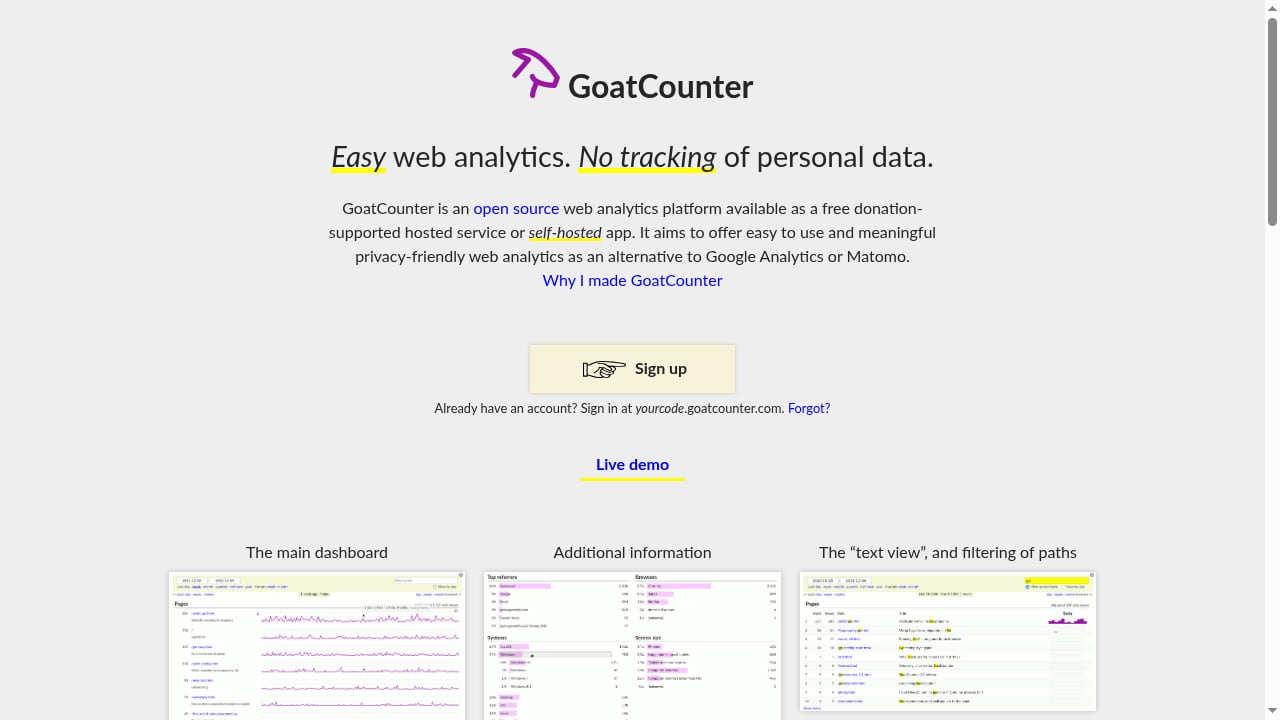
First viewport screenshot of GoatCounter – open source web analytics.
Data4: analytics without the complexity
Data4 is positioned as a simple and efficient data analysis tool and a Google Analytics alternative. Its core capabilities include real-time traffic tracking, audience analysis, and customizable reporting. The platform is designed for global use and serves marketers, website owners, and analysts who need a privacy-conscious alternative to mainstream analytics tools.
The emphasis is on ease of use and efficiency. You monitor visitor behavior, measure traffic sources, and turn website data into insights without building a data engineering project around it.
GoatCounter: open source, privacy-friendly, donation-supported
GoatCounter is an open source web analytics platform. It is available as a free donation-supported hosted service or as a self-hosted app. Its stated aim is to offer easy-to-use and meaningful privacy-friendly web analytics as an alternative to Google Analytics or Matomo.
The open source model is the defining feature. You can inspect the code, run it on your own infrastructure, and avoid sending visitor data to a third party if you self-host. That control is real, but it comes with operational responsibilities that a hosted platform handles for you.
Setup and maintenance compared
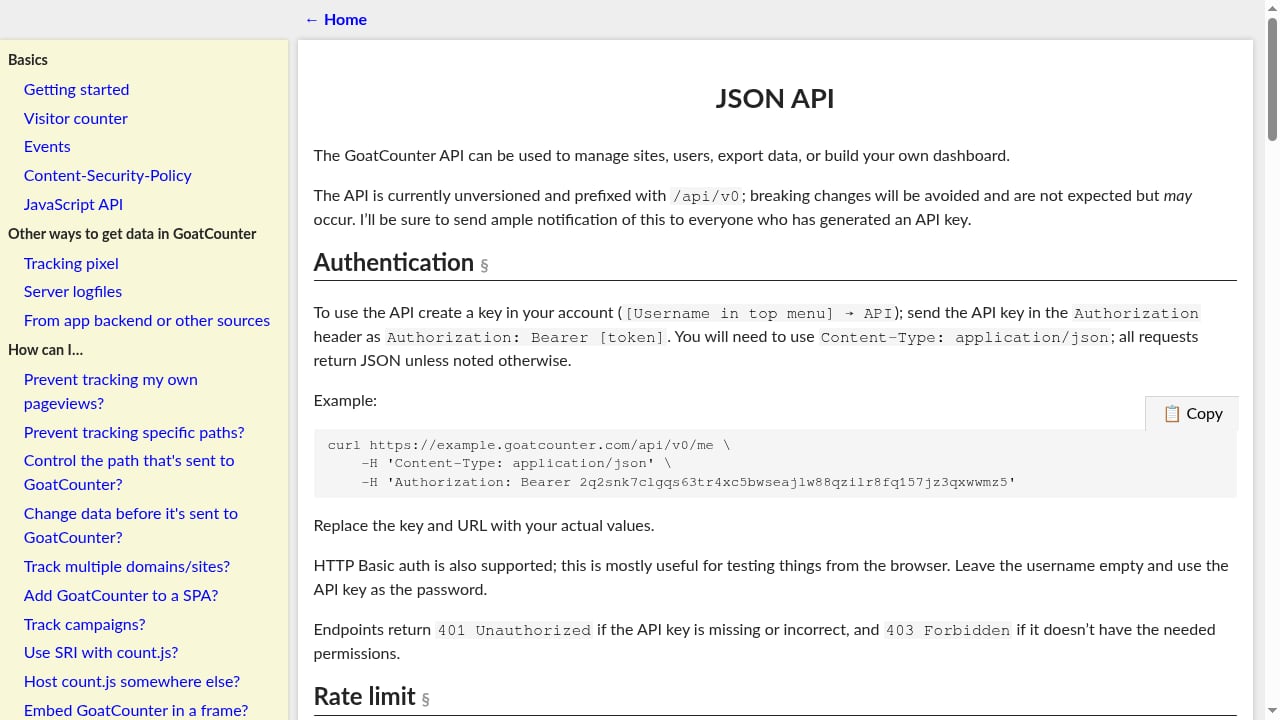
First viewport screenshot of GoatCounter documentation.
| Factor | Data4 | GoatCounter |
|---|---|---|
| Deployment model | Hosted analytics platform | Hosted (donation-supported) or self-hosted |
| Setup effort | Account creation and tracking snippet | Hosted: minimal. Self-hosted: server, database, and updates |
| Maintenance burden | Handled by the platform | Self-hosted users manage upgrades, backups, and uptime |
| Data ownership | Platform-managed | Full control when self-hosted |
| Source code access | Not applicable | Open source |
For teams without a sysadmin, the self-hosted path in GoatCounter is the biggest practical hurdle. You are responsible for the server, the database, and keeping the application patched. The hosted version removes that burden but reintroduces a third-party dependency, which is exactly what some teams are trying to avoid.
Data4 takes the opposite approach. There is no server to run and no upgrade cycle to manage. The trade-off is that you do not get access to the source code or the ability to run the entire stack on your own hardware.
If you are weighing analytics platforms more broadly, our Top 10 Web Analytics Software Products for 2026 breaks down pricing, privacy notes, and fit across the market.
Privacy and data handling
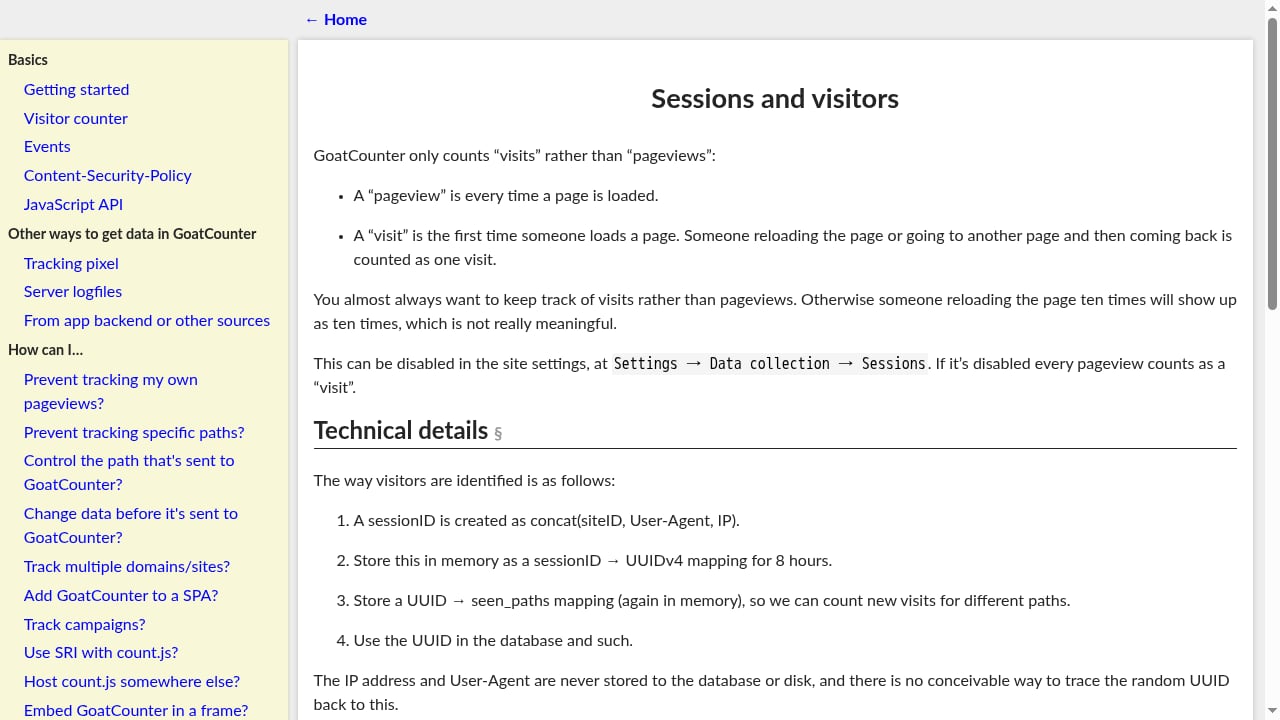
First viewport screenshot of GoatCounter documentation.
Both tools sit in the privacy-conscious category, but they achieve it differently.
GoatCounter's privacy story is structural. Because the code is open source and can be self-hosted, you can verify what data is collected and where it goes. For organizations with strict data residency or compliance requirements, that verifiability matters.
Data4's privacy positioning is about avoiding the complexity and invasiveness of mainstream analytics suites. It is designed as a privacy-conscious alternative, not as a self-hosted open source project. If your requirement is "no third-party processor under any circumstances," GoatCounter self-hosted is the stronger fit. If your requirement is "simpler, less invasive analytics without running infrastructure," Data4 is the more direct answer.
For a wider view of cookieless and privacy-first options, see Top 10 Privacy-First Web Analytics Software for 2026.
Reporting depth and day-to-day use
GoatCounter's design goal is meaningful but minimal analytics. It focuses on the essentials: page views, referrers, and basic visitor context. That restraint is a feature for people who found Google Analytics overwhelming, but it can become a limitation when you need deeper audience segmentation or custom reporting.
Data4 includes real-time traffic tracking, audience analysis, and customizable reporting. The reporting layer is built to be actionable rather than exhaustive, which keeps it usable for marketers and analysts who need answers, not dashboards they never open.
The practical difference shows up when your questions get more specific. If you want to understand which traffic sources produce engaged visitors, or how audience segments behave over time, Data4's reporting structure is designed for that. If you only need to know which pages were viewed and where people came from, GoatCounter covers it cleanly.
Where GoatCounter's open source model creates friction
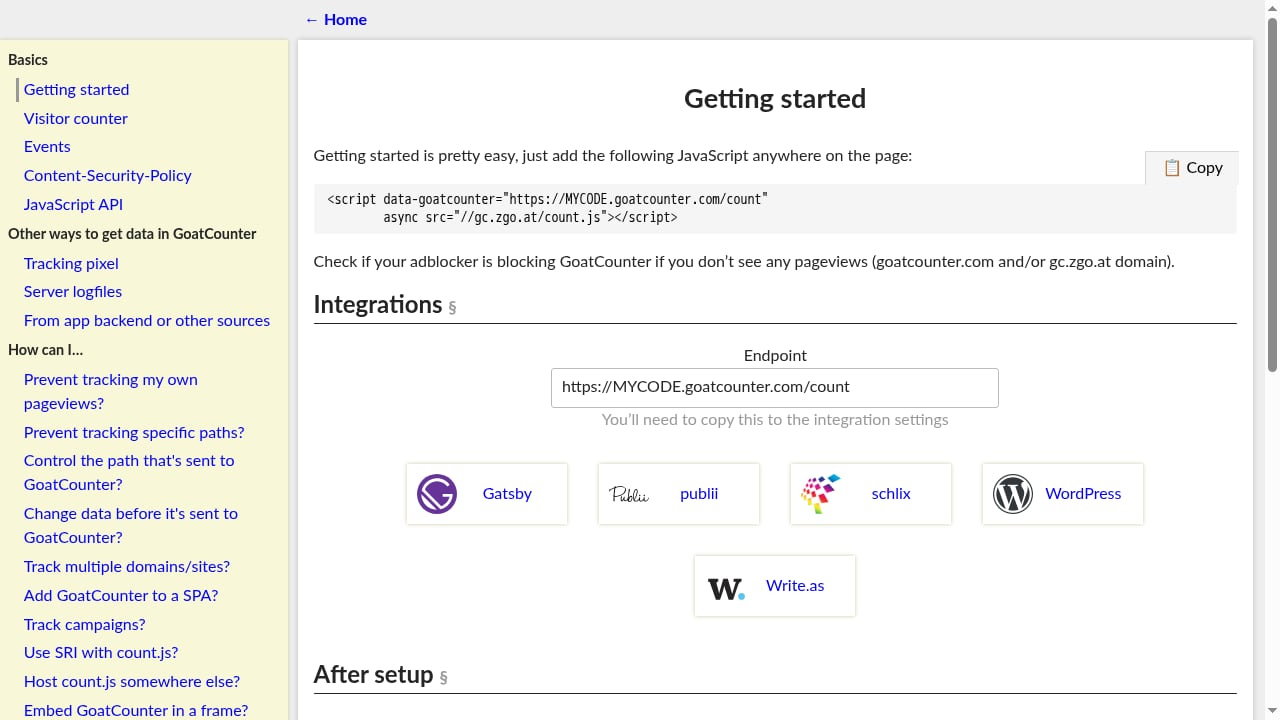
First viewport screenshot of GoatCounter documentation.
The open source approach is genuinely valuable, but it is not free of cost.
- Self-hosting requires ongoing effort. You need a server, a database, and a process for updates. That is manageable for a developer and a distraction for a marketing team.
- The hosted service depends on donations. A donation-supported model can work well, but it does not carry the same commercial support expectations as a paid platform.
- Feature scope is intentionally narrow. GoatCounter aims for easy and meaningful analytics, not a full reporting suite. Teams that outgrow the basics will need to look elsewhere or extend the tool themselves.
- No vendor support contract. With open source, help comes from documentation and community channels rather than a support desk.
None of these are dealbreakers on their own. Together, they define the profile of the team GoatCounter fits best: technically capable, comfortable with self-hosting, and satisfied with core metrics.
Where Data4 fits better
Data4 suits teams that want the privacy-conscious positioning without the operational overhead. You get real-time tracking, audience analysis, and customizable reporting in a hosted platform that does not require you to run infrastructure or manage upgrades.
It is also a better fit when reporting needs to serve non-technical stakeholders. Marketers and analysts can work with the data directly instead of filing requests to whoever maintains the self-hosted instance.
If your analytics data feeds into a broader customer understanding, the behavioral layer matters. Our guide to building a Customer 360 View with website analytics data explains how first-party website data connects to a unified customer profile.
How to decide
Choose GoatCounter if:
- You need full control over where visitor data lives.
- You have the technical capacity to self-host and maintain the application.
- Core metrics like page views and referrers are enough for your questions.
- Open source licensing and code auditability are hard requirements.
Choose Data4 if:
- You want privacy-conscious analytics without running a server.
- You need audience analysis and customizable reporting, not just page counts.
- Your team includes non-technical users who need direct access to insights.
- You want to avoid the maintenance and support uncertainty of a donation-supported or self-hosted tool.
The honest summary: GoatCounter wins on control and openness. Data4 wins on usability, reporting depth, and the absence of operational burden. The right choice depends on whether your constraint is technical capability or time.
Related reading
- Data4 vs Visitors vs Matomo: Best Privacy Analytics? - Compare Data4, Visitors, and Matomo on privacy, cookies, setup, and reporting depth to choose the right analytics platform for your site.
Sources and further reading
- Adding Analytics | Gatsby - Why use analytics? Most professional website teams using Gatsby use one of three types of analytics services on their website: Google…
- Even Connect · 1000 connections, zero middleman - Connect your AI agents to 564+ services (Stripe, Slack, Notion, Cloudflare, Linear, and more) with keys that never leave your machine. One MCP, a few meta-tools, no context bloat. Search the full catalog.
- The Simplifier · The Record - One price level each for gold, silver and platinum every Monday, graded by Friday's close. The wrong ones stay up. Nothing is ever deleted.
Frequently asked questions
Is Data4 open source?
Data4 is a hosted website analytics platform. It is not presented as an open source project. GoatCounter is the open source option in this comparison.
Can I self-host Data4?
Data4 is a hosted platform, so self-hosting is not part of its model. If self-hosting is a requirement, GoatCounter is the appropriate choice.
Is GoatCounter really free?
GoatCounter offers a free donation-supported hosted service and a self-hosted application. The hosted version is free to use, supported by donations. Self-hosting is also free in licensing terms, but you pay in server costs and maintenance time.
Which tool is better for a small website?
For a small site with basic needs and a developer available, GoatCounter is a practical, low-cost fit. For a small site without technical resources, Data4 removes the infrastructure question entirely.
Do both tools work as Google Analytics alternatives?
Yes. Both are positioned as alternatives to Google Analytics. GoatCounter explicitly targets Google Analytics and Matomo users who want something simpler and privacy-friendly. Data4 is positioned as a simple, efficient Google Analytics alternative for global use.
What if I need deeper behavioral analytics?
If your needs go beyond traffic and audience reporting into behavioral analytics, compare dedicated platforms. Our KISSmetrics review covers people-based tracking, funnels, and cohorts for teams that need that depth.
Conclusion
Data4 and GoatCounter both reject the complexity of mainstream analytics, but they solve different problems. GoatCounter gives you open source code, self-hosting control, and a deliberately minimal feature set. Data4 gives you a hosted platform with real-time tracking, audience analysis, and customizable reporting, without the server maintenance that self-hosting demands.
If control over infrastructure is your priority and you have the technical resources to support it, GoatCounter is a sound choice. If your priority is getting useful, privacy-conscious analytics into the hands of your team quickly, Data4 is the more direct path. Match the tool to your constraint, and the decision becomes straightforward.