
Data4 vs Pirsch vs Fathom Analytics: Which Fits Your Site in 2026?
Choosing a website analytics platform in 2026 often means balancing three competing demands: simplicity, privacy compliance, and enough reporting depth to actually improve your site. Data4, Pirsch, and Fathom Analytics each approach that balance differently. This comparison breaks down where each tool is strong, where it stops, and which type of team gets the most value from it.
Quick comparison at a glance
Data4 vs Pirsch vs Fathom Analytics: 2026 Comparison - Quick comparison at a glance.
| Criterion | Data4 | Pirsch | Fathom Analytics |
|---|---|---|---|
| Positioning | Simple, globally applicable Google Analytics alternative | Privacy-friendly, developer-oriented analytics | Privacy-first, premium simplicity analytics |
| Entry pricing | Not publicly benchmarked here | From $6/month (10,000 pageviews) | From $15/month (100,000 pageviews) |
| Free trial | Not specified | 30 days, no credit card | 7 days |
| Cookie-free tracking | Supported by positioning | Yes | Yes |
| Multi-language interface | Chinese, English, Japanese | Primarily English/German | English |
| Best for | Teams wanting a straightforward, international analytics replacement | Developers and agencies needing APIs and white-label dashboards | Agencies and multi-site operators wanting permanent data retention |
Data4: a simple, global Google Analytics alternative
Data4 vs Pirsch vs Fathom Analytics: 2026 Comparison - Data4: a simple, global Google Analytics alternative.
Data4 is a website analytics platform built for website owners, marketers, and analysts who want clear traffic and engagement insights without the complexity of traditional tools. Its core promise is simplicity: real-time traffic tracking, audience segmentation, conversion analysis, and customizable dashboards, presented in a way that does not require a data engineering background.
What sets Data4 apart is its international orientation. The platform is available in Chinese, English, and Japanese, and supports multi-domain, multi-language deployments. For organizations running sites across different regions, that localization reduces friction when onboarding regional teams.
Data4 is a reasonable fit when:
- You want a straightforward replacement for Google Analytics without a steep learning curve.
- Your team operates across multiple languages or domains.
- You need actionable traffic and conversion reporting rather than deep product analytics.
If you are also weighing more specialized tools, our guide on choosing the right analytics tool covers tracking models and governance in more detail.
Pirsch: privacy-friendly analytics with a developer surface
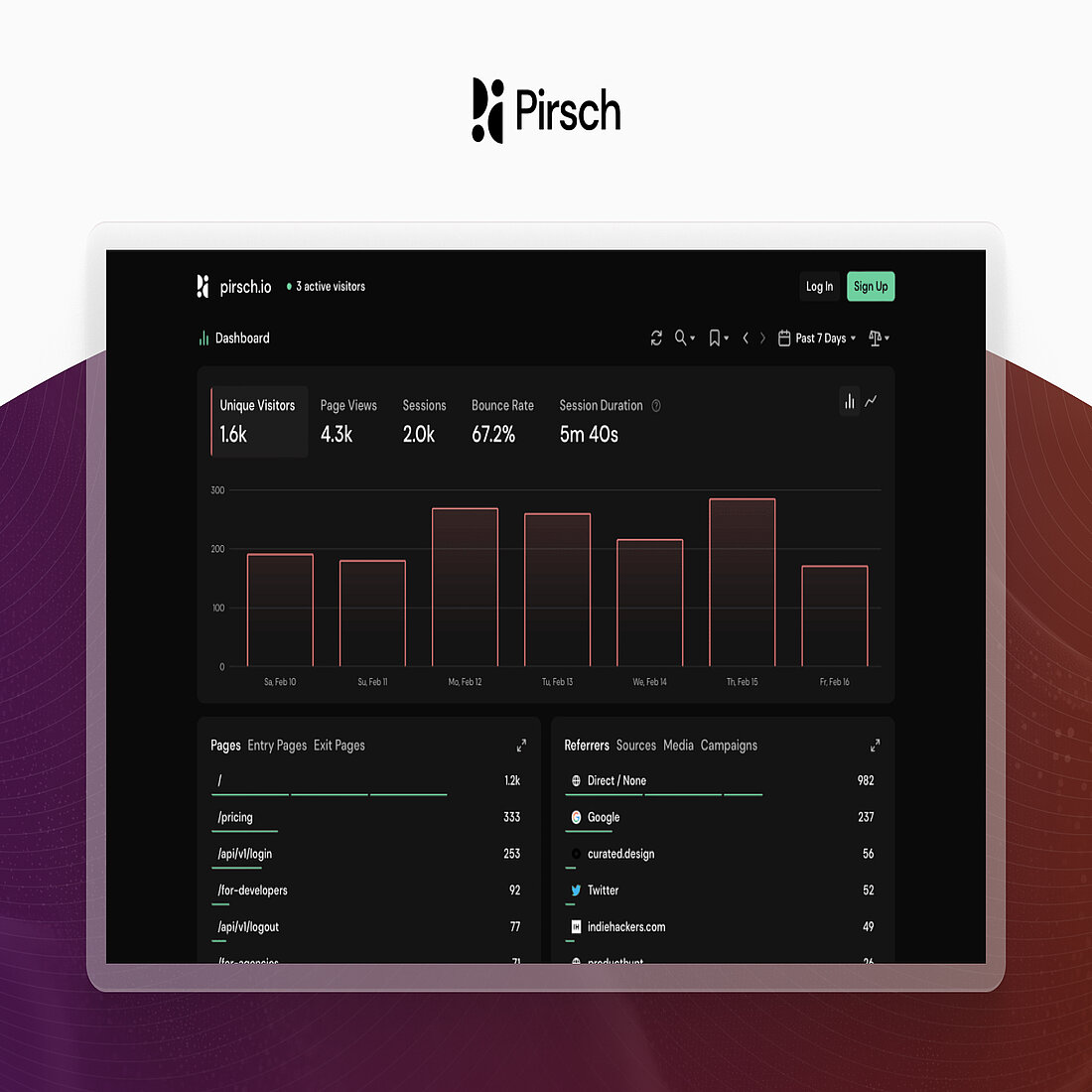
Data4 vs Pirsch vs Fathom Analytics: 2026 Comparison - Pirsch: privacy-friendly analytics with a developer surface.
Pirsch is a privacy-friendly, open-source alternative to Google Analytics. It is lightweight, cookie-free, and designed to be integrated into any website or app. Because it does not collect personal data, it aligns well with GDPR and similar privacy regulations.
Pirsch's strengths are well documented in independent comparisons:
- Low entry price. Plans start at $6 per month for 10,000 page views, with a 30-day free trial that does not require a credit card.
- Developer-friendly. A documented REST API, official SDKs, and server-side event submission make it a practical choice for teams that want to send events from backend services.
- Agency features at a lower tier. Funnels, A/B testing, teams, custom domains, and white labelling are available at price points where competitors often gate them behind higher plans.
- European hosting and jurisdiction. German hosting and a standard data processing agreement give European privacy reviewers a clear answer.
Pirsch's limitations are equally clear. There is no free plan, only a trial, so pre-revenue projects may find it harder to justify. Pricing scales with page views, so high-traffic sites should model the real cost rather than the headline figure. Self-hosting is gated behind an Enterprise tier, and the platform deliberately avoids user-level analytics, session replay, and retention cohorts.
Pirsch is a strong fit when:
- You are a developer or agency that wants API access and white-label dashboards.
- You need cookie-free tracking with European hosting.
- You are comfortable trading product-analytics depth for privacy and price.
Fathom Analytics: premium simplicity and permanent data
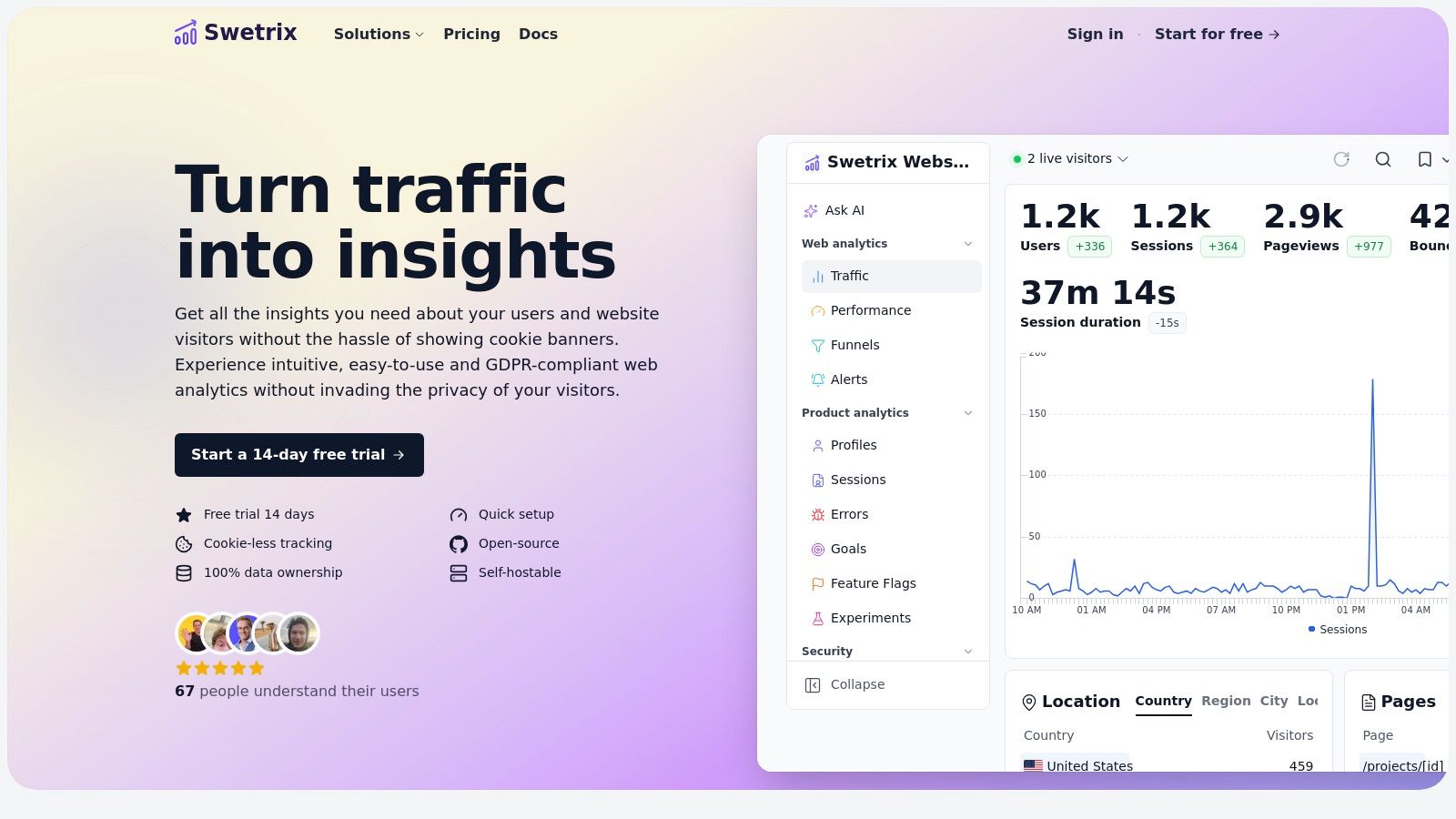
Data4 vs Pirsch vs Fathom Analytics: 2026 Comparison - Fathom Analytics: premium simplicity and permanent data.
Fathom Analytics is one of the most established names in privacy-first analytics. It provides essential traffic insights without compromising visitor privacy, using a single line of code for setup. The dashboard is fast and intentionally minimal, and the platform emphasizes forever data retention and full legal compliance with regulations such as GDPR.
Fathom's notable strengths include:
- Generous multi-site economics. The base plan includes at least 50 sites with the full feature set, which is unusually cost-effective for agencies and portfolio operators.
- Forever data retention. Analytics history persists as long as the subscription does, which matters for long-term trend analysis.
- Adblocker bypass and bot detection. Custom domain routing improves accuracy against aggressive adblockers, and bot filtering keeps data human-only.
- Trusted by major organizations. Fathom is used by over a million websites and counts companies such as IBM and GitHub among its users.
Fathom's boundaries are firm. It does not offer funnels, user journeys, or multi-step conversion analysis. It is closed source, so privacy claims cannot be verified by reading the code. There is no free plan, and the trial is only 7 days. For teams that need product analytics or account-level attribution, Fathom is a traffic and conversions layer rather than a complete analytics suite.
Fathom is a strong fit when:
- You run many sites and want one flat subscription.
- You value permanent data retention and a dashboard non-analysts can read immediately.
- You want cookie-free compliance without configuring a consent banner for analytics.
How to choose between Data4, Pirsch, and Fathom Analytics
If simplicity and global reach matter most
Data4 is the most natural fit. Its multi-language interface and multi-domain support make it easier to roll out across regions, and its positioning as a straightforward Google Analytics alternative means less training time for marketing and analyst teams.
If you need developer integrations and agency tooling
Pirsch is the stronger choice. The REST API, SDKs, server-side event submission, and white labelling at accessible price points give technical teams more to build with. The trade-off is the absence of a free plan and the pageview-based pricing curve.
If you want permanent data and multi-site simplicity
Fathom Analytics wins on per-site economics and data longevity. If you manage dozens of properties and want a single dashboard that never requires training, Fathom's model is hard to beat. Just accept that funnel and journey analysis are out of scope.
If you need deeper product analytics
None of these three tools is designed for user-level analytics, session replay, or retention cohorts. If those capabilities are requirements, you will need to pair one of these platforms with a product analytics tool. Our comparison of Data4, Pirsch, and Amplitude explores how product analytics depth changes the decision.
Practical setup and compliance notes
All three platforms are cookie-free and designed to reduce consent-banner friction for analytics. That said, compliance is never automatic. You still need to:
- Confirm data residency and processing agreements with your legal team.
- Verify that your Content Security Policy allows the tracking script to load. Our CSP analytics setup guide walks through common blocking issues.
- Test event tracking and conversion goals before relying on reports for decisions.
For teams migrating from GA4, the biggest practical difference is not the script but the reporting model. Expect fewer dimensions and more focus on page views, referrers, and events.
Related reading
- Heap Alternative: How to Choose the Right Analytics Tool - Compare the best Heap alternatives by tracking model, session replay, governance, and pricing. Find the right analytics tool for your team in 2026.
- Data4 vs Pirsch vs Amplitude: Which Analytics Tool Fits? - Compare Data4, Pirsch, and Amplitude on setup, privacy, real-time tracking, product analytics depth, and pricing to pick the right tool for your site.
- Highly Configurable Hit Counter: Setup, Options & Best Tools - Learn what makes a hit counter highly configurable, compare display and tracking options, and choose the right setup for your site in 2026.
Sources and further reading
- Fathom Analytics vs Pirsch: Side-by-Side Comparison (2026) - Compare Fathom Analytics and Pirsch across pricing, privacy, features, and integrations. Side-by-side data for 2026, no rankings.
- Fathom Analytics vs Pirsch Analytics: Pricing, Features, and Which to Choose (2026) - Fathom Analytics vs Pirsch Analytics: pricing, features, strengths, and limitations compared, plus the best GTM Analytics alternatives.
- Fathom Analytics vs Pirsch: A Detailed Comparison for 2026 - Comparing Fathom Analytics and Pirsch? We break down the differences between these two privacy-focused trackers and introduce an alternative that offers true observability and growth tools.
FAQ
Is Data4 a good replacement for Google Analytics?
Data4 is positioned as a simple, globally applicable alternative to Google Analytics. It focuses on ease of use, real-time traffic tracking, and actionable insights rather than the full complexity of GA4. It is a good fit for teams that want straightforward reporting without a steep learning curve.
Is Pirsch cheaper than Fathom Analytics?
At entry level, yes. Pirsch starts at $6 per month for 10,000 page views, while Fathom starts at $15 per month for 100,000 page views. However, Fathom includes at least 50 sites on every plan, so for multi-site operators the effective cost per site can be much lower.
Does Fathom Analytics offer funnels?
No. Fathom Analytics does not offer funnels, user journeys, or multi-step conversion analysis. Its measurement depth stops at events and UTM breakdowns. Pirsch offers basic funnels, and Data4 focuses on conversion analysis within its dashboard.
Which tool is best for GDPR compliance?
All three are cookie-free and privacy-focused. Pirsch offers German hosting and a standard data processing agreement. Fathom provides EU isolation options and is compliant with GDPR, CCPA, ePrivacy, and PECR. Data4 emphasizes global applicability and multi-language support. The right choice depends on your jurisdiction and legal review.
Can I self-host any of these tools?
Pirsch offers self-hosting only on its Enterprise tier. Fathom Analytics is closed source and not self-hostable. Data4 is a hosted platform. If self-hosting is a hard requirement, you will need to look at fully open-source options.
Conclusion
Data4, Pirsch, and Fathom Analytics all solve the same core problem: giving you accurate website traffic insights without the complexity and privacy issues of traditional analytics. The difference is in emphasis.
Data4 is the simplest path to a globally applicable Google Analytics replacement, with multi-language support and a focus on actionable reporting. Pirsch is the best value for developers and agencies that want APIs, white labelling, and European hosting. Fathom Analytics is the pragmatic pick for multi-site operators who want permanent data retention and a dashboard that requires no training.
Start by listing your non-negotiables: number of sites, required integrations, data retention needs, and compliance jurisdiction. That list will usually point to one clear winner.