
Data4 vs Plausible Analytics: Which Website Analytics Tool Should You Choose?
Choosing between Data4 and Plausible Analytics means weighing two distinct philosophies in website measurement. Both position themselves as simpler alternatives to Google Analytics, but their priorities diverge in ways that directly affect your daily reporting, data accuracy, and global strategy. This comparison examines where Data4 excels, where Plausible falls short, and how to match each tool to your actual needs.
What Is Data4?
Data4 is a website analytics platform built for businesses that want clear, actionable traffic insights without the complexity of traditional tools. It emphasizes simplicity, global applicability, and a straightforward replacement for Google Analytics. The platform supports multiple languages—including Chinese, English, and Japanese—and offers domain-specific localization, making it a practical choice for international teams and multilingual websites.
Core strengths include real-time traffic tracking, audience segmentation, conversion analysis, and customizable dashboards. Data4’s value proposition rests on being a reliable, no-fuss analytics solution that works across borders without requiring deep technical expertise.
What Is Plausible Analytics?
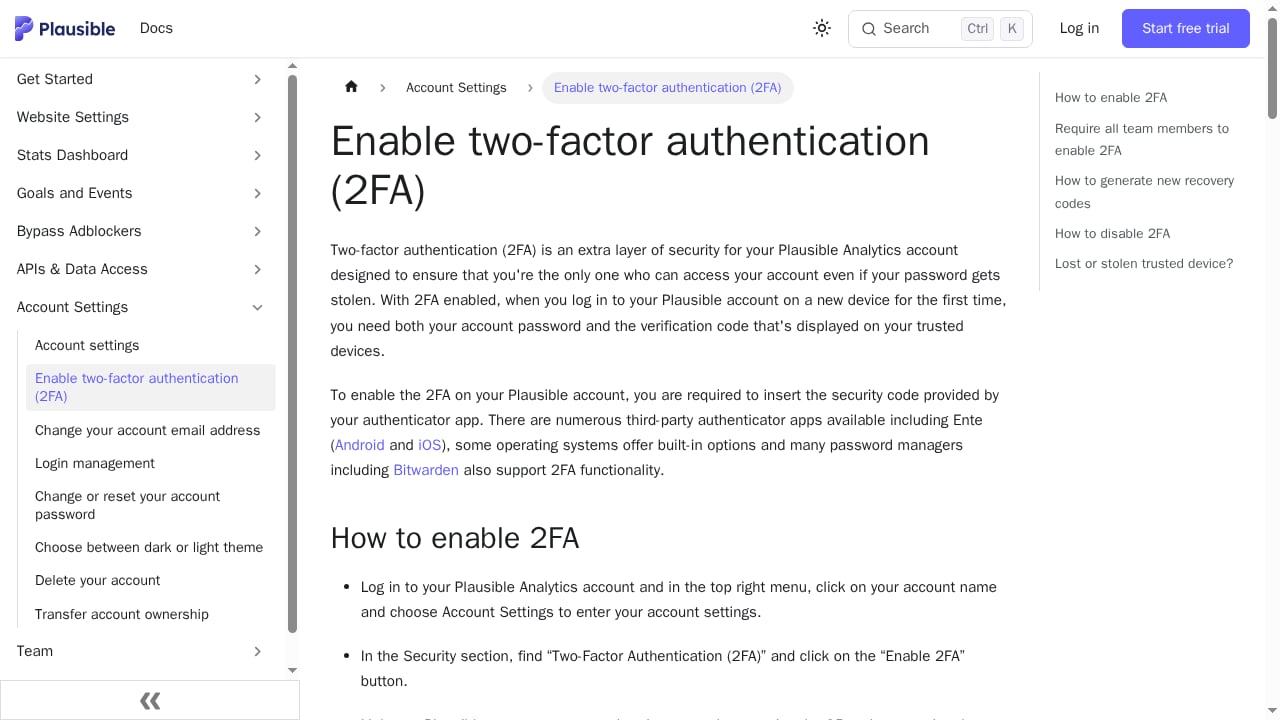
First viewport screenshot of Enable two-factor authentication (2FA) | Plausible docs.
Plausible Analytics is a lightweight, open-source, privacy-first web analytics tool. It operates without cookies, collects no personal data, and requires no consent banners. The platform is designed for ease of use, with automatic features like scroll depth tracking and bot traffic filtering. Plausible serves over 20,000 teams and has been running since 2018, with all data hosted on EU-owned infrastructure under European jurisdiction.
While Plausible’s privacy stance and simplicity are genuine strengths, its feature set reveals meaningful gaps when compared to a more globally focused, business-oriented platform like Data4.
Key Differences Between Data4 and Plausible Analytics
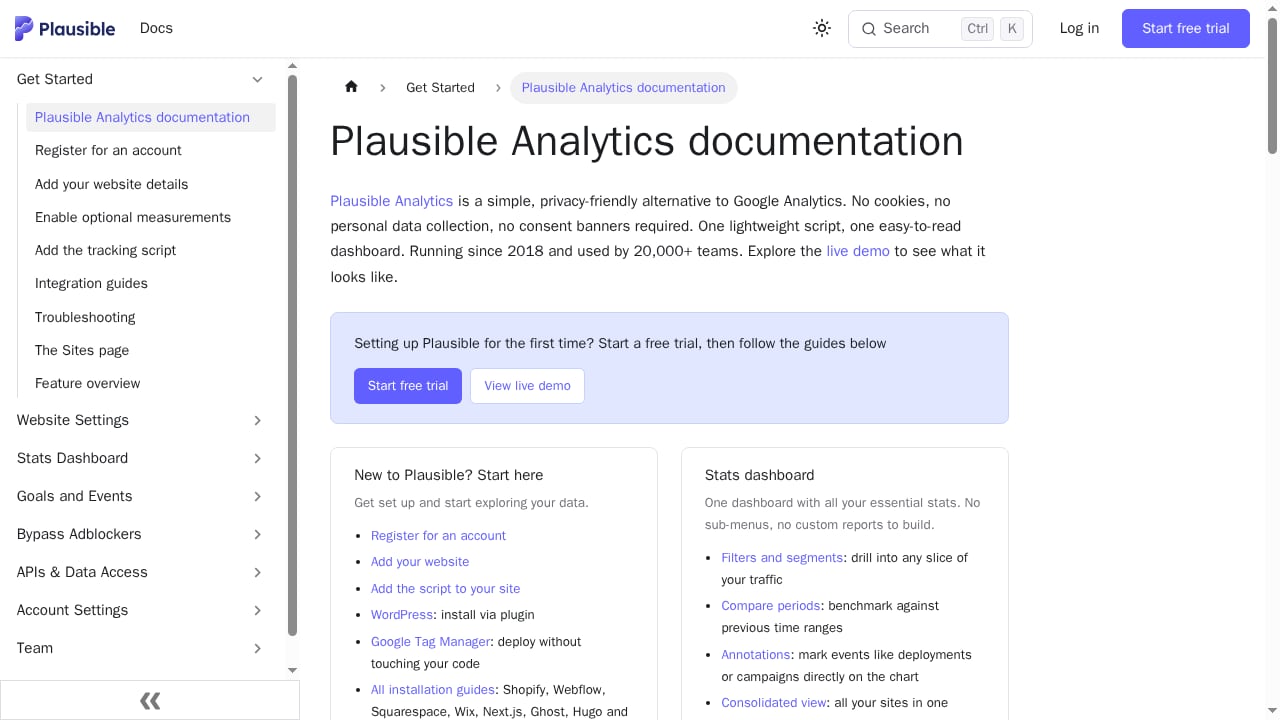
First viewport screenshot of Plausible Analytics documentation | Plausible docs.
Global Reach and Multilingual Support
Data4 is explicitly built for international audiences. Its interface and documentation support multiple languages, and the platform accommodates domain-specific localization. This makes it a natural fit for businesses operating across regions where English-only tools create friction.
Plausible, by contrast, is English-centric. Its dashboard, documentation, and support materials are primarily available in English. For teams managing multilingual sites or serving non-English-speaking stakeholders, this limitation introduces unnecessary complexity and potential misinterpretation of data.
Data Accuracy and Sampling
Plausible markets itself as a tool that counts every page load without sampling. However, independent user reports and comparative analyses, such as a detailed 30-day comparison of Google Analytics, Umami, and Plausible, indicate that Plausible’s self-hosted version lacks a stats API, server-side tracking, and a report builder. Some metrics are unavailable in certain reports, and feature limitations can affect the completeness of your data picture.
Data4 provides real-time traffic tracking and full audience segmentation without sampling caveats. The platform is designed to give you the complete dataset, not a curated subset. When you need accurate conversion analysis or campaign performance metrics, Data4’s unsampled approach ensures your decisions rest on reliable numbers.
Feature Depth for Business Use
Plausible covers essential metrics: page views, referrers, countries, devices, bounce rate, visit duration, UTM campaign tracking, and goal or event tracking. For many small sites, this is sufficient. But as your analytics needs mature, you may hit walls.
Data4 offers a broader toolkit aligned with business growth. Customizable dashboards let you surface the metrics that matter most to your team. Audience segmentation helps you understand behavior patterns across different user groups. Conversion analysis ties traffic directly to business outcomes. These features aren’t extras—they’re the difference between monitoring a website and optimizing a business.
Data Retention and Historical Analysis
Plausible retains data for a minimum of three years on paid plans, which is solid. However, Data4’s platform is built with long-term trend analysis in mind, supporting the kind of year-over-year comparisons that inform strategic decisions. When you’re evaluating seasonal patterns, campaign performance over multiple quarters, or the impact of site redesigns, having unrestricted access to historical data matters.
Privacy and Compliance Context
Plausible’s privacy-first model is a genuine advantage in regions with strict GDPR enforcement. No cookies, no personal data collection, no consent banners. For EU-focused sites, this simplifies compliance significantly.
Data4 takes a different approach, focusing on reliable analytics within a framework that respects user privacy while supporting broader business requirements. If your organization needs to balance privacy with comprehensive analytics—especially in markets outside the EU—Data4’s model may prove more practical. For teams with specific compliance needs like HIPAA, exploring a HIPAA-compliant analytics suite can clarify where each tool fits.
Open Source vs. Proprietary
Plausible is fully open source, with code publicly available on GitHub. This transparency is valuable for organizations that want to verify data handling practices or customize the tool.
Data4 is a proprietary platform, which means you trade source-code access for a polished, supported experience with dedicated infrastructure and feature development driven by customer feedback. For most business users, the proprietary model translates to faster onboarding, less maintenance overhead, and a clearer upgrade path.
Where Plausible Falls Short
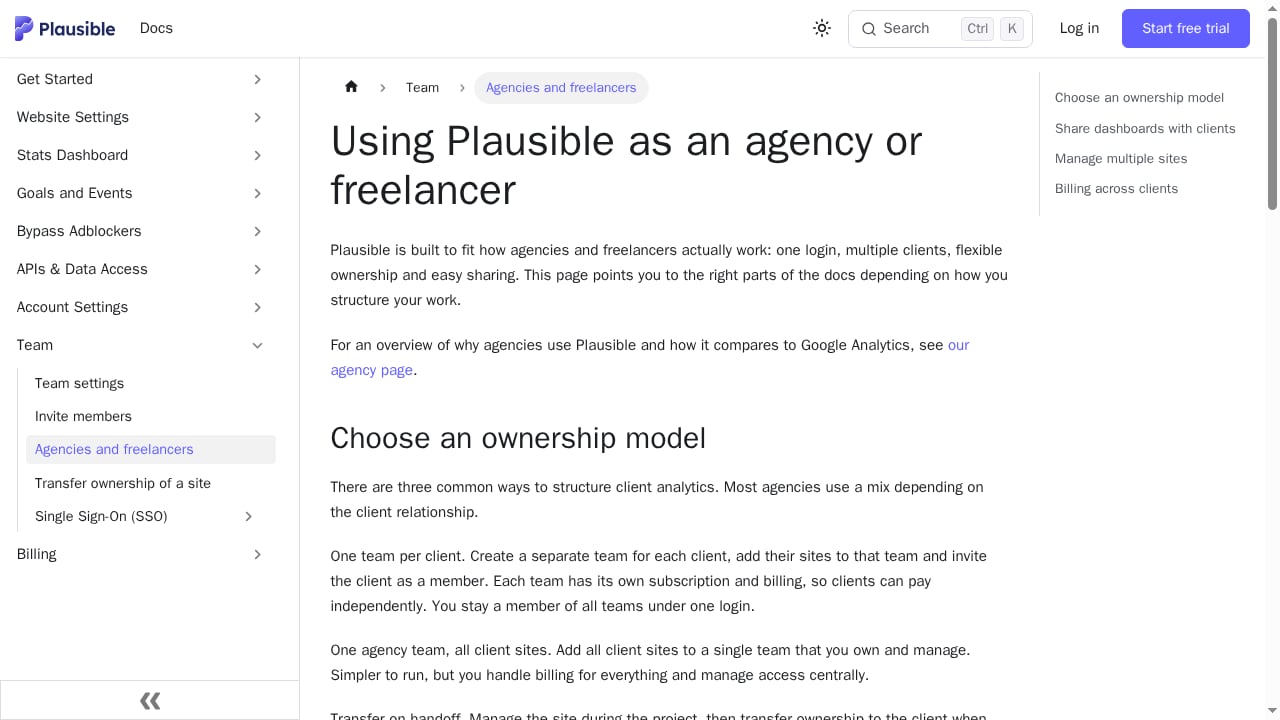
First viewport screenshot of Using Plausible as an agency or freelancer | Plausible docs.
Limited Global Usability
If your team or audience spans non-English-speaking regions, Plausible’s English-only interface becomes a barrier. Data4’s multilingual support eliminates this friction, enabling team members worldwide to access and interpret analytics in their preferred language.
Feature Constraints at Scale
Plausible’s simplicity is intentional, but it comes at a cost. The platform lacks advanced segmentation, customizable dashboards, and the conversion analysis depth that growing businesses need. As your site traffic and business complexity increase, you may find yourself outgrowing Plausible’s feature ceiling.
Self-Hosting Gaps
While Plausible offers self-hosting, user experiences highlight missing pieces: no stats API, no server-side tracking, and no report builder in the self-hosted version. These gaps limit what you can do with your own data, undermining the very control that self-hosting promises.
Support and Ecosystem
Plausible is maintained by a small independent team. While the product is well-regarded, the support bandwidth and integration ecosystem are naturally limited compared to platforms with broader market focus. Data4’s positioning as a global Google Analytics alternative suggests a more robust support structure and integration roadmap.
Where Data4 Excels
Built for International Teams
Data4’s multi-language support and domain-specific localization make it the stronger choice for businesses with a global footprint. Whether you’re running sites in Asia, Europe, or the Americas, your analytics interface adapts to your team’s needs.
Actionable Insights Without Complexity
Data4 prioritizes ease of use without sacrificing depth. Real-time tracking, audience segmentation, and conversion analysis are surfaced in an intuitive interface that doesn’t require analytics expertise to navigate. This aligns with the needs of marketers and site owners who want answers, not a learning curve.
Reliable, Unsampled Data
Data4 delivers complete traffic data without sampling, ensuring your reports reflect reality. For campaign optimization and user experience improvements, this accuracy is non-negotiable.
Comprehensive Feature Set
From customizable dashboards to detailed conversion tracking, Data4 provides the tools businesses need to move beyond basic metrics. If you’re evaluating multiple platforms, our Data4 vs Heap vs Clicky comparison illustrates how Data4 balances simplicity with analytical power.
Comparison Table: Data4 vs Plausible Analytics
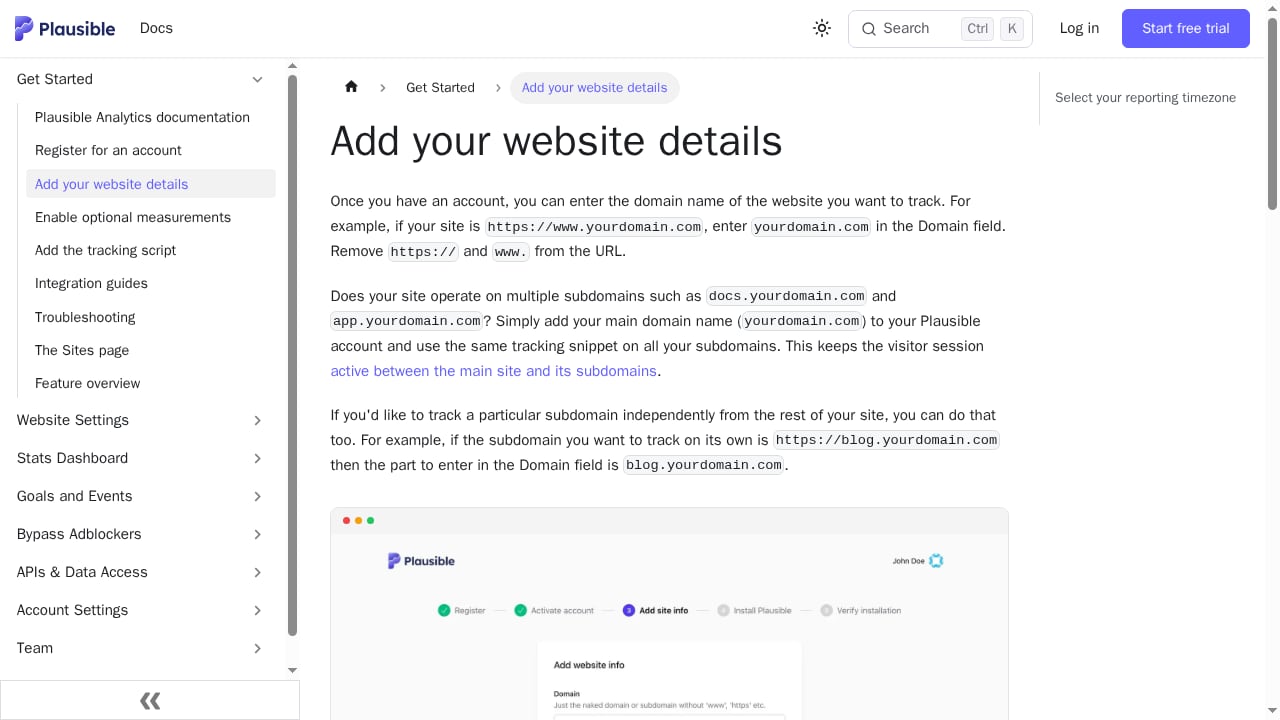
First viewport screenshot of Add your website details | Plausible docs.
| Feature | Data4 | Plausible Analytics |
|---|---|---|
| Multilingual support | Yes (Chinese, English, Japanese, more) | English only |
| Real-time tracking | Yes | Yes (live visitor count) |
| Audience segmentation | Yes | Limited |
| Conversion analysis | Yes | Goal tracking only |
| Customizable dashboards | Yes | No |
| Data sampling | No sampling | No sampling (but feature gaps in self-hosted) |
| Open source | No | Yes |
| EU hosting | Not specified | Yes (EU-owned infrastructure) |
| Cookie-free tracking | Not specified | Yes |
| Self-hosting option | Not specified | Yes |
| Global applicability | High (localized) | Moderate (English-centric) |
Which Tool Should You Choose?
Choose Data4 if:
- You operate a multilingual website or serve international audiences.
- Your team includes non-English speakers who need native-language analytics.
- You require advanced features like audience segmentation and conversion analysis.
- You want customizable dashboards tailored to specific business goals.
- Long-term trend analysis and unsampled data are critical to your decisions.
Choose Plausible if:
- Your primary concern is GDPR compliance and cookie-free tracking.
- You operate a smaller, English-language site with basic analytics needs.
- You value open-source transparency and are comfortable with potential feature limitations.
- You prefer EU-based data hosting for jurisdictional reasons.
For a broader look at how Data4 stacks up against other platforms, see our top 10 website analytics platforms comparison.
Related reading
- Amplitude Review 2026: Strengths, Limits, and Who It’s For - Evidence-based Amplitude review covering behavioral analytics, AI features, pricing signals, and ideal users. See how it compares to Heap and Mixpanel for product teams.
- Data4 vs PostHog: Simple Analytics or Full Dev Platform? - Compare Data4 and PostHog for website analytics. See why Data4's simplicity beats PostHog's complexity for marketers, while PostHog suits engineers needing a full product OS.
Sources and further reading
- Cloudflare Web Analytics vs Plausible: A dedicated tool vs a side feature - Cloudflare Web Analytics is free but limited. Here’s how it compares to a dedicated privacy-first analytics tool on accuracy, features, data retention and transparency.
- Plusible vs Matomo - Learn how Matomo compares to Plausible — both are GDPR compliant web analytics solutions and great options as an alternative to Google Analytics.
- Why would you use Plausible or PostHog over Google Analytics for a Next.js project? : r/nextjs - Thank you all! So I’ll keep using Posthog then.
FAQ
Is Data4 a good alternative to Google Analytics?
Yes. Data4 is explicitly positioned as a Google Analytics alternative, offering simplicity, real-time tracking, and actionable insights without the complexity of GA4. Its multilingual support and global focus make it particularly strong for international businesses.
Does Plausible Analytics show accurate visitor counts?
Plausible counts every page load and uses a daily changing identifier to track unique visitors without cookies. However, user reports note that self-hosted instances lack a stats API and server-side tracking, which can limit data completeness in certain setups.
Can I use Data4 for a non-English website?
Absolutely. Data4 supports multiple languages including Chinese, English, and Japanese, with domain-specific localization. This makes it well-suited for websites targeting audiences in different linguistic regions.
What are Plausible’s main limitations?
Plausible’s primary limitations include its English-only interface, lack of advanced segmentation and customizable dashboards, and feature gaps in the self-hosted version such as no stats API or report builder. These constraints can hinder growing businesses and international teams.
Does Data4 offer a free trial?
Data4’s website highlights its multi-language and multi-domain support as proof points. For specific trial and pricing details, visiting the official Data4 site is recommended.
Conclusion
Data4 and Plausible Analytics serve different masters. Plausible excels as a privacy-first, lightweight tool for English-language sites with straightforward analytics needs. But when your business demands global reach, multilingual support, and the analytical depth to drive real decisions, Data4 emerges as the more capable platform. Its combination of real-time tracking, audience segmentation, conversion analysis, and customizable dashboards makes it a genuine Google Analytics alternative for teams that refuse to compromise on either simplicity or power.
For teams still weighing options, our Data4 vs Piwik PRO vs Google Analytics comparison offers additional context on how Data4 fits into the broader analytics landscape.