
Data4 vs Similarweb vs PostHog: Which Analytics Platform Should You Choose?
Choosing the right analytics platform can feel overwhelming. One team needs simple, privacy-friendly website metrics. Another needs deep competitive intelligence. A third needs a developer-centric product OS that can fix bugs automatically. Data4, Similarweb, and PostHog each serve a distinct audience, and picking the wrong one creates friction instead of clarity. This comparison breaks down their strengths, ideal users, and where each tool genuinely excels—so you can match the platform to your actual workflow.
What Is Data4?
Data4 is a website analytics platform built for simplicity and global reach. It positions itself as a straightforward alternative to Google Analytics, stripping away the complexity that often frustrates website owners and marketers. The platform tracks visitor behavior, traffic sources, and engagement metrics through customizable dashboards and real-time reporting.
Where Data4 stands out is its multi-language, multi-domain support. The platform is available in Chinese, English, and Japanese, with localization that reflects a genuine commitment to international users. For businesses operating across regions or serving diverse audiences, this global-first design removes friction that other analytics tools introduce. The core promise is actionable insights without the learning curve—a tool you can set up quickly and actually use daily.
What Is Similarweb?

Similarweb product interface.
Similarweb is an AI-powered digital intelligence platform that goes far beyond your own website. It provides a holistic view of digital channels—web, app, and AI search—to help marketing leaders, SEO specialists, and growth teams benchmark performance and uncover competitor strategies. The platform collects billions of digital signals from four distinct sources: first-party direct measurement, a contributory network of consumer products, partnerships with ISPs and measurement companies, and public data extraction. This multi-dimensional approach creates what Similarweb calls the "Triple Effect"—Traffic, Visibility, and Efficiency—giving users total visibility with zero blind spots.
Similarweb's methodology is grounded in statistical representativeness across countries, industries, and devices. Their machine learning algorithms clean, synthesize, and model data to provide industry-leading estimations. One documented case showed a 30% traffic increase with a 20% budget reduction, and another SEO client achieved a 167% year-over-year revenue boost. Plans start at $125 per month for web intelligence, with specialized packages for AI search, app, and retail analytics.
What Is PostHog?
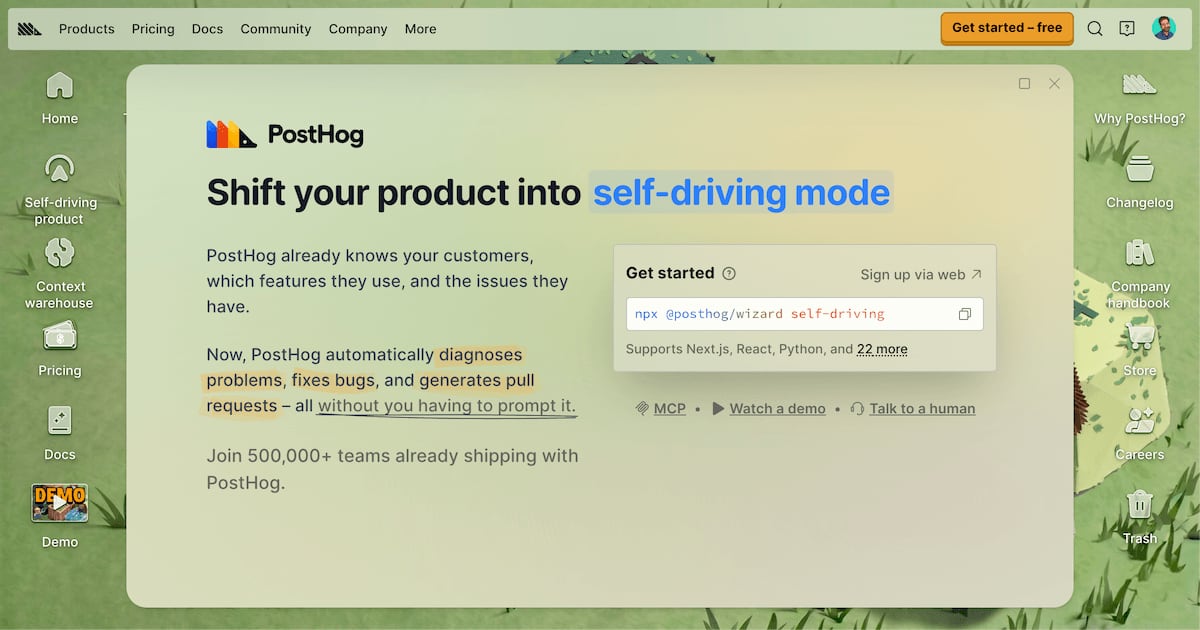
PostHog product interface.
PostHog is an all-in-one product analytics and AI-powered platform designed for engineers and product teams. It bills itself as a "self-driving product OS" that can automatically diagnose problems, fix bugs, and generate pull requests without prompting. The platform bundles product analytics, web analytics, session replay, feature flags, experiments, surveys, error tracking, a managed data warehouse, and over a dozen other tools into a single suite.
PostHog's pricing model is unusually generous: over 90% of companies use it for free, with usage-based pricing and spike detection to prevent surprise bills. It integrates with 120+ external sources and provides a context warehouse for unified data querying. Notable customers include Arena, ElevenLabs, Exa, and Hasura, and the platform serves over 500,000 teams. The philosophy is simple—give engineers full context for decision-making without forcing them to switch between fragmented tools.
Data4 vs Similarweb vs PostHog: Feature Comparison
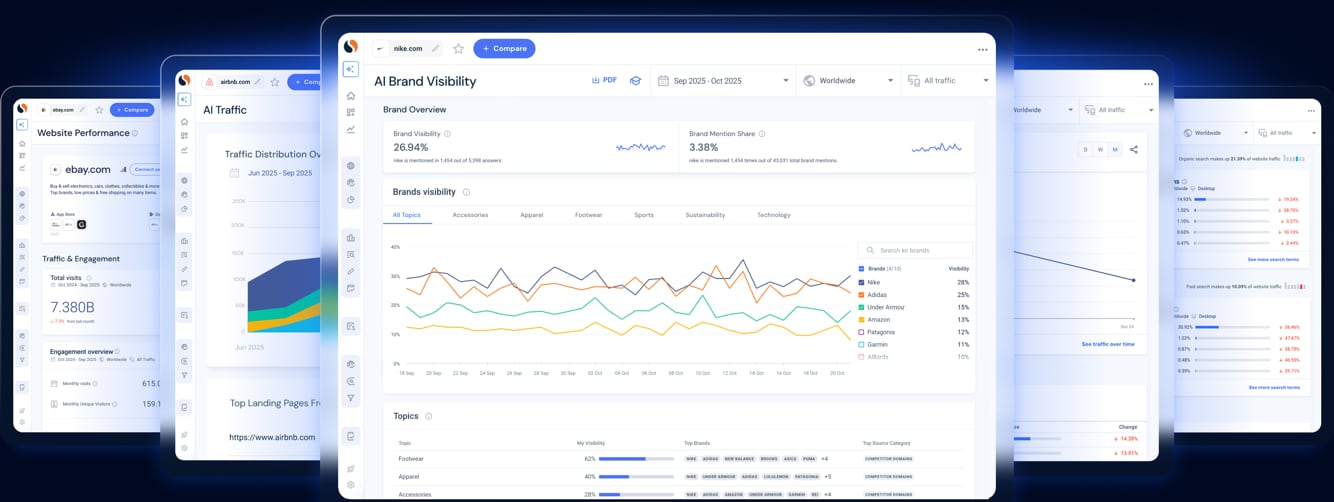
Analyze websites.
Website Analytics and Traffic Tracking
Data4 delivers real-time traffic tracking, audience segmentation, and conversion analysis through a clean, uncluttered interface. It covers the essentials—visitor counts, page views, traffic sources, bounce rates—without overwhelming users with features they won't use. For website owners who just need to understand how their site performs and where visitors come from, Data4 provides a focused, efficient experience.
Similarweb offers website analytics as part of a broader intelligence suite, but its true power lies in competitive benchmarking. You can analyze any website's traffic, engagement metrics, and audience demographics—not just your own. The platform's relative data, such as pages per visit and average visit duration, tends to be close to reality according to user reports, though absolute traffic numbers for smaller or local sites can vary significantly. This makes Similarweb excellent for trend analysis and market sizing rather than precise internal reporting.
PostHog includes web analytics as one component of its product analytics suite. It tracks pageviews, sessions, and user paths, but the interface and feature set are optimized for product teams analyzing user behavior within applications, not for marketers running content websites. Session replay and heatmaps add visual context that pure traffic numbers can't provide.
Where Data4 has an advantage: For users who want a dedicated, simple website analytics tool without competitive intelligence or product analytics overhead, Data4 offers a more streamlined experience. Its multi-language support and global localization also make it uniquely suited for international teams that find other platforms too English-centric.
Competitive Intelligence and Market Analysis
This is where Similarweb operates in a category of its own. The platform provides competitive traffic estimates, audience insights, keyword analysis, and industry benchmarks that no first-party analytics tool can replicate. You can see competitors' top traffic sources, geographic distribution, and engagement trends. For SEO specialists and growth teams, Similarweb's AI engine optimization (AEO) capabilities extend this intelligence into the emerging AI search landscape.
The data methodology combines direct measurement from millions of websites that voluntarily share their Google Analytics data, behavioral data from consumer products, partnerships with ISPs and DSPs, and public data extraction. This redundancy makes the platform resilient to market changes. However, users should understand the limitations: traffic estimates for smaller websites or locally-focused businesses can be off by significant margins. The platform is best used for directional insights and trend identification rather than precise competitive benchmarking.
Data4 and PostHog do not offer competitive intelligence. They are first-party analytics tools focused on your own digital properties. If understanding competitor performance is central to your workflow, Similarweb is the clear choice among these three.
Product Analytics and User Behavior
PostHog dominates this category with a developer-first approach that embeds analytics into the product development lifecycle. Feature flags let teams roll out changes gradually. A/B testing runs experiments without third-party tools. Session replay shows exactly how users interact with your product. Error tracking catches issues before users report them. And the AI capabilities can automatically diagnose problems and generate pull requests—a genuinely unique capability in the analytics space.
Data4 focuses on website-level behavior rather than in-product user journeys. It tracks page interactions, traffic flows, and conversion funnels, but it doesn't offer feature flags, experiment frameworks, or session replay. For content websites, marketing landing pages, and informational sites, this is perfectly adequate—and arguably preferable to a more complex tool.
Similarweb provides some user behavior insights through its engagement metrics and audience analysis, but these are aggregated at the market level rather than tracked at the individual user session level. You can understand how audiences behave across your industry, but you can't watch individual user sessions or run product experiments.
Pricing and Accessibility
PostHog's free tier is remarkably generous, covering product analytics, web analytics, session replay, feature flags, and more for up to 1 million events per month. The usage-based pricing means costs scale with your actual usage, and spike detection prevents surprise bills. For startups and small product teams, this makes PostHog accessible in a way that enterprise analytics tools are not.
Similarweb starts at $125 per month for web intelligence, with additional costs for AI search, app, and retail intelligence packages. This pricing reflects the value of competitive data that can't be obtained elsewhere, but it's a meaningful investment for smaller businesses.
Data4 positions itself as an accessible Google Analytics alternative, though specific pricing isn't detailed in the available context. The simplicity-first approach suggests a pricing model that aligns with straightforward website analytics needs rather than enterprise-scale intelligence or product analytics.
Developer Experience and Integration
PostHog is built by developers for developers. The platform integrates with 120+ external sources, provides a context warehouse for unified querying, and exposes APIs that let teams build custom workflows. The AI capabilities—automatic bug fixing, pull request generation, problem diagnosis—are designed to reduce engineering toil rather than add another dashboard to check.
Data4 prioritizes ease of use for non-technical users. The customizable dashboards and straightforward reporting are accessible to marketers and website owners without engineering support. This is a strength for teams that don't have dedicated data resources.
Similarweb sits between these extremes. The platform is designed for marketing and strategy professionals rather than engineers, but the data depth and API access support advanced analytical workflows. The AI-powered recommendations help users interpret data without needing a data science background.
When to Choose Each Platform

PostHog product interface.
Choose Data4 if:
- You need a simple, Google Analytics alternative for website traffic tracking
- Your team operates across multiple languages and regions
- You want actionable insights without a steep learning curve
- Competitive intelligence and product analytics are not priorities
- You value clean, focused dashboards over feature breadth
For a deeper look at how Data4 compares to other privacy-focused alternatives, see our Data4 vs Plausible Analytics comparison.
Choose Similarweb if:
- Competitive benchmarking and market analysis are central to your strategy
- You need to understand industry trends, not just your own performance
- SEO and AI search optimization are key priorities
- Your budget supports a premium intelligence platform (starting at $125/month)
- You understand that competitive traffic estimates are directional, not precise
Choose PostHog if:
- You're a product team that needs analytics embedded in the development workflow
- Feature flags, experiments, and session replay are essential tools
- You want an all-in-one platform to replace multiple point solutions
- The generous free tier and usage-based pricing fit your budget
- Your team has engineering resources to leverage the full platform
For an in-depth look at PostHog's capabilities and trade-offs, read our PostHog Review 2026.
Related reading
- Data4 vs Fathom Analytics: Which Simple Analytics Fits? - Compare Data4 and Fathom Analytics for website analytics. See why Data4's global simplicity and multi-language support challenge Fathom's privacy-first model.
- What Is a Heap? Data Structure Guide with Examples - Learn what a heap data structure is, how max-heap and min-heap work, their operations, real-world uses, and how they compare to other data structures.
- Data4 vs Contentsquare vs Mixpanel: Which Analytics Fits? - Compare Data4, Contentsquare, and Mixpanel for website and product analytics. See strengths, use cases, and which tool matches your team's needs.
Sources and further reading
- SimilarWeb vs SEM Rush Traffic Analytics - You mean you need accurate numbers for other companies' websites? Never gonna happen. Client-side analytics isn't even that accurate for your own website.
- Similarweb Data Methodology - A 360-Degree View into the Digital Landscape
Data analysis is the foundation of our entire business. Through this, we have developed a unique, multi-dimensional approach to understanding the digi...
- SEMrush vs Similarweb for Traffic Analysis - Which is Better? - Enjoy the videos and music you love, upload original content, and share it all with friends, family, and the world on YouTube.
FAQ
Can Similarweb replace my website analytics tool?
Not entirely. Similarweb excels at competitive intelligence and market analysis, but its traffic estimates for your own site are modeled rather than directly measured. You still need a first-party analytics tool like Data4 or PostHog for accurate internal reporting. Similarweb's methodology combines direct measurement, contributory networks, partnerships, and public data to estimate traffic, but these estimates can vary significantly for smaller or local sites.
Is PostHog really free for most teams?
Yes. PostHog reports that over 90% of companies use it for free, with the free tier including product analytics, web analytics, session replay, feature flags, and more for up to 1 million events per month. The usage-based pricing and spike detection help prevent unexpected bills as you scale.
Does Data4 offer competitive intelligence like Similarweb?
No. Data4 is a first-party website analytics platform focused on your own traffic and performance. It does not provide competitive benchmarking, market analysis, or traffic estimates for other websites. If competitive intelligence is essential, Similarweb is the appropriate tool among these three.
Can PostHog replace Google Analytics for marketing websites?
PostHog includes web analytics capabilities, but it's primarily designed for product analytics within applications. For content websites and marketing landing pages, a dedicated tool like Data4 may provide a more focused, marketer-friendly experience. PostHog's strength is understanding user behavior within your product, not optimizing content marketing performance.
How accurate is Similarweb's traffic data?
Similarweb's relative metrics (pages per visit, average visit duration) tend to be reasonably close to reality according to user reports. Absolute traffic numbers can be less precise, particularly for smaller websites or those serving local markets. The platform is best used for trend analysis, competitive benchmarking, and market sizing rather than exact traffic counts.
Final Verdict
Data4, Similarweb, and PostHog don't truly compete—they solve different problems for different teams. Data4 is the pragmatic choice for website owners and marketers who want simple, globally accessible analytics without the complexity of enterprise tools. Similarweb is the go-to platform for competitive intelligence and market analysis, providing insights no first-party tool can replicate. PostHog is the developer's choice, an all-in-one product analytics suite that embeds experimentation, session replay, and AI-powered debugging into the engineering workflow.
Your decision should follow your primary use case. Need to understand your own website traffic across multiple languages? Data4. Need to benchmark against competitors and analyze market trends? Similarweb. Need to build better products with data-driven development? PostHog. Many teams will find value in pairing a first-party analytics tool with competitive intelligence, using each platform for what it does best.