
Data4 vs Visitors vs Fathom Analytics: Privacy-First Google Analytics Alternative
If you are leaving Google Analytics, the shortlist usually comes down to tools that promise privacy without gutting your reporting. Data4, Visitors, and Fathom Analytics all make that promise, but they solve different problems. This comparison looks at where each tool is genuinely strong, where the trade-offs sit, and how to decide based on your team, your stack, and what you actually need to measure.
Search intent and what this comparison covers
People searching for "Data4 vs Visitors vs Fathom Analytics" are usually in one of two situations: they have decided to leave GA4 and want a privacy-first replacement, or they already run a lightweight analytics tool and are evaluating a switch. The intent is commercial-investigational, so the useful output is not a feature dump but a decision framework.
This article compares the three tools on privacy posture, tracking model, reporting depth, setup effort, and fit for different teams. It also flags where a tool has a real advantage and where the honest answer is "it depends."
Quick comparison at a glance
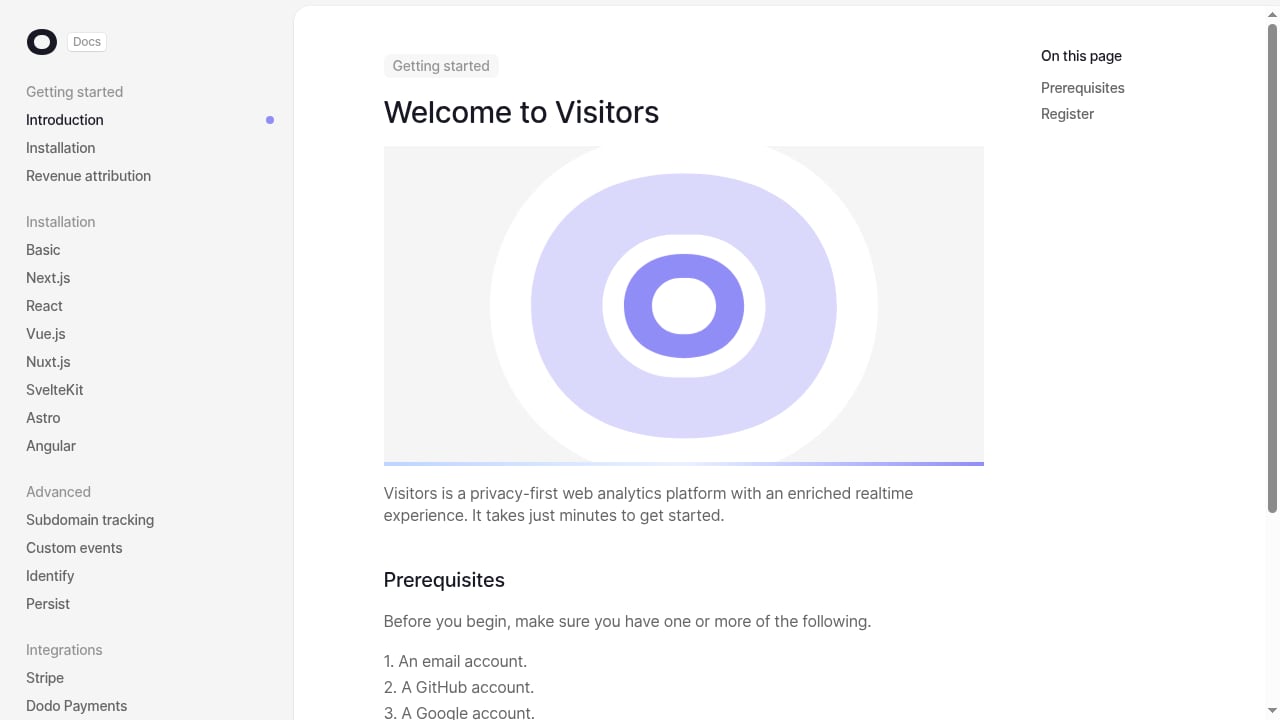
First viewport screenshot of Documentation - Visitors docs.
| Criterion | Data4 | Visitors | Fathom Analytics |
|---|---|---|---|
| Core positioning | Simple, efficient website analytics and GA alternative | Privacy-first realtime analytics with revenue attribution | Privacy-focused, GDPR-compliant GA alternative |
| Tracking model | Privacy-conscious traffic tracking | Cookie-free by default, no consent banner needed | Privacy-focused, GDPR-compliant tracking |
| Real-time data | Yes | Yes, realtime dashboards are a core feature | Yes |
| Revenue attribution | Not a stated core capability | Yes, via Stripe, Dodo Payments, and RevenueCat | Not a stated core capability |
| Custom events and user identification | Not a stated core capability | Yes, including cross-device identification | Not a stated core capability |
| API access | Not a stated core capability | Full Account API and Project API | Not a stated core capability |
| Framework integrations | Not a stated core capability | Next.js, React, Vue, Nuxt, SvelteKit, Astro, Angular | Not a stated core capability |
| Best fit | Marketers and owners who want lightweight traffic insight | Product teams that need realtime behavior plus revenue context | Teams that want a mature, privacy-first GA replacement |
Privacy and consent: where each tool stands
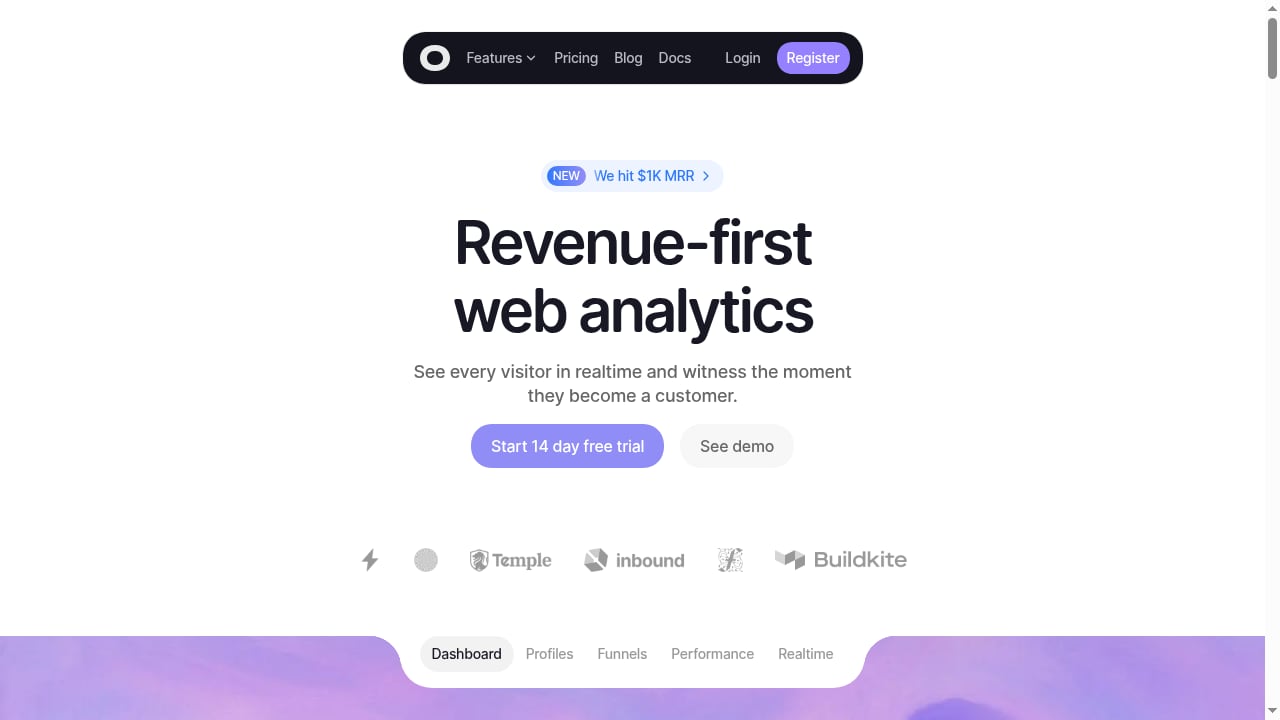
First viewport screenshot of Visitors - Privacy-friendly Google Analytics alternative.
All three tools are built around the idea that you should not need a cookie consent banner to count visits. That shared foundation matters more than the marketing language around it, because it changes what your legal and front-end teams have to maintain.
Data4
Data4 is positioned as a privacy-conscious alternative to mainstream analytics. It focuses on tracking website traffic and analyzing visitor behavior without the complexity of enterprise suites. For organizations that want a straightforward, lightweight tool, that simplicity is the point: fewer scripts, fewer settings, less to explain to stakeholders.
Visitors
Visitors is explicit about its privacy model: cookie-free tracking by default, with no consent banner required for default analytics. It is designed for teams that need GDPR-compliant measurement without bolting on a consent management platform for basic traffic counts. That clarity is a genuine strength if compliance review is part of your buying process.
Fathom Analytics
Fathom has built its reputation specifically as a GDPR-compliant, privacy-first Google Analytics alternative from a sustainable, independent company. For teams that want a well-known name in the privacy analytics space, that track record is the main draw.
If privacy architecture is your primary filter, our guide to analytics for the privacy-conscious website owner walks through how to build a compliant stack without losing useful data.
Real-time tracking and audience insight
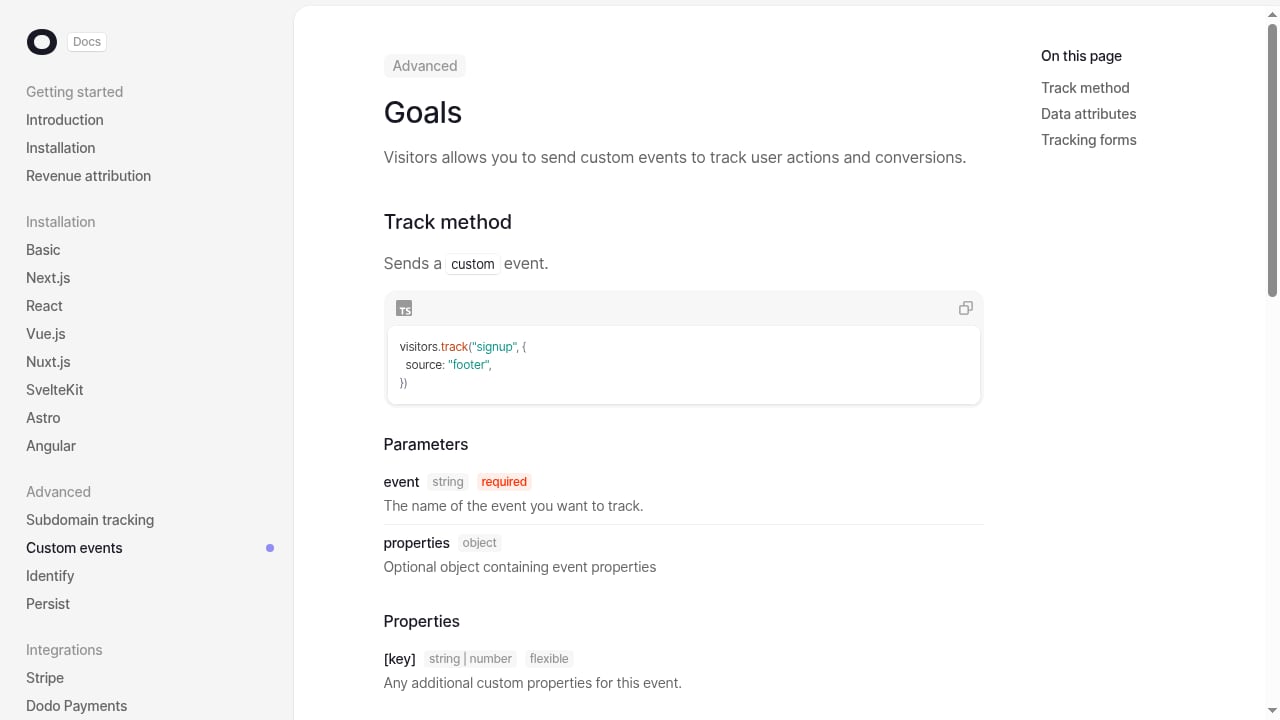
First viewport screenshot of Goals - Visitors docs.
Real-time data is table stakes in this category, but the depth varies.
Data4 emphasizes real-time traffic tracking alongside audience analysis and customizable reporting. The value here is speed of comprehension: you open the dashboard, you see what is happening, and you can act. It is aimed at marketers, website owners, and analysts who want actionable insight without a learning curve.
Visitors treats realtime dashboards as a headline feature, not a side panel. If your work depends on watching a launch, a campaign, or a product release as it happens, that realtime-first design is a real advantage.
Fathom provides the live view you expect from a modern privacy analytics tool, with a clean interface that favors clarity over configuration.
Reporting depth and customization
This is where the tools diverge most.
Data4 offers customizable reporting, which matters if you need to shape views around specific stakeholders, such as a weekly traffic summary for leadership or a source breakdown for a campaign team. Its positioning as a simple and efficient data analysis tool suggests the reporting is designed to be used, not configured for days.
Visitors goes further into product and revenue reporting: performance analytics, revenue attribution tied to visitor sessions, referrers, and UTM campaigns, plus custom events and user identification across devices. For a SaaS or subscription business, connecting revenue to traffic source is a meaningful capability that pure traffic tools do not offer.
Fathom focuses on clean, reliable website analytics. It is not positioned as a revenue attribution platform, and teams that need that should look elsewhere.
Setup, integrations, and developer experience
Installation effort is often the deciding factor for small teams.
Visitors has the most explicit developer story of the three: lightweight installation with support for Next.js, React, Vue.js, Nuxt.js, SvelteKit, Astro, and Angular, plus a full Account API and Project API for programmatic access. If your engineering team wants to script project setup or pull data into internal tools, that is a concrete advantage.
Data4 is built for ease of use, which typically means a simple script and a dashboard you can understand quickly. It suits organizations that want a lightweight yet powerful analytics solution without dedicating engineering time.
Fathom is known for a straightforward setup and a polished interface, consistent with its positioning as a drop-in GA replacement.
Revenue attribution and product analytics
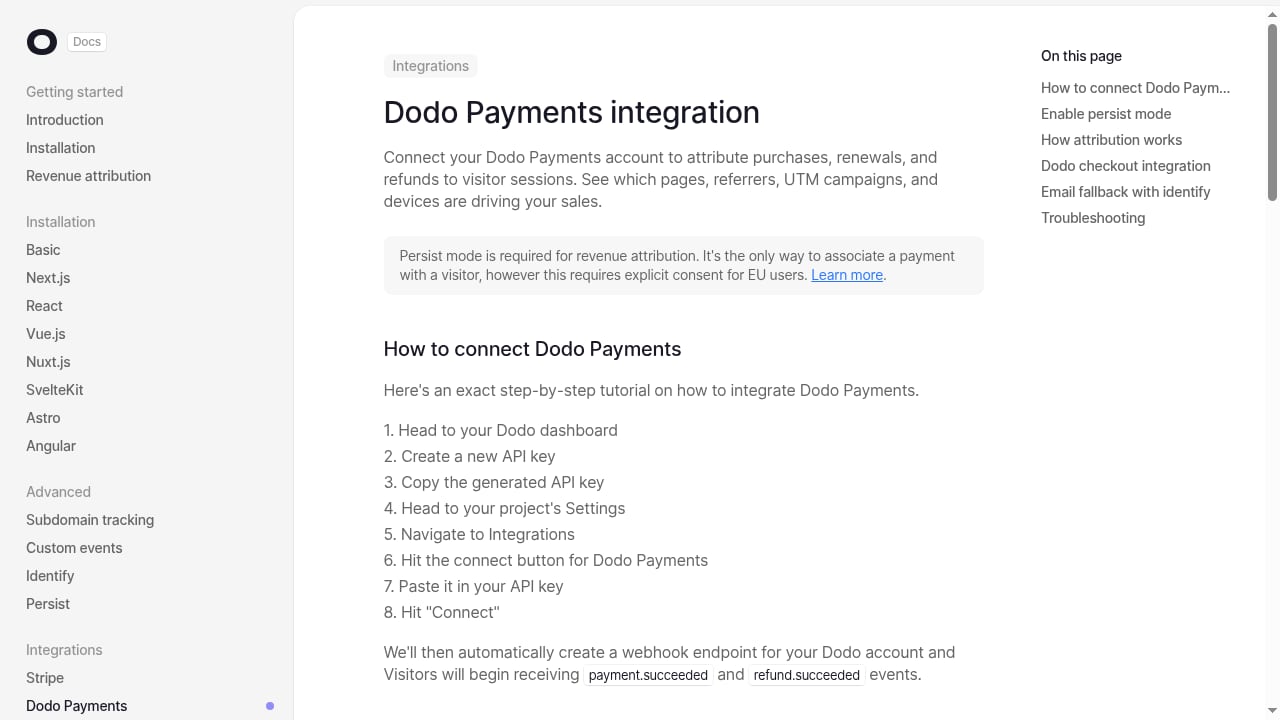
First viewport screenshot of Dodo Payments Revenue Attribution - Visitors docs.
If your question is "which channel brings paying customers," the comparison narrows quickly. Visitors supports revenue attribution through Stripe, Dodo Payments, and RevenueCat, and allows anonymous user persistence across sessions and subdomain tracking. That combination is designed for product teams that need to connect acquisition to subscription revenue.
Data4 and Fathom are website analytics tools first. They help you understand traffic sources and visitor behavior, but neither is presented as a revenue attribution platform. If revenue attribution is a hard requirement, Visitors is the stronger fit among these three; if it is not, you are paying for complexity you may not need.
Who should choose which tool
Choose Data4 if:
- You want a simple, efficient Google Analytics alternative without a steep learning curve.
- Your priority is real-time traffic tracking, audience analysis, and customizable reporting.
- You are a marketer, website owner, or analyst who needs actionable insight rather than a product analytics suite.
- You value a lightweight setup over deep API or revenue integrations.
Choose Visitors if:
- Cookie-free, consent-banner-free tracking is a compliance requirement.
- You need realtime dashboards plus revenue attribution from Stripe, Dodo Payments, or RevenueCat.
- You want custom events, cross-device user identification, and subdomain tracking.
- Your team builds on modern frameworks and wants API access for automation.
Choose Fathom Analytics if:
- You want a well-established, GDPR-compliant privacy-first GA replacement.
- You prefer a focused website analytics tool from a sustainable, independent company.
- You do not need revenue attribution or a developer API.
Practical example: matching the tool to the question
A content-led B2B site mostly asks, "Which pages and sources bring qualified traffic?" Data4's traffic and audience reporting fits that question without extra configuration.
A subscription SaaS asks, "Which UTM campaign produced customers who paid?" That requires joining sessions to revenue, which is where Visitors' attribution model earns its place.
A privacy-sensitive publisher asks, "Can we measure readership without a consent banner?" All three can answer yes, so the tiebreaker becomes reporting style and price rather than privacy.
For a broader look at how privacy-first tools compare across the market, see our Data4 vs Simple Analytics vs Woopra breakdown and the Umami analytics review for an open-source perspective.
Related reading
- Data4 vs Umami: Open-Source Web & Product Analytics Compared - Compare Data4 and Umami for web and product analytics. See how they differ on privacy, ease of use, reporting, and self-hosting to pick the right tool.
- Mixpanel Review 2026: Product Intelligence for the AI Era - Evidence-based Mixpanel review: AI-powered insights, session replay, experiments, feature flags, pricing signals, setup, and who it fits in 2026.
- Top 10 Digital Experience Intelligence Platforms 2026 - Independent 2026 ranking of the top 10 digital experience intelligence platforms, judged on behavioral analytics, session replay, AI insight, and privacy.
Sources and further reading
- Best Analytics & Data — Indie Makers (2026) - 25 of the best analytics & data in 2026, including Marc Lou, Josh Pigford and Monica Lent. Makers building privacy-friendly analytics, dashboards and data…
- 300+ climate fintech startups - Climate Fintech startups are facilitating climate action and driving decarbonization, and are being fueled by record amounts of VC funding. Climate Fintech startups raised $2.3B in 2022, already more than the $1.8B rais…
- Claude Marketing Skills: Full Setup Guide 2026 | ObserviX - Step-by-step guide to building Claude Marketing Skills that connect to Meta Ads, Google Ads, GA4, and first-party attribution data via MCP. No data warehouse required.
FAQ
Is Data4 a good Google Analytics alternative?
Yes, for teams that want simpler traffic tracking, real-time data, and customizable reporting without GA4's complexity. It is positioned as a lightweight, privacy-conscious alternative rather than a full product analytics suite.
Does Visitors require a cookie consent banner?
Visitors is designed for cookie-free tracking by default, so default analytics do not require a consent banner. You should still confirm your specific configuration with your legal team.
Is Fathom Analytics GDPR compliant?
Fathom is positioned as a GDPR-compliant, privacy-first analytics tool. Compliance also depends on how you configure and use any analytics tool, so review your setup against your own obligations.
Which tool is best for revenue attribution?
Among these three, Visitors is the clear fit because it integrates with Stripe, Dodo Payments, and RevenueCat to connect revenue to sessions, referrers, and UTM campaigns.
Can I use these tools alongside Google Analytics?
Yes. Many teams run a privacy-first tool in parallel during a transition period, then retire GA once reporting and stakeholder needs are covered.
Conclusion
Data4, Visitors, and Fathom Analytics all deliver on the core promise of a privacy-first Google Analytics alternative: useful traffic data without the consent overhead of cookie-based tracking. The right choice depends on what you need beyond pageviews.
If you want a simple, efficient analytics platform with real-time tracking and customizable reporting, Data4 is built for that job. If you need realtime product analytics with revenue attribution and developer APIs, Visitors goes deeper. If you want a mature, focused, GDPR-compliant website analytics tool, Fathom is the established option.
Start by writing down the one question your analytics must answer this quarter, then pick the tool that answers it with the least configuration.