
Mixpanel Review 2026: Product Intelligence for the AI Era
Mixpanel markets itself as "the product intelligence platform for the AI era," bundling analytics, session replay, experiments, feature flags, and AI-assisted insights into one system. That's a broad claim, so this review separates what the platform actually does from what it promises — and helps you decide whether it fits your team.
What Mixpanel actually is
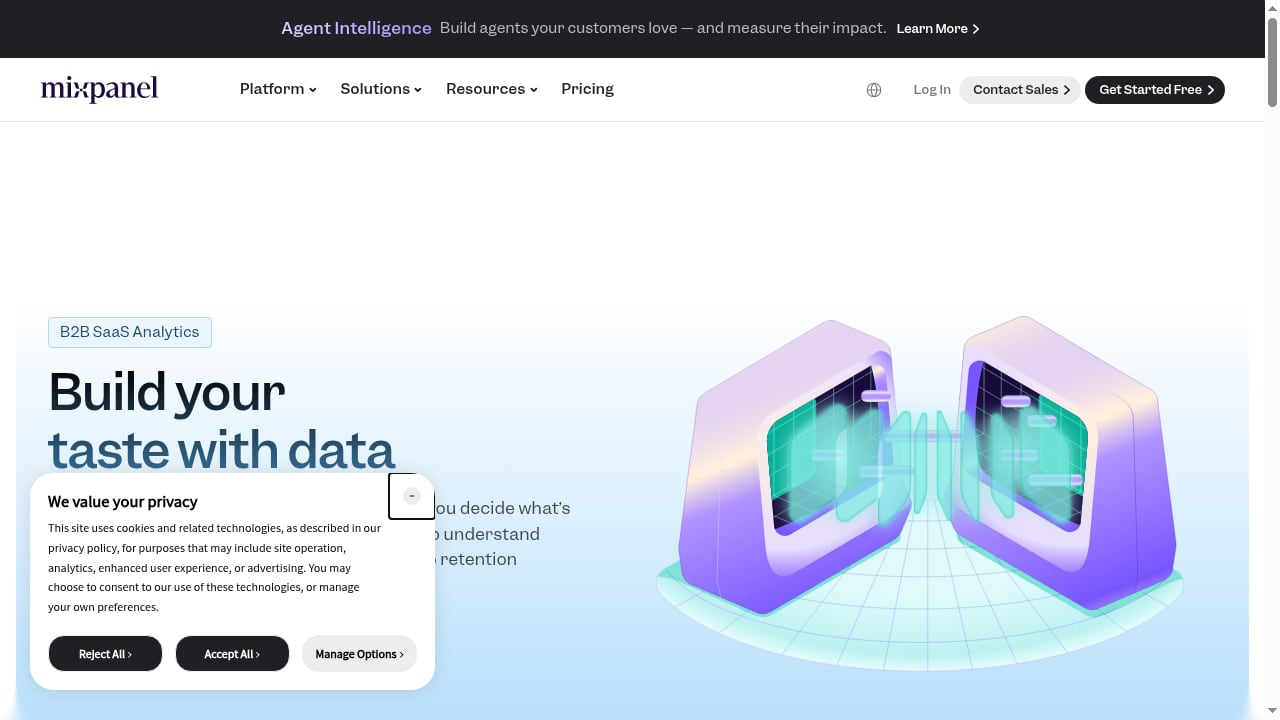
First viewport screenshot of Mixpanel: B2B SaaS Product & Digital Analytics Platform.
Mixpanel is a product analytics platform built around event-based tracking. You instrument user actions (signup completed, report exported, subscription upgraded), then analyze them through funnels, retention curves, cohorts, and path analysis.
In its current positioning, Mixpanel extends beyond classic analytics into a wider product intelligence stack:
- Analytics — funnels, retention, cohorts, flows, and impact analysis
- Session replay — watch real user sessions alongside behavioral data
- Experiments — run A/B tests and measure outcomes inside the same platform
- Feature flags — control rollouts and gate features without a separate tool
- AI-powered insights — contextual AI that surfaces patterns grounded in your data
- Integrations and MCP — connect warehouses, CDPs, and AI clients like Claude, ChatGPT, or Cursor via Mixpanel MCP
Mixpanel reports more than 29,000 customers worldwide, including Workday, Pinterest, and LG, and cites a commissioned Forrester study claiming 354% ROI and six months to payback for enterprises.
Who Mixpanel is built for
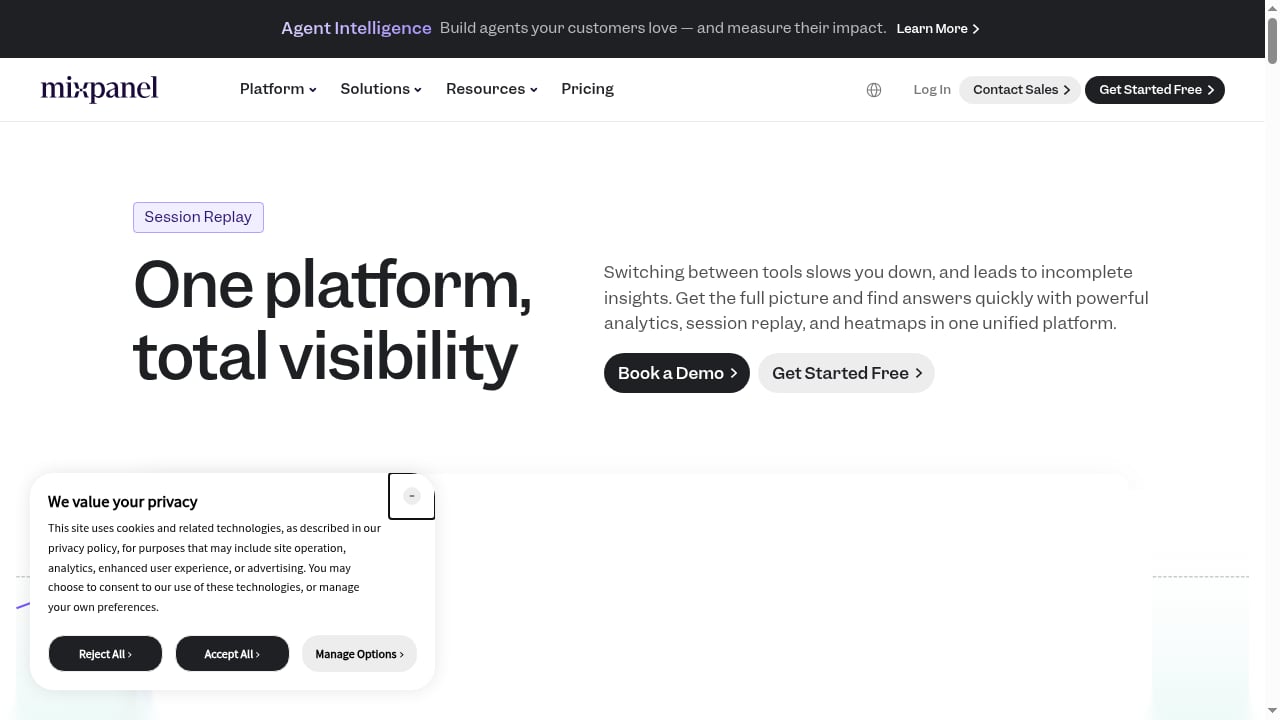
First viewport screenshot of Session Replay & Heatmaps | Mixpanel.
Mixpanel fits teams that already treat product behavior as a first-class input to decisions. In practice, that means:
Product managers at SaaS companies who need to answer questions like "where do users drop off in onboarding?" or "which cohort retains best after the new pricing page?" without filing a data request every time.
Growth and lifecycle teams running experiments on activation, conversion, and expansion — and who want experiment results sitting next to the behavioral data that explains them.
Data-mature engineering organizations that already have a warehouse, a clean event taxonomy, and the discipline to maintain it. Mixpanel rewards this; it does not remove the need for it.
Enterprises with governance requirements — security reviews, SSO, data residency, and support expectations that a lightweight analytics tool can't meet.
If you're a solo site owner who mainly wants pageviews and referrers, Mixpanel is heavier than you need. A simpler setup — for example, the options compared in this privacy-conscious website owner analytics guide — will get you further with less maintenance.
Core use cases where Mixpanel earns its place
First viewport screenshot of Customers | Mixpanel.
1. Funnel and retention diagnosis
The classic Mixpanel workflow: define a funnel, segment by acquisition channel or plan tier, and find the step where users stall. Retention charts then show whether the fix actually holds over weeks, not just days.
2. Turning insight into action with experiments and flags
Because experiments and feature flags live in the same platform, a team can spot a drop-off, ship a variant behind a flag, and read the result without stitching three tools together. That loop — observe, test, measure — is the strongest argument for the combined stack.
3. Session replay for "why" questions
Funnels tell you where users leave. Replay helps explain why: a confusing modal, a validation error, a slow step. Mixpanel's replay is useful context, though teams whose primary job is UX debugging often prefer tools built replay-first, as discussed in this comparison of digital experience intelligence platforms.
4. AI-assisted analysis
Mixpanel's contextual AI is designed to reduce manual query work — summarizing trends, answering questions in natural language, and surfacing anomalies. The important caveat: it's grounded in your tracked data, so if your event taxonomy is messy, the AI output will be too. The same applies to MCP connections that let tools like Claude or ChatGPT query Mixpanel directly.
Strengths
- Speed at scale. Mixpanel's proprietary database, Arb, is built for fast queries on large event volumes — a real differentiator when dashboards lag elsewhere.
- Breadth in one platform. Analytics, replay, experiments, and flags reduce tool sprawl and the reporting inconsistencies that come with it.
- Strong ecosystem. Warehouse, CDP, and DevOps integrations mean Mixpanel can sit alongside your existing data stack rather than replacing it.
- Enterprise readiness. Security, support, and infrastructure that scale from startup to large organization.
- Active community and learning resources. Mixpanel cites a community of 12,000+ analytics practitioners plus docs, tutorials, and free courses.
Limitations and trade-offs
- Event-based pricing can be hard to predict. Costs scale with tracked volume, so a tracking mistake or a traffic spike can move your bill. Budget-conscious teams often weigh this against tools with flatter pricing — see this website analytics pricing comparison for how the models differ.
- Setup requires discipline. Mixpanel is not a set-and-forget tool. You need a naming convention, a tracking plan, and someone accountable for it. Teams without that will accumulate event sprawl.
- Replay and UX research are supporting features, not the core. If session replay, heatmaps, or in-product surveys are your primary need, a specialist tool may serve you better.
- Not built for simple website metrics. If you want traffic, sources, and top pages with near-zero configuration, a lighter analytics tool is the better fit.
- AI features still need human judgment. They accelerate analysis; they don't replace knowing which question matters.
Pricing signals
Mixpanel does not publish a simple public price list for every tier. What's visible and reported:
- A free tier exists for smaller event volumes, which is enough to evaluate the product seriously.
- Paid plans are usage-based, scaling with monthly tracked events and feature access.
- Enterprise agreements are custom, with security, support, and infrastructure terms negotiated.
- Third-party procurement data cited in alternative roundups puts large-company annual contract values in the tens of thousands of dollars, well above entry-level plans.
Practical takeaway: model your cost against your actual event volume, not your user count. A small user base with heavy instrumentation can cost more than expected.
Setup: what to expect
The technical installation is straightforward — a JavaScript snippet for web, SDKs for mobile and server-side, and integrations for warehouses and CDPs.
The real work is organizational:
- Define a tracking plan before you instrument anything. Decide which events and properties matter and what they're called.
- Implement consistently across platforms so web and mobile data are comparable.
- Verify data quality early — a week of bad events is much cheaper to fix than a quarter.
- Build a small set of core dashboards for the questions you ask weekly, not every question you might ask.
- Connect your stack — warehouse, CDP, and AI clients via MCP if relevant — so data flows where your team already works.
Teams that skip steps 1 and 3 usually end up rebuilding their analytics from scratch within a year.
How to decide: Mixpanel vs. the alternatives
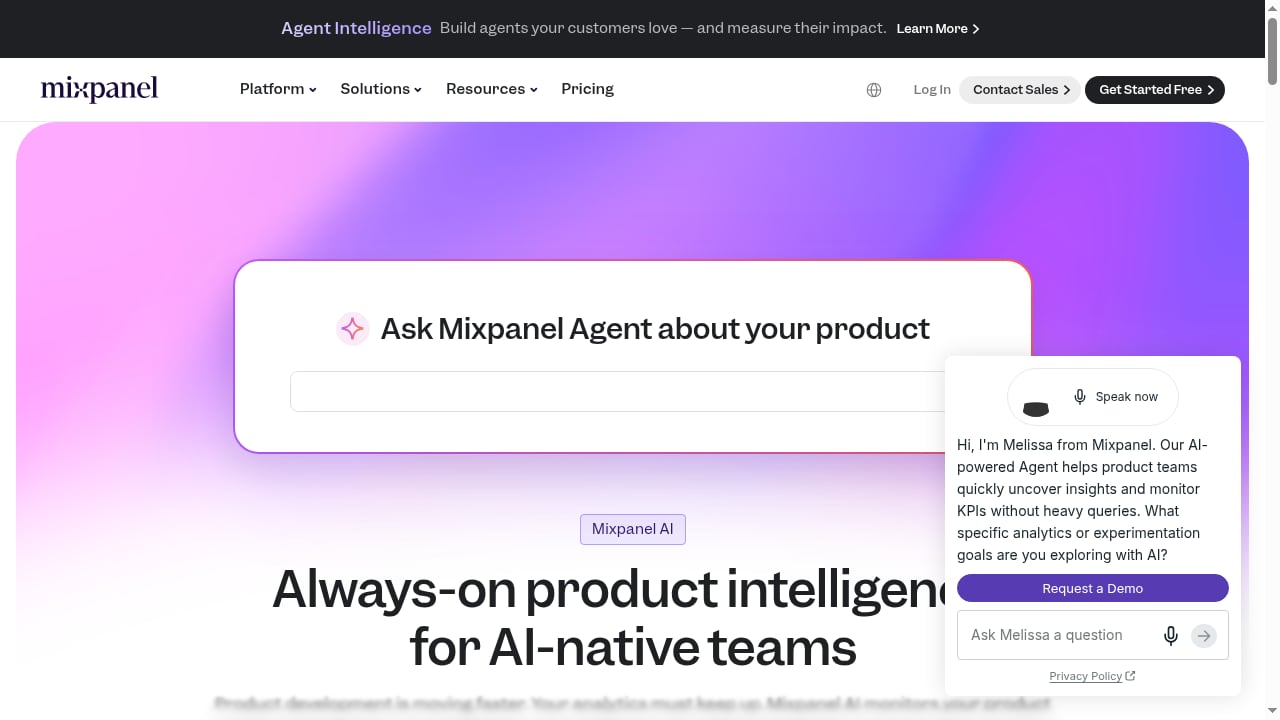
First viewport screenshot of Mixpanel AI: Always-on product intelligence.
| If your priority is... | Consider... |
|---|---|
| Deep behavioral analytics plus built-in experimentation | Mixpanel |
| Autocapture without manual event tracking | Heap or similar autocapture tools |
| Session replay and UX debugging first | Fullstory, Hotjar, or a replay-first platform |
| Open-source, self-hosted, developer-led analytics | PostHog |
| Privacy-first, GDPR-focused, full data ownership | Matomo or a privacy-focused analytics tool |
| Simple website traffic with minimal setup | A lightweight web analytics tool |
A useful test: write down the three questions your team asks most often about user behavior. If they're funnel, retention, or experiment questions, Mixpanel is a strong candidate. If they're traffic or content questions, it probably isn't.
Related reading
- Data4 vs Simple Analytics vs Woopra: Which Fits? - Compare Data4, Simple Analytics, and Woopra on privacy, journey analytics, setup, and pricing to pick the right website analytics tool.
- Data4 vs Burst Statistics: Which Analytics Tool Fits? - Compare Data4 and Burst Statistics on setup, privacy, reporting depth, and WordPress fit to decide which website analytics tool suits your site.
Sources and further reading
- Mixpanel Reviews 2026: Details, Pricing, & Features - G2 - Mixpanel's product intelligence turns data clarity into innovation. Trusted by more than 29,000 companies, including Workday, Pinterest, LG, ...
- I Investigated 7 Mixpanel Alternatives Worth Your Time - Compare 7 Mixpanel Alternatives based on their use cases, key features, and honest breakdowns of when they make sense and when they don’t.
- Product Intelligence Platform for the AI Era | Mixpanel - Mixpanel is the product intelligence platform for the AI era, combining analytics, session replay, experiments, feature flags, and AI-powered insights.
FAQ
Is Mixpanel good for small startups? Yes, if you're a product-led startup with a defined activation metric and someone who owns analytics. The free tier lets you validate that before paying. If you just need traffic numbers, it's overkill.
Does Mixpanel include session replay? Yes. Session replay is part of the platform, though it's positioned as supporting context for behavioral analysis rather than a dedicated UX research suite.
Can Mixpanel run A/B tests? Yes — experiments and feature flags are built in, which is one of the main reasons teams consolidate onto Mixpanel instead of pairing an analytics tool with a separate experimentation platform.
How does Mixpanel's AI work? Mixpanel applies AI across the platform to reduce manual analysis, grounded in your tracked data. It also offers MCP connections so AI clients like Claude, ChatGPT, or Cursor can query Mixpanel directly.
Is Mixpanel expensive? Entry and mid-tier pricing is usage-based and can be reasonable at low event volumes. Large enterprise contracts run much higher. The main risk is unpredictable cost if tracking volume grows unexpectedly.
What's the biggest reason teams leave Mixpanel? Common reasons cited in alternative roundups: wanting in-app engagement or surveys, needing stronger autocapture, consolidating tools for cost reasons, or preferring self-hosted and privacy-first options.
Conclusion
Mixpanel's pitch — product intelligence for the AI era — holds up better than most platform rebrands. The combination of fast analytics, session replay, experiments, and feature flags in one system is genuinely useful for product teams that want to move from insight to action without switching tools.
The trade-offs are equally clear: event-based pricing rewards discipline, setup demands a real tracking plan, and specialist tools beat Mixpanel at replay-first UX research or simple website metrics. If your team's core questions are about funnels, retention, and experiments — and you're prepared to maintain clean data — Mixpanel is one of the strongest options available in 2026. If your questions are simpler, choose a simpler tool and revisit later.