
Product Intelligence: What It Is and How to Use It in 2026
Product intelligence is the practice of automatically collecting, analyzing, and acting on data about how people use a product. The goal is simple: turn raw usage signals into decisions that make the next version measurably better. Whether you manage a SaaS app, an e-commerce site, or a physical product with embedded sensors, product intelligence closes the loop between what users do and what your team builds next.
This guide explains the core definition, how product intelligence differs from related disciplines, the metrics and tools involved, and a practical workflow you can start using today.
What Is Product Intelligence?

Product Intelligence: What It Is and How to Use It in 2026 - What Is Product Intelligence?.
Product intelligence is an automated system for gathering and analyzing information about a product's performance and feeding that insight back to the people who design and build it. The purpose is to accelerate innovation and increase customer satisfaction through faster, evidence-based iteration.
Three characteristics define the practice:
- Automated data collection. Usage, quality, and performance data is captured continuously, not through occasional manual audits.
- Conversion into insight. Raw events become patterns, segments, and answers to specific product questions.
- Actionable feedback. The insight flows directly to product managers, designers, and engineers who can act on it in the next release.
Product intelligence is not artificial intelligence, though AI can support parts of the process. It is also not limited to software. Electronics manufacturers have used automated test and performance data for years to refine hardware iterations.
Why Product Intelligence Matters Now
Product Intelligence: What It Is and How to Use It in 2026 - Why Product Intelligence Matters Now.
Customer expectations shift faster than most roadmaps. A feature that delighted users last quarter can feel outdated today. Product intelligence helps teams detect those shifts early and respond before churn becomes visible in revenue reports.
Research from Mixpanel's guide to product intelligence highlights the cost of ignoring this: a large share of customers will leave a brand after a single bad experience, and most companies now compete primarily on customer experience rather than price or features alone.
The practical benefits include:
- Faster iteration. Teams stop guessing which change will move a metric and start testing with a baseline.
- Better prioritization. Usage data shows which features are actually used, not just requested.
- Lower churn. Early warning signals, such as declining engagement in a key workflow, appear before cancellation.
- Stronger positioning. Understanding how users get value from your product improves marketing and sales messaging.
Product Intelligence vs Product Analytics vs Business Intelligence
Product Intelligence: What It Is and How to Use It in 2026 - Product Intelligence vs Product Analytics vs Business Intelligence.
These terms overlap, but they answer different questions.
| Discipline | Primary question | Focus |
|---|---|---|
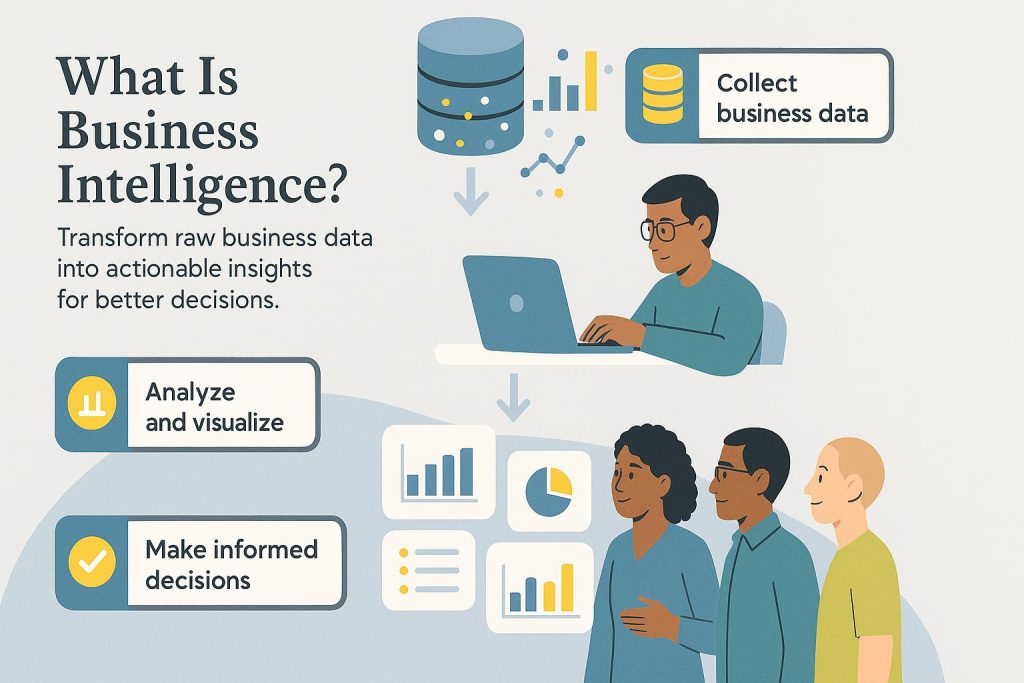
| Business intelligence | How healthy is the business? | Revenue, operations, market trends, departmental performance |
| Product analytics | What is happening in the product? | Events, funnels, retention, conversion, session data |
| Product intelligence | What should we do next, and why? | Turning analytics into decisions, hypotheses, and roadmap actions |
Product analytics is the measurement layer. Product intelligence is the decision layer built on top of it. A team can have excellent analytics dashboards and still lack product intelligence if nobody translates the numbers into shipped improvements.
Contentsquare's guide frames the distinction well: analytics tells you it is raining; intelligence tells you whether to stock umbrellas or sunscreen for next quarter.
What Product Intelligence Measures
Product Intelligence: What It Is and How to Use It in 2026 - What Product Intelligence Measures.
A useful product intelligence program tracks more than page views. The most valuable signals fall into four categories.
1. Engagement and Adoption
- How often do users return?
- Which features do they discover and adopt?
- Where do they stall or abandon a workflow?
2. Conversion and Retention
- What percentage of trial users reach an activation moment?
- Which behaviors predict long-term retention?
- Where do users drop off in the funnel?
3. Quality and Performance
- How fast do key flows load?
- Where do errors or crashes occur?
- Which devices, browsers, or regions underperform?
4. Sentiment and Feedback
- What do reviews, surveys, and support tickets reveal?
- How does sentiment shift after a release?
- Which complaints repeat across user segments?
For website-centric products, tools like Data4 can track traffic sources, engagement metrics, and conversion paths in real time, giving product teams a clear view of how visitors behave before and after a change ships.
A Practical Product Intelligence Workflow
Product intelligence works best as a repeatable loop rather than a one-off project. Here is a five-step cycle you can implement with modest tooling.
Step 1: Define the Question
Start with a specific, falsifiable question. "How do users behave?" is too vague. "Do users who complete onboarding within one day retain better at week four?" is testable.
Step 2: Instrument the Right Events
Track the events that map to your question. For a SaaS product, that might include signup, first project creation, invitation sent, and second-week login. For a content site, it might include scroll depth, time on page, and return visits.
Step 3: Segment and Analyze
Break users into meaningful cohorts: acquisition channel, plan tier, geography, device type, or behavior pattern. Compare cohorts to find what separates retained users from churned ones.
Step 4: Form a Hypothesis and Test
Turn the finding into a change. If users who invite a teammate retain better, test making the invite action more prominent. Run the test, measure the result against your baseline, and document the outcome.
Step 5: Feed Results Back
Share what you learned with product, design, engineering, and marketing. Update the roadmap based on evidence, not opinion. Then start the next question.
Choosing Tools for Product Intelligence
Your tooling depends on your product type and team size.
Website and marketing analytics platforms work well for content sites, e-commerce stores, and marketing-led products. They track traffic sources, page performance, and conversion funnels. Data4 positions itself as a simple, globally accessible alternative to Google Analytics, with real-time tracking and customizable dashboards that make this data approachable for non-analysts.
Product analytics platforms add event-based tracking, cohort analysis, and retention curves for software products. They are more powerful but also more complex to configure.
Session replay and heatmap tools reveal the "why" behind quantitative patterns. If you want to understand how users actually navigate a page, see our Microsoft Clarity review for an evidence-based look at what free session recording can and cannot do.
Voice-of-customer tools capture surveys, interviews, and review sentiment. They complement behavioral data with direct user feedback.
Most teams combine at least two categories: one for quantitative behavior and one for qualitative context.
Product Intelligence for Different Teams
Product intelligence is not just for product managers. Each team extracts different value from the same data.
- Product managers use it to prioritize features, validate assumptions, and communicate impact to stakeholders.
- Designers and engineers use it to find friction points, confirm that shipped changes worked, and decide what to improve next.
- Marketers use it to understand which channels bring high-quality users and which product benefits resonate most in campaigns.
- Customer success teams use it to spot accounts at risk of churn before the customer complains.
Common Mistakes to Avoid
Even well-intentioned teams undermine their product intelligence efforts with a few predictable errors.
Tracking everything without a question. More events do not equal more insight. Instrument what you need to answer current questions, and add events as new questions arise.
Confusing dashboards with decisions. A beautiful dashboard that nobody acts on is analytics theater. Product intelligence requires a process for turning charts into changes.
Ignoring qualitative data. Behavioral data shows what happened. Surveys, interviews, and support tickets explain why. Use both.
Skipping privacy and compliance. If you collect user data, you need a lawful basis and transparent disclosure. See our guide on GDPR-compliant analytics to avoid building your intelligence program on a shaky legal foundation.
Related reading
- Data4 vs GoatCounter: Which Analytics Tool Fits You? - Compare Data4 and GoatCounter for website analytics. See how Data4's simple, globally accessible tracking stacks up against GoatCounter's privacy-first open source approach.
Sources and further reading
- Product intelligence - From Wikipedia, the free encyclopedia
Frequently Asked Questions
What is the difference between product intelligence and product analytics?
Product analytics is the measurement layer: tools and methods for tracking events, funnels, retention, and conversion. Product intelligence is the decision layer: the process of turning that measurement into hypotheses, roadmap changes, and shipped improvements.
Can small teams practice product intelligence?
Yes. Start with one question, a lightweight analytics tool, and a simple feedback loop. You do not need an enterprise platform or a dedicated data team to begin making evidence-based product decisions.
Is product intelligence only for software products?
No. The concept originated in manufacturing, where automated test and performance data feeds back into the next hardware iteration. Any product that generates usage or performance data can support a product intelligence loop.
What metrics matter most for product intelligence?
The most useful metrics depend on your product and question. Common starting points include activation rate, feature adoption, retention by cohort, conversion rate, and time-to-value. Quality metrics such as error rate and load time also matter.
How does product intelligence relate to customer experience?
Product intelligence is a major input to customer experience. By understanding where users struggle, succeed, and disengage, teams can remove friction and design more rewarding experiences, which directly improves satisfaction and loyalty.
Conclusion
Product intelligence turns your product into its own best source of feedback. By automating data collection, asking sharp questions, and building a repeatable loop of analysis and action, teams can iterate faster, reduce churn, and stay ahead of competitors who still rely on intuition alone.
The tools matter less than the discipline. Start with one question, instrument the events that answer it, and commit to acting on what you learn. That loop, repeated consistently, is what separates intelligent products from merely monitored ones.
For teams evaluating analytics platforms, our comparison of Data4, Amplitude, and PostHog can help you match tooling to your product intelligence maturity and team size.