
Swetrix Review 2026: Privacy-First Analytics Tested
Swetrix is an open-source, cookieless web analytics platform that bundles traffic reporting, funnels, error monitoring, and (on cloud plans) session replay into one dashboard. It targets teams that want Google Analytics-style answers without cookies, consent banners, or personal data collection. This review weighs its real strengths, its rough edges, and the situations where it is the wrong tool.
What Swetrix is and who it is for
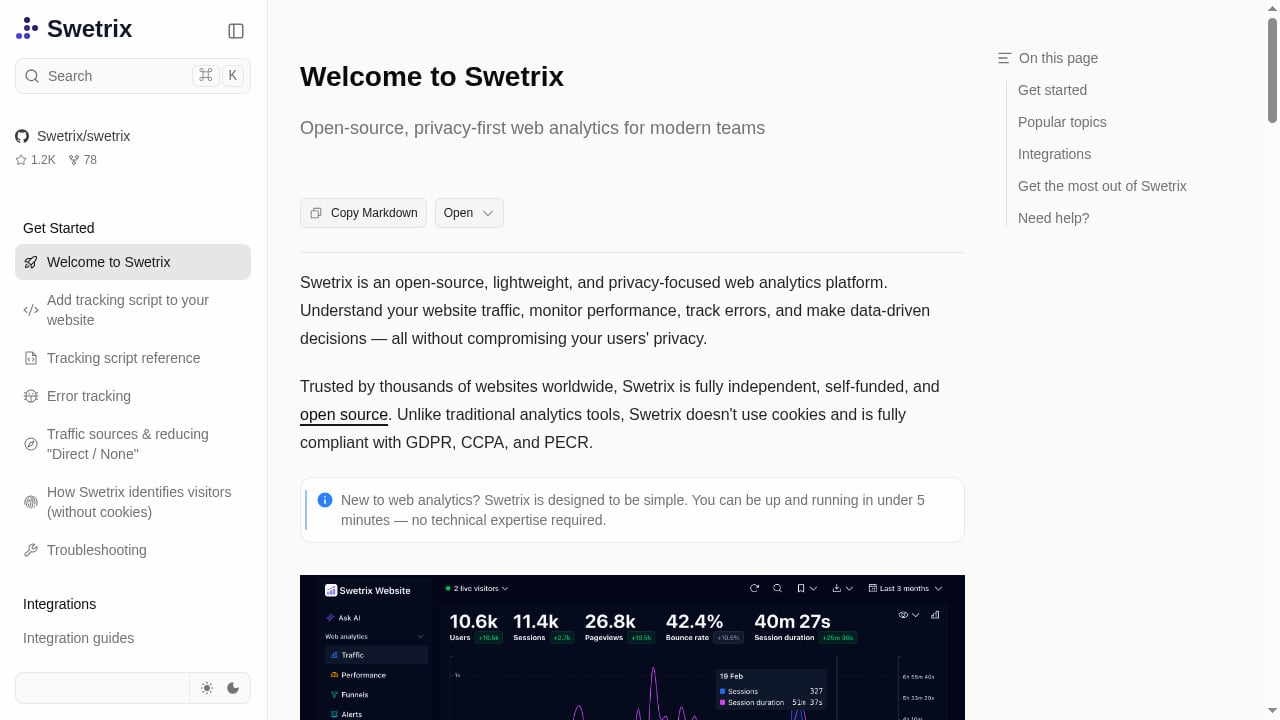
First viewport screenshot of swetrix.com.
At its core, Swetrix is a privacy-first analytics tool. It records pageviews, visitors, traffic sources, campaigns, custom events, and conversion goals without setting cookies or writing to localStorage. Instead, it derives a short-lived anonymous identifier server-side using a rotating salt — the session salt rotates every 24 hours and the profile salt monthly. That design is why it can claim GDPR compliance out of the box and why most sites can skip a cookie banner.
The product has grown beyond simple traffic counting. The current feature set includes:
- Real-time dashboards for visitors, pageviews, referrers, and campaigns
- Custom events, conversion goals, and multi-step funnels
- Built-in JavaScript error tracking alongside traffic data
- Session and user profile analysis (with explicit
identify()calls for logged-in users) - Advanced bot detection and ad-blocker bypass
- Annotations for marking releases or campaigns
- Google Search Console integration for query and click data
- Session replays, feature flags, and A/B/n testing on higher tiers
- Framework and platform integrations including Angular, ASP.NET, Astro, BigCommerce, Bubble.io, and Carrd
That combination — analytics plus error monitoring in one self-hostable app — is the feature that separates Swetrix from lighter open-source tools like Plausible or Umami.
Ideal users
Swetrix fits best when you answer yes to most of these:
- You want privacy-first analytics without operating a separate consent management stack.
- You are a developer or small product team comfortable with a slightly denser interface.
- You want to see a conversion drop and a JavaScript error spike on the same screen.
- You need funnels and basic experimentation but not a full data warehouse.
- You may want to self-host for data sovereignty, or you want a managed EU-hosted option.
Poor fits
- Teams that want the simplest possible dashboard and nothing else.
- Organizations that need a broad product-analytics platform with SQL, a CDP, surveys, and warehouse sync.
- Anyone who wants zero infrastructure decisions and zero vendor-continuity risk.
Strengths: where Swetrix earns its place
First viewport screenshot of swetrix.com.
1. Privacy architecture is the default, not a setting
Cookieless tracking is not an add-on here. Because no cookies or persistent local storage are used, the common trigger for a consent banner disappears. For marketing sites, content sites, and EU-facing businesses, that removes friction from the first visit and simplifies compliance reviews. The trade-off is real, though: anonymous server-side identifiers are less precise for audiences behind shared NATs, and cross-device tracking is not automatic. If you need accurate logged-in user tracking, you must pass an explicit opaque profileId — and then you own the governance questions that come with it.
2. Analytics and error monitoring in one place
The most useful differentiator is seeing a funnel step decline next to a spike in JavaScript exceptions. Most small teams only connect those dots by accident, usually after a support ticket. Having both in one self-hostable application is a genuine convenience for teams without a Sentry budget or the appetite for another vendor.
3. A focused feature set that covers the practical middle
Funnels, goals, campaign attribution, revenue tracking, Search Console data, annotations, and A/B testing cover a lot of day-to-day product and marketing questions. You are not assembling three tools to answer "where did this traffic come from, did it convert, and did anything break?"
4. Deployment flexibility
Swetrix Cloud is a script tag away. Self-hosting is Docker-based and documented, with a stack that includes a frontend, API layer, Nginx proxy, Redis, and ClickHouse. That matters for agencies and B2B software providers with data residency requirements or embedded analytics use cases.
5. Transparent, modest pricing
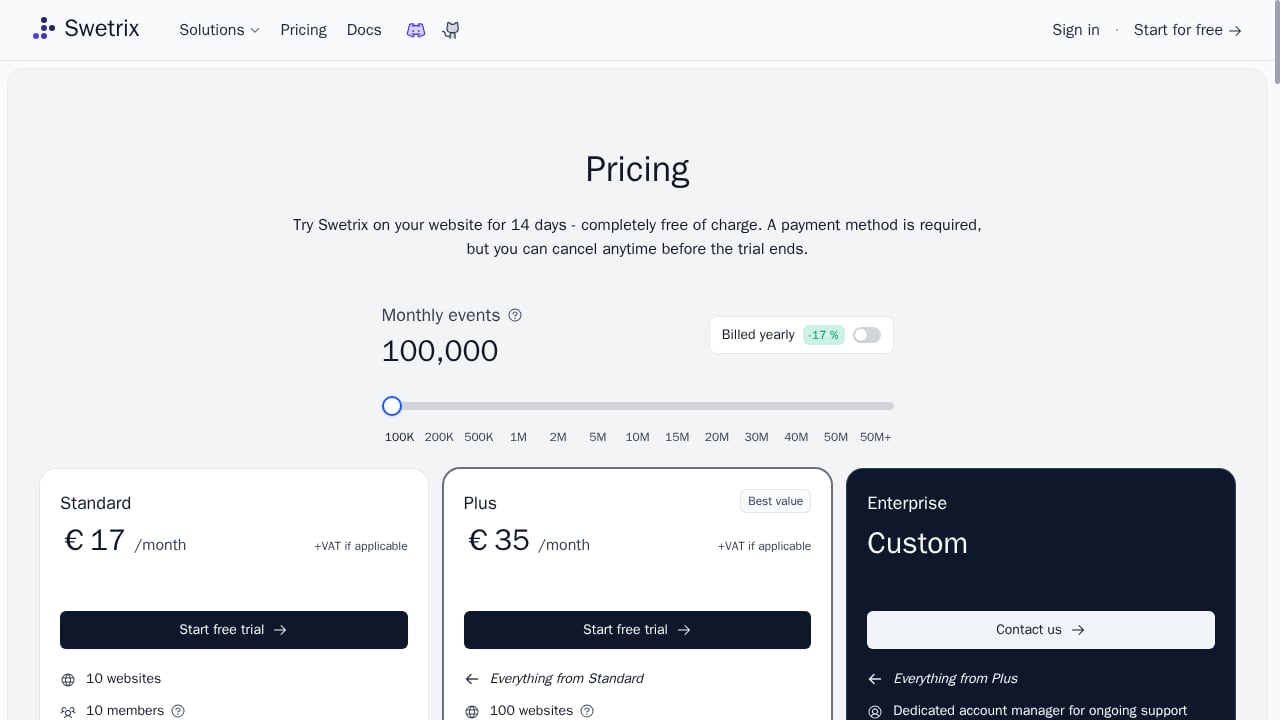
Published tiers start at $19/month for 10 websites, 10 members, and 100K events, rising to $39/month for 100 websites, 25 members, session replays, feature flags, A/B testing, higher API limits, and priority support. Enterprise adds on-premise installation, SSO, SLAs, and dedicated support. A 14-day free trial lowers the evaluation cost.
Limitations: what the polish does not hide
Swetrix is a younger, smaller project than the market leaders, and that shows in specific ways.
- Interface density. Reports are capable but not always legible. Some screens pack more than a first-time user can parse quickly.
- Documentation depth. Docs assume more prior knowledge than they should, particularly around self-hosting and migrations.
- Self-hosting overhead. The ClickHouse and Postgres stack is more infrastructure than lighter alternatives. Updates can require manual database migrations, and you own uptime, backups, and disaster recovery.
- Feature parity across deployments. Session replays are a cloud feature; self-hosted instances do not get them. Feature flags and experiments do run self-hosted.
- Continuity risk. With a smaller user base than Matomo or Umami, the long-term vendor risk is higher than with entrenched tools. Open source mitigates this somewhat, but only if you are prepared to maintain a fork.
- Not a product-analytics platform. There is no data warehouse, no CDP-style pipeline, no SQL workbench, and no survey tool. If you need those, you will source them elsewhere.
Pricing signals and what they mean
First viewport screenshot of swetrix.com.
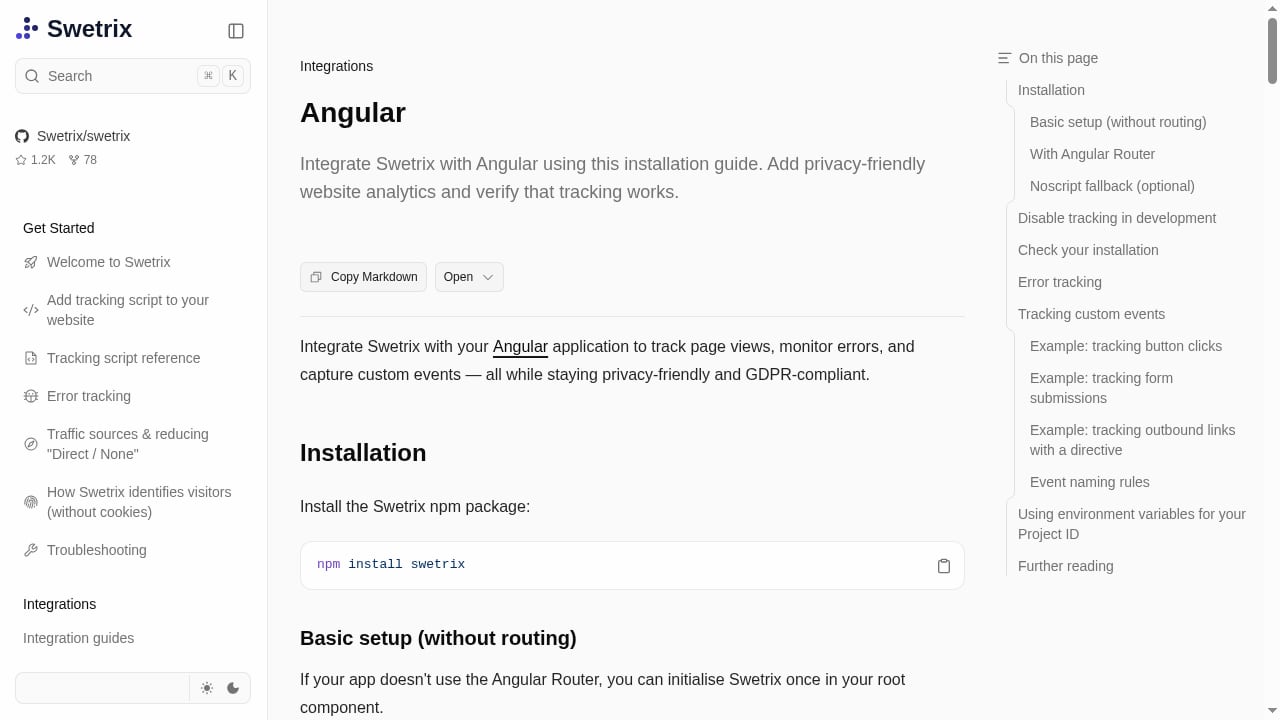
Swetrix prices by monthly event volume rather than by pageviews, which aligns cost with tracking activity rather than traffic alone. The jump from Standard to Plus is where most of the differentiated value sits: session replays, feature flags, A/B testing, and priority support. If you are evaluating Swetrix primarily for experimentation or replay, budget for Plus from the start rather than treating it as an upgrade later.
Self-hosting is free and open source, but the real cost is engineering time. A rough rule: if your team already runs Docker workloads and a database, self-hosting is plausible; if not, the hosted tiers are usually cheaper than the hours you would spend on migrations and monitoring.
For a broader view of how cookieless tools compare on price and depth, see our ranking of the top 10 privacy-friendly web analytics software.
Setup: cloud versus self-hosted
Cloud: add the script tag, verify the domain, and data starts flowing in real time. Search Console integration requires an OAuth connection and typically shows a one-to-two-day processing delay. Session replay and experiments are available according to plan.
Self-hosted: expect a Docker Compose deployment against ClickHouse and Postgres, plus Redis and an Nginx proxy. Plan for backups, upgrade windows, and migration testing. The payoff is full data ownership and the ability to run feature flags and experiments on your own infrastructure.
Tracking logged-in users: use the identify() method with an opaque internal ID — never an email address or plain-text phone number. Only attach traits your privacy policy permits. This is the point where a cookieless tool starts to look more like a traditional analytics platform, and your governance should reflect that.
How Swetrix compares to alternatives
First viewport screenshot of swetrix.com.
| Need | Swetrix | Lighter open-source tools (e.g., Plausible, Umami) | Broad platforms (e.g., PostHog) |
|---|---|---|---|
| Cookieless by default | Yes | Yes | Configurable |
| Error tracking included | Yes | No | Yes |
| Funnels and goals | Yes | Limited | Yes |
| Session replay | Cloud only | Rarely | Yes |
| Self-hosting complexity | Moderate (ClickHouse, Postgres) | Lower | High |
| Product-analytics depth | Focused | Basic | Extensive |
Against PostHog specifically, Swetrix is the lighter, more privacy-opinionated option. You give up the data warehouse, autocapture depth, and broad developer platform, and you gain a simpler workflow and clearer cookieless positioning. Swetrix's own comparison makes the same trade-off explicit.
If you are weighing other privacy-friendly tools, our Clicky review covers a real-time alternative with different privacy defaults, and our Visitors review looks at another GA4 replacement with streaming and Core Web Vitals.
Decision criteria: should you choose Swetrix?
Choose Swetrix if:
- Privacy is a product requirement, not a nice-to-have, and you want cookieless tracking without a consent banner.
- You want analytics and error monitoring together and would otherwise run two tools.
- You need funnels and basic experimentation but not a full product-analytics platform.
- You value open source and self-hosting optionality, and you have the engineering capacity to use it.
- Your budget is modest and the $19–$39/month range fits.
Look elsewhere if:
- You want the most legible dashboard for the money — Plausible is simpler and more polished.
- You need deep product analytics — PostHog, Heap, or Contentsquare cover more ground; our Heap by Contentsquare review is a useful starting point.
- You cannot tolerate vendor-continuity risk — a larger, more established vendor is safer.
- You want zero infrastructure work — hosted-only tools remove that burden entirely.
Related reading
- Woopra Review 2026: Customer Journey & Product Analytics Tested - Evidence-based Woopra review covering customer journey analytics, product usage tracking, ideal users, pricing signals, setup, strengths, and limitations.
- Statcounter Review 2026: Free Web Analytics Tested - Evidence-based Statcounter review: real-time hit counter, invisible tracking, pricing signals, setup, strengths, limitations, and who should use it in 2026.
Sources and further reading
- Swetrix: Cookieless and open source Google Analytics alternative | Product Hunt - Easy-to-use and GDPR-compliant web analytics without invading the privacy of your visitors.
Understand your website traffic, speed, user sessions, sales, funnels and errors in a single, intuitive dashboard.
FAQ
Is Swetrix really cookieless?
Yes. The default tracker sets no cookies and does not write to localStorage. It uses a short-lived anonymous server-side identifier with a rotating salt. If you call identify() for logged-in users, you are introducing explicit identifiers and should review your privacy policy accordingly.
Is Swetrix GDPR compliant?
Its cookieless, no-personal-data design is built for GDPR compliance out of the box, which is why many sites can skip a cookie banner. Compliance is still your responsibility: if you send explicit identifiers or traits, you need a lawful basis and appropriate disclosures.
Does Swetrix include session replay?
Yes, but only on Swetrix Cloud and on plans that include it (Plus and above). Self-hosted instances do not include session replays, though they do support feature flags and experiments.
How much does Swetrix cost?
Standard is $19/month for 10 websites, 10 members, and 100K events. Plus is $39/month for 100 websites, 25 members, session replays, feature flags, A/B testing, higher API limits, and priority support. Enterprise plans add on-premise installation, SSO, SLAs, and dedicated support. A 14-day free trial is available.
Can I self-host Swetrix?
Yes. It is open source and deploys via Docker against ClickHouse and Postgres, with Redis and an Nginx proxy. Expect manual database migrations on upgrades and full responsibility for uptime, backups, and disaster recovery.
How does Swetrix compare to PostHog?
Swetrix is a focused, privacy-first analytics tool with built-in error tracking and SEO reporting. PostHog is a broad developer platform with a data warehouse, CDP-style pipelines, surveys, and deeper product analytics. Choose Swetrix for simplicity and privacy defaults; choose PostHog for depth and ecosystem.
Conclusion
Swetrix is the most ambitious of the smaller open-source analytics projects, and the ambition is mostly justified. Bundling cookieless traffic analytics, funnels, and error monitoring in one self-hostable application solves a real problem for small teams. The costs are a denser interface, thinner documentation, more self-hosting infrastructure, and the continuity risk that comes with a younger project.
If you want privacy-first analytics with error tracking and you are comfortable with a few rough edges, Swetrix is a strong candidate — start with the 14-day trial, test the funnel and error views on real traffic, and decide whether the Plus tier's replay and experimentation features justify the higher price. If you want maximum polish or maximum depth, the alternatives are better documented and better established.
For further reading, Swetrix publishes its own comparison with PostHog, and independent scoring is available from GTM Analytics.