
Woopra Review 2026: Customer Journey & Product Analytics Tested
Customer journey analytics tools promise a single timeline from first marketing touch to product usage. Woopra is one of the few platforms that has built its identity around that promise rather than bolting journey views onto a traditional web analytics core. This review examines what Woopra actually does well, where it falls short, and which teams should consider it in 2026.
What Woopra Is and What It Tracks
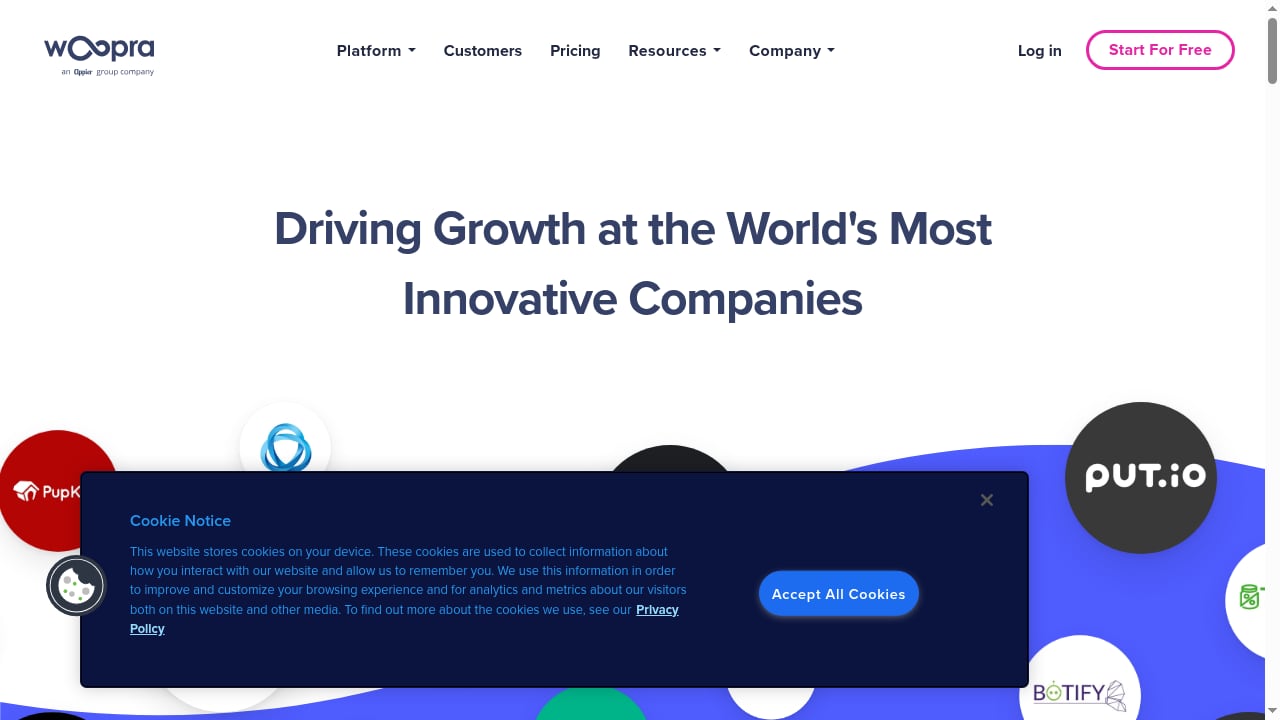
First viewport screenshot of www.woopra.com.
Woopra is a customer journey and product analytics platform. It collects event data from websites, mobile apps, and backend systems, resolves identities across sessions, and presents a unified timeline per customer. The core object is the individual profile, not the page view. You can see a person's marketing touchpoints, product actions, and account-level attributes in one place, then segment and trigger actions based on that combined view.
The platform sits in the customer journey analytics and orchestration category that Gartner defines as solutions tracking how customers interact across multiple channels over time, combining cross-channel interaction data with transactional and profile data on a time axis. Woopra's implementation leans toward product-led and SaaS teams rather than large contact-center operations.
Key capabilities include:
- Identity resolution across anonymous and known users, stitching sessions into a persistent profile.
- Journey timelines showing ordered events per person, not just aggregate funnels.
- Segmentation and cohorts built on any event or attribute.
- Real-time triggers for actions like emails, webhooks, or in-app messages when a user meets a condition.
- Product analytics such as feature adoption, retention, and funnel drop-off.
- Integrations with CRM, marketing automation, and data warehouses, including a HubSpot marketplace listing that emphasizes measuring campaign impact across touchpoints.
Who Woopra Is For
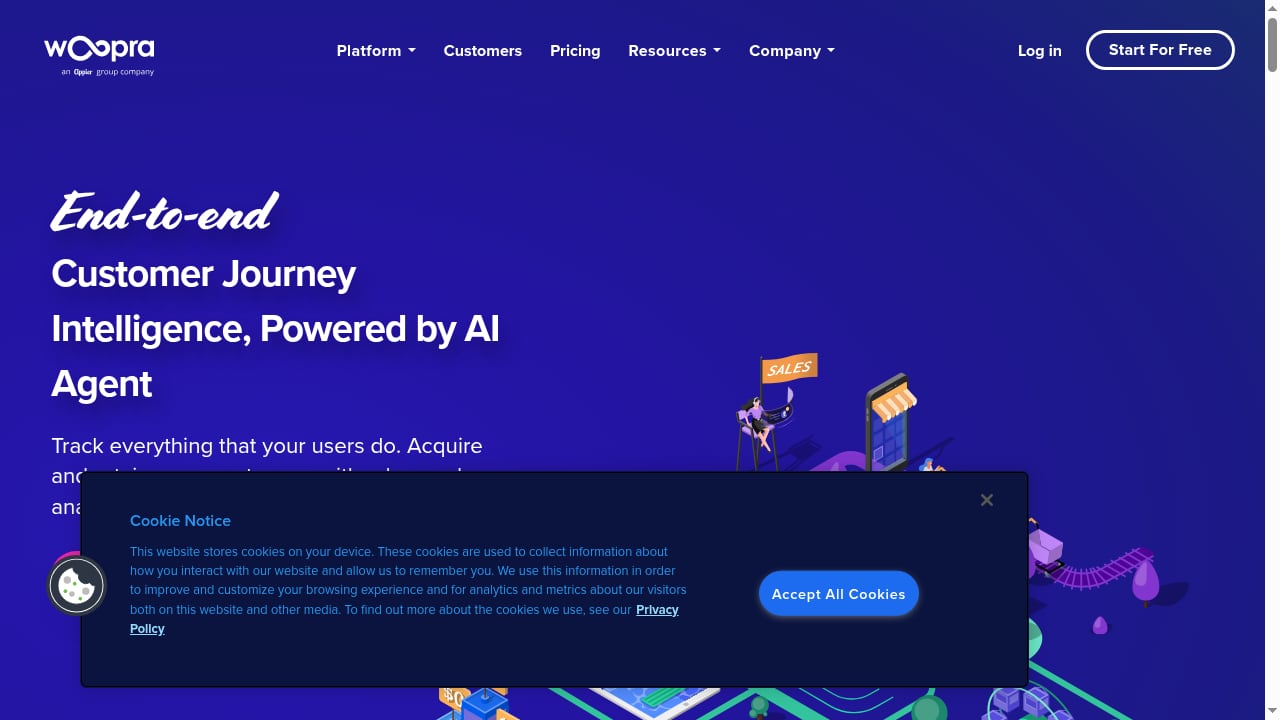
First viewport screenshot of www.woopra.com.
Woopra fits teams that need to connect marketing activity to product behavior without assembling a separate CDP and analytics stack. Typical ideal users include:
- Product-led SaaS teams that want to see how acquisition source relates to feature adoption and retention.
- Growth and lifecycle marketers who need behavioral segments for onboarding, activation, and win-back campaigns.
- Customer success and support leads who want account-level context before a call or ticket.
- Small to mid-size analytics teams without dedicated data engineering resources to build a custom pipeline.
It is less suited to organizations that need deep offline journey stitching, contact-center analytics, or enterprise-scale orchestration across dozens of channels. Those needs point toward platforms like Adobe Customer Journey Analytics or full CJA/O suites reviewed in marketplaces such as Gartner Peer Insights.
Strengths: Where Woopra Delivers
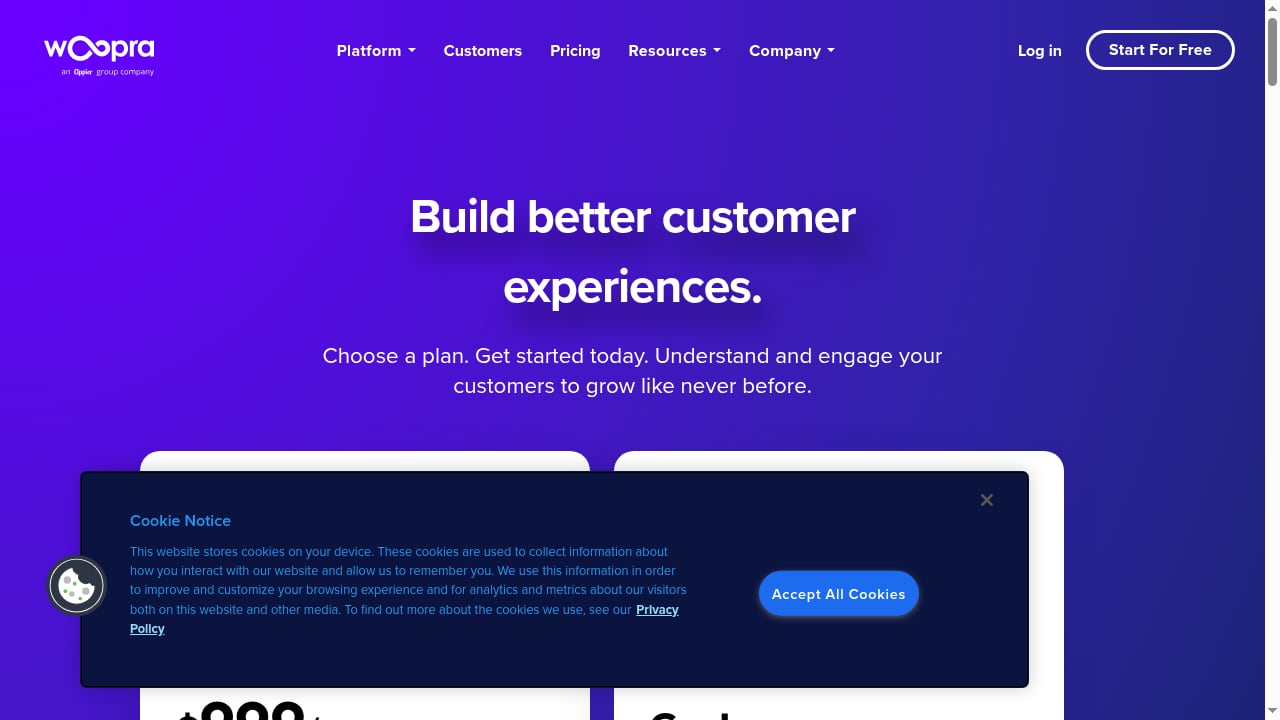
First viewport screenshot of www.woopra.com.
1. Journey-first data model
Most analytics tools start with events and aggregate upward. Woopra starts with the person and builds a timeline. For questions like "what did this account do before upgrading?" or "which marketing touch preceded this feature adoption?", the model is a natural fit. You spend less time reconstructing sequences in SQL and more time reading them directly.
2. Real-time behavioral triggers
Woopra's action layer lets you respond to behavior as it happens. A user who visits pricing three times in a week can trigger a sales alert; a user who stalls in onboarding can receive a nudge. This blends analytics with lightweight orchestration, which is valuable for teams that cannot justify a separate engagement platform.
3. Accessible setup for non-engineers
Event tracking and segmentation are configurable through the interface, and the integration library covers common SaaS tools. Teams without a dedicated analytics engineer can get to a first useful dashboard faster than with warehouse-native tools that require modeling work upfront.
4. Marketing-to-product continuity
Because Woopra ingests campaign and CRM data alongside product events, it answers a question many product analytics tools ignore: which acquisition channels produce users who actually stick. The HubSpot integration listing frames this as measuring campaign impact across every touchpoint, which is a fair summary of the value proposition.
Limitations and Trade-offs
First viewport screenshot of www.woopra.com.
1. Not a full CDP or orchestration suite
Woopra handles identity resolution and triggers, but it is not a complete customer data platform. Teams needing complex audience syncs, reverse ETL at scale, or multi-channel journey orchestration will likely pair it with other tools. Gartner's CJA/O category includes platforms with broader orchestration scope; Woopra is narrower by design.
2. Behavioral data still cannot explain "why"
Like all journey analytics tools, Woopra shows where and when users drop off, not why. A 2026 ranking by Perspective AI makes this point sharply: behavioral telemetry records actions, not motives. Woopra users should pair journey data with surveys, interviews, or session replay to close that gap.
3. Pricing scales with events and features
Woopra's pricing is not fully transparent on the public site; plans are typically quoted based on event volume and feature needs. Smaller teams can start on a free or entry tier, but costs rise as tracking volume and seats increase. Buyers should model event volume carefully, especially if they plan to track backend events at high frequency.
4. Learning curve for advanced segmentation
Basic dashboards are approachable, but advanced segmentation and trigger logic require understanding of event schemas and identity rules. Teams without an analyst may underuse the platform's most valuable features.
Pricing Signals
Woopra offers a free plan suitable for small projects and evaluation. Paid tiers are generally structured around monthly tracked users or events, with additional features such as longer data retention, more integrations, and advanced permissions. Because exact pricing is quote-based, decision-makers should request a trial with realistic event volume and confirm overage costs. Compared with warehouse-native tools, Woopra's total cost may be lower for teams without engineering time, but higher than lightweight web analytics tools for simple tracking needs.
Setup and Time to Value
A typical Woopra implementation involves:
- Installing the tracking script on web properties and SDKs in mobile apps.
- Defining key events such as signup, activation, feature use, and purchase.
- Configuring identity resolution so anonymous and logged-in sessions merge correctly.
- Connecting integrations for CRM, email, and support data.
- Building segments and triggers for the journeys that matter most.
Most teams can send first events within a day. A useful journey dashboard typically takes one to three weeks depending on event taxonomy readiness. The biggest setup risk is inconsistent event naming, which undermines segmentation later.
Woopra vs Alternatives: Decision Criteria
| Criterion | Woopra | Product analytics (e.g., Amplitude, Mixpanel) | Enterprise CJA/O (e.g., Adobe) |
|---|---|---|---|
| Journey timeline per user | Strong | Moderate | Strong |
| Marketing-to-product stitching | Strong | Moderate | Strong |
| Real-time triggers | Strong | Moderate | Varies |
| Offline/contact-center data | Limited | Limited | Strong |
| Setup without engineers | Moderate | Moderate | Low |
| Pricing transparency | Low | Moderate | Low |
Choose Woopra when the priority is a readable per-customer journey, lightweight orchestration, and fast setup for a product-led team. Choose a dedicated product analytics tool if you need deep experimentation and cohort analysis without marketing data. Choose an enterprise CJA/O platform if you need omnichannel identity across offline and digital channels at scale.
For broader context on privacy-friendly and real-time alternatives, see our Top 10 Privacy-Friendly Web Analytics Software 2026 and the Visitors review for a lighter-weight journey view.
Related reading
- Statcounter Review 2026: Free Web Analytics Tested - Evidence-based Statcounter review: real-time hit counter, invisible tracking, pricing signals, setup, strengths, limitations, and who should use it in 2026.
- Clicky Review 2026: Privacy-Friendly Real-Time Analytics - Evidence-based Clicky review: real-time visitor logs, heatmaps, uptime monitoring, privacy defaults, pricing signals, setup, limitations, and ideal users in 2026.
- Contentsquare AI-First Experience Platform Review 2026 - Evidence-based Contentsquare review: AI-first experience platform covering Sense AI, agent analytics, pricing signals, setup, strengths, limitations, and ideal users.
Sources and further reading
- Woopra - Marketing Analytics App for HubSpot - Aug 9, 2025 ... Measure the impact of HubSpot campaigns across every touchpoint in the customer journey. See how marketing activities impact product engagement, ...
FAQ
Is Woopra a CDP?
No. Woopra resolves identities and triggers actions, but it is not a full customer data platform. It is best described as customer journey and product analytics with lightweight orchestration.
Does Woopra have a free plan?
Yes, Woopra offers a free plan for small projects and evaluation. Paid plans scale with tracked volume and features.
Can Woopra track mobile app behavior?
Yes, through SDKs. Identity resolution across web and app works when the same user identifier is passed consistently.
How does Woopra compare to Amplitude?
Amplitude is stronger for pure product analytics and experimentation. Woopra is stronger for connecting marketing touchpoints to product behavior in a single timeline.
What is the biggest limitation of Woopra?
Like all behavioral analytics tools, it shows what happened, not why. Pair it with qualitative research to understand drop-off reasons.
Conclusion
Woopra earns its place as a customer journey and product analytics tool for teams that want to see the whole person, not just page views or events. Its journey-first model, real-time triggers, and marketing-to-product continuity are genuine strengths. The trade-offs are narrower orchestration scope, quote-based pricing, and the inherent limits of behavioral data. If you are a product-led SaaS team that needs a readable journey timeline without building a warehouse pipeline, Woopra is worth a serious trial. If you need enterprise omnichannel stitching or deep experimentation, compare it against dedicated alternatives before committing.