
Top 10 Behavioral Analytics Platforms for 2026: Ranked
Behavioral analytics platforms answer a question that traffic dashboards cannot: what did individual users actually do, and why did they convert or leave? This 2026 ranking evaluates ten platforms that genuinely belong to the behavioral analytics category — tools that track events, sessions, funnels, cohorts, and journeys at the user level. Each entry includes the evidence behind its placement, the teams it fits best, and the trade-offs to weigh before you buy.
How We Evaluated These Platforms
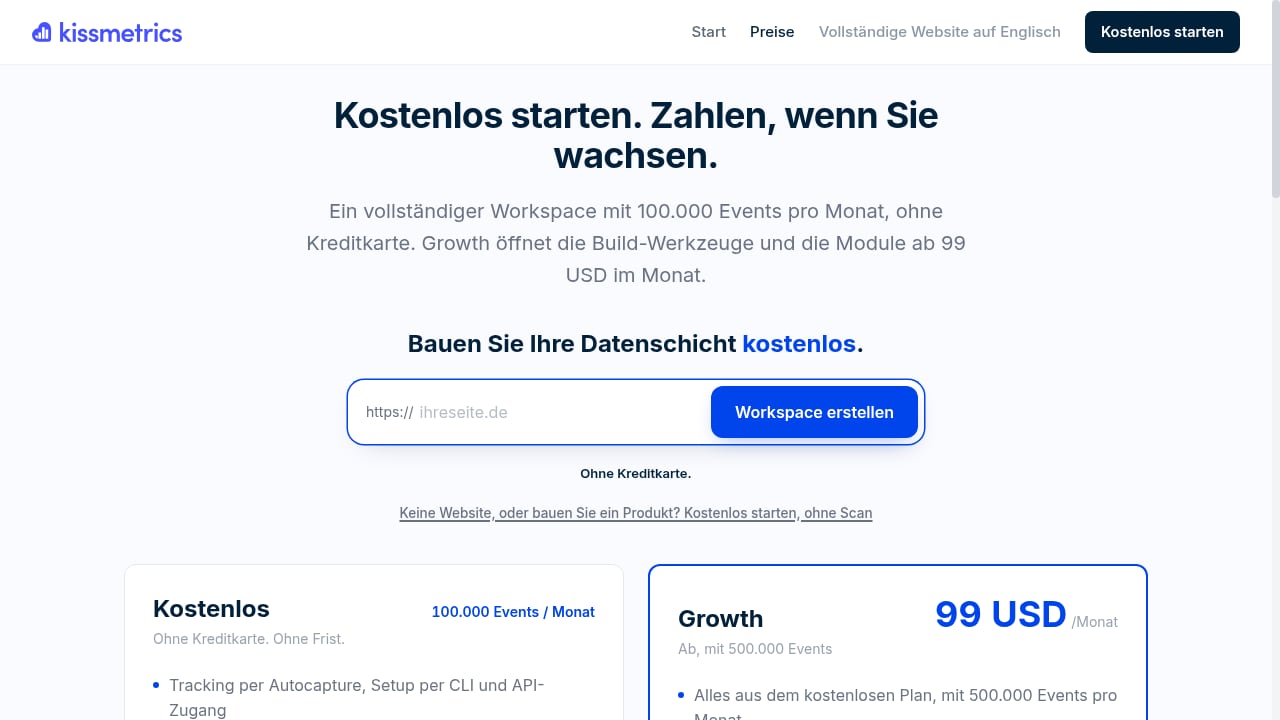
First viewport screenshot of Preise | KISSmetrics.
No single scoring model fits every team, so we weighted six dimensions that consistently separate strong behavioral analytics platforms from shallow event trackers:
- Behavioral tracking depth (25%): event capture, identity resolution across devices and sessions, funnel and path analysis, cohort building, and retention curves.
- Revenue and outcome linkage (20%): whether behavior can be tied to conversion, retention, and revenue rather than activity metrics alone.
- Usability and time to value (20%): setup effort, instrumentation requirements, self-serve exploration, and dashboard quality.
- Integration and data flow (15%): connectors to warehouses, CRMs, marketing automation, and survey or feedback tools.
- Privacy and compliance (10%): data ownership, GDPR controls, data residency, and audit capability.
- Pricing transparency (10%): published entry pricing, event-based versus user-based economics, and overage risk.
Scores reflect documented product capabilities and publicly reported user feedback as of early 2026. Pricing changes frequently, so treat every figure as a starting signal, not a quote.
The Top 10 Behavioral Analytics Platforms in 2026
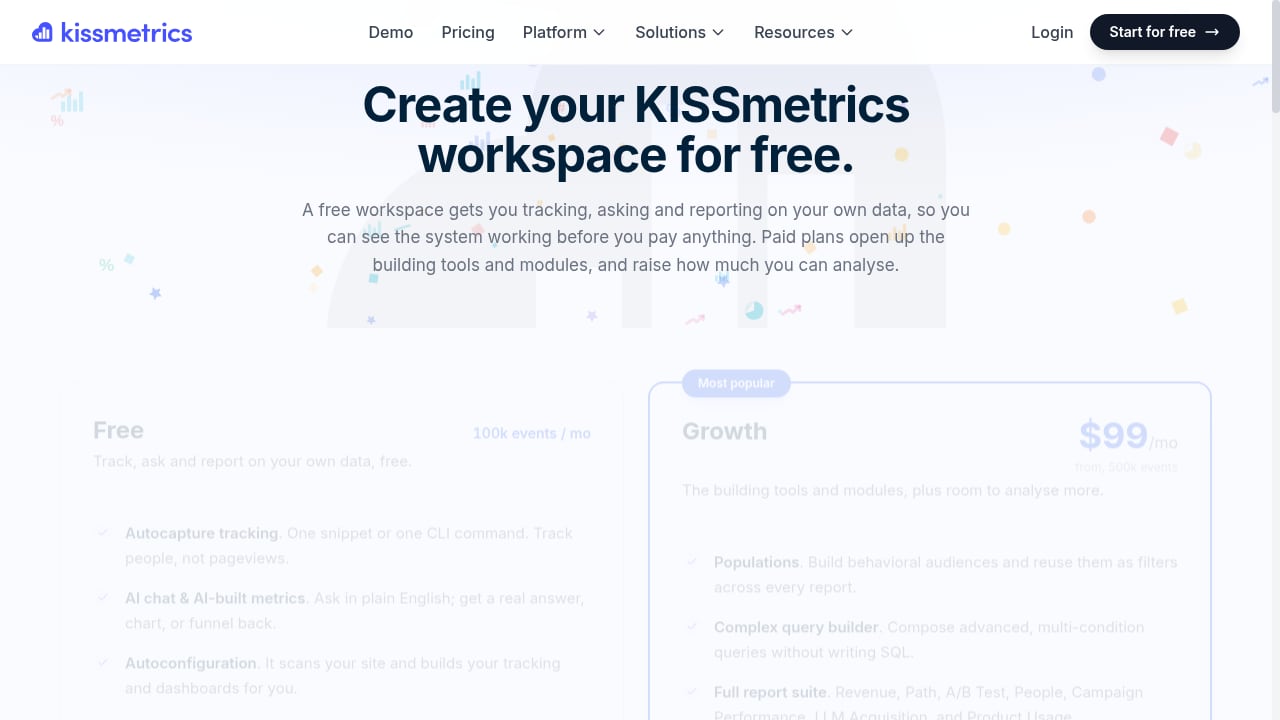
First viewport screenshot of KISSmetrics Pricing - Create your workspace free, then $99/month.
1. Mixpanel — Best for Self-Serve Product and Event Analytics
Mixpanel remains the reference point for fast, self-serve behavioral analytics. Teams instrument events once and then explore funnels, retention, user flows, and behavioral cohorts without filing engineering requests. Its impact analysis connects product changes to shifts in user behavior, and its API and data export options keep raw event data portable.
Why it ranks first: the combination of depth, speed, and a usable free tier is still unmatched for product-led teams. Public review platforms consistently place it around 4.5 out of 5 for analytics depth and real-time event tracking.
Watch-outs: advanced governance, predictive features, and higher event volumes push pricing into custom territory, and non-technical marketers may need help with initial tracking plans.
2. Amplitude — Best for Behavioral Cohorts and Predictive Insight
Amplitude is built for teams that want to move from describing behavior to anticipating it. Behavioral cohorts, retention analysis, journey mapping, and machine-learning-driven insights surface patterns and anomalies automatically. Its experimentation and feature-flag capabilities let teams act on findings inside the same platform.
Why it ranks second: Amplitude's cohort and predictive tooling is deeper than most competitors, and its free Starter plan (up to 50,000 monthly tracked users) makes evaluation realistic for small teams. Paid plans begin around $49 per month for higher tracked-user volumes.
Watch-outs: the breadth of features can overwhelm lean teams, and enterprise pricing scales quickly with tracked users.
3. KISSmetrics — Best for Funnel-Based Behavioral Segmentation Tied to Revenue
KISSmetrics tracks individual users across devices and sessions, which makes it a strong fit for marketing teams that need to understand complete customer journeys and attribute revenue to specific behaviors. Funnel-based segmentation is its core strength: you can group users by the actions they took (or skipped) and then compare conversion and retention between those groups.
Why it ranks third: few platforms at its price point connect behavioral segmentation directly to revenue outcomes. Entry pricing has historically started around $25 per month, making it accessible for conversion-focused teams.
Watch-outs: the interface feels more traditional than newer event-first tools, and teams wanting heavy in-app experimentation may pair it with a product analytics platform.
4. FullStory — Best for Qualitative Behavior Visibility
FullStory pairs automatic event capture with session replay, heatmaps, and frustration signals such as rage clicks and dead clicks. That combination helps UX, product, and support teams see not just where users drop off but what the experience looked like when they did.
Why it ranks here: its qualitative depth is genuinely differentiated, and automatic capture reduces instrumentation effort. It is a natural complement to a quantitative platform rather than a full replacement.
Watch-outs: pricing is custom, and revenue attribution is less central than in the platforms ranked above it.
5. Woopra — Best for Real-Time Journey Analytics and Automation
Woopra focuses on end-to-end journey analytics with real-time triggers, making it a good fit for SaaS and subscription teams that want to act on behavior while a session is still active. Cross-channel profiles combine product, marketing, and support touchpoints.
Why it ranks here: real-time automation is a meaningful differentiator for lifecycle teams. A free tier exists, with paid plans scaling toward enterprise pricing.
Watch-outs: the product has a smaller ecosystem than Mixpanel or Amplitude, so integration checks matter before committing.
6. Heap — Best for Automatic Capture Without Manual Tracking
Heap's automatic data capture records interactions broadly, then lets teams define events retroactively. That removes the classic bottleneck where a question arrives before the tracking plan does. Journey and funnel analysis sit on top of the captured dataset.
Why it ranks here: retroactive event definition is a real time-saver for product and growth teams that iterate quickly.
Watch-outs: automatic capture can create noisy datasets, and governance discipline is required as volume grows.
7. Contentsquare — Best for Experience Analytics at Enterprise Scale
Contentsquare, which now includes Hotjar's website behavior tooling, specializes in experience analytics: heatmaps, session recordings, zone-based attention analysis, and friction detection. It suits large organizations optimizing digital experience across web and app properties.
Why it ranks here: its visual diagnostics are among the most mature in the market, and the Hotjar lineage gives it strong mid-market reach.
Watch-outs: enterprise-oriented pricing and implementation cycles make it a poor fit for small teams.
8. Microsoft Clarity — Best Free Option for Friction Diagnosis
Microsoft Clarity provides heatmaps, session recordings, and basic behavioral signals at no cost, with no session limits. For small and mid-sized teams, it is often the fastest way to see usability friction before investing in a paid platform.
Why it ranks here: the price-to-capability ratio is unmatched for qualitative diagnosis.
Watch-outs: it lacks funnels, cohorts, and revenue attribution, so it works best as a companion tool rather than a primary behavioral analytics platform.
9. Matomo — Best for Privacy-First Behavioral Analytics with Data Ownership
Matomo offers event tracking, funnels, cohorts, and heatmaps while letting organizations self-host and retain full data ownership. That makes it a frequent choice for regulated industries and European teams with strict compliance requirements.
Why it ranks here: few behavioral platforms combine meaningful analytics depth with on-premise deployment and cookieless configuration options.
Watch-outs: self-hosting shifts maintenance and scaling work onto your team, and the interface is less polished than commercial SaaS rivals.
10. Google Analytics 4 — Best Baseline for Web and App Behavior
GA4 provides event-based tracking, funnel exploration, audience building, and BigQuery export at no cost. It is the default starting point for most organizations and integrates with advertising and marketing stacks out of the box.
Why it ranks here: as a baseline behavioral dataset, its reach and price are hard to beat, and BigQuery export unlocks advanced analysis.
Watch-outs: reporting complexity, sampling in some configurations, and privacy scrutiny push many teams to pair GA4 with a dedicated behavioral platform. If you need simpler traffic reporting alongside deeper behavioral tooling, a lightweight website analytics layer such as Data4 can complement this stack without duplicating it.
How to Choose the Right Behavioral Analytics Platform
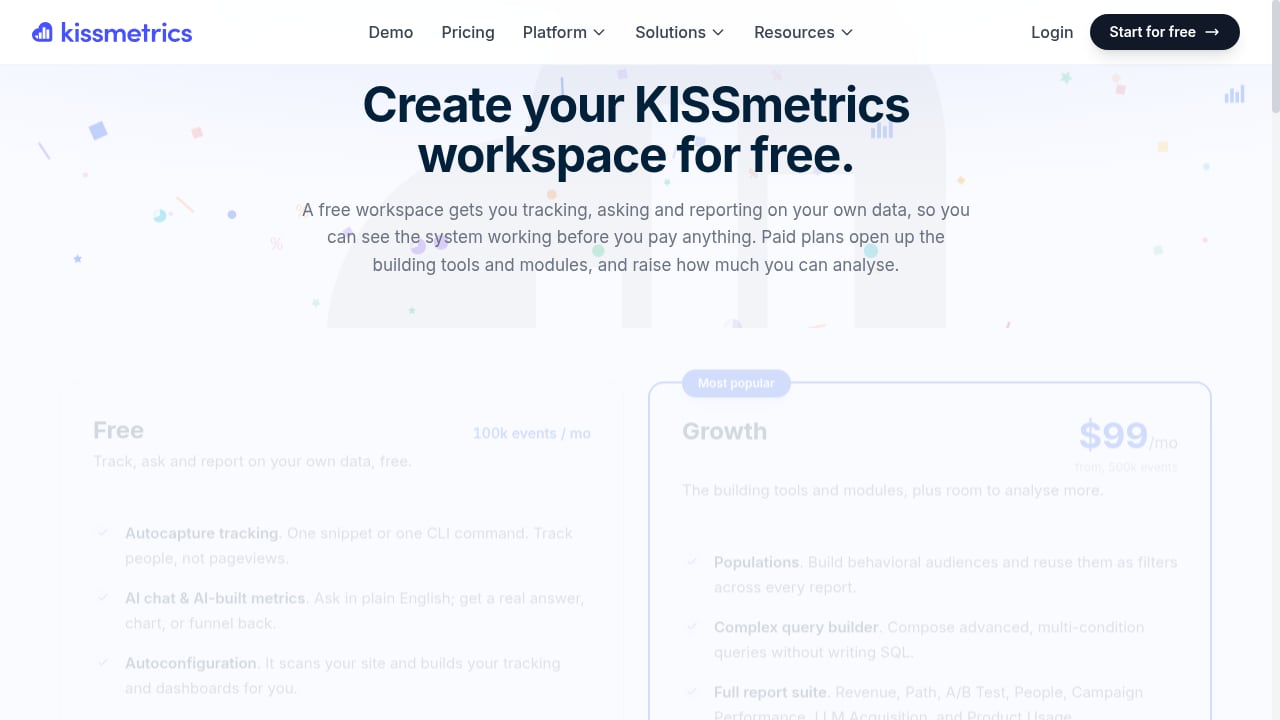
First viewport screenshot of KISSmetrics Pricing - Create your workspace free, then $99/month.
Match the platform to the decision you need to make, not to the longest feature list:
- Optimizing conversion funnels and revenue attribution: prioritize KISSmetrics, Mixpanel, or Woopra.
- Understanding retention and predicting churn: Amplitude and Mixpanel lead on cohorts and retention curves.
- Diagnosing UX friction: FullStory, Contentsquare, or Microsoft Clarity.
- Meeting strict privacy or data-residency rules: Matomo, or a privacy-first website analytics tool as a complement.
- Starting with no budget: GA4 plus Microsoft Clarity covers baseline behavior and friction diagnosis.
A practical pattern for many teams is a two-layer stack: a quantitative behavioral platform for events, funnels, and cohorts, plus a lightweight analytics or feedback layer for traffic context and qualitative input. If you are weighing that second layer, comparisons such as Data4 vs Mixpanel and Data4 vs Matomo clarify where website analytics ends and product intelligence begins. Product managers building a measurement plan from scratch will also find the product manager analytics guide useful for choosing between web, product, and BI tools.
Related reading
- Data4 vs Clicky vs Fathom: Best Privacy Analytics Pick - Compare Data4, Clicky, and Fathom Analytics on privacy, real-time tracking, ease of use, and fit. Find the best Google Analytics alternative for your team.
- Data4 vs Mixpanel: Website Analytics or Product Intelligence? - Data4 vs Mixpanel compared: website traffic analytics versus product intelligence for the AI era. See which fits your team, use case, and budget.
- Pirsch Analytics Review: Privacy-Friendly GA Alternative - An evidence-based Pirsch review covering ideal users, use cases, setup, pricing signals, strengths, limitations, and how it compares to Google Analytics.
Sources and further reading
- The Best User Behavior Analytics Tools of 2026: A Comprehensive Review - Discover the top user behavior analytics tools of 2026. Analyze user data effectively to drive engagement and results. Read the full review!
- 10 Best Customer Analytics Software in 2026 - Discover the 10 best customer analytics software in 2026. Compare features, integrations, data privacy, pricing, and behavioral and journey analytics capabilities.
- 10 Best Customer Behavior Analysis Tools to use in 2026 - Compare customer behavior analysis tools for ecommerce teams. Learn categories, use cases, and how platforms connect behavior to conversion, retention, and LTV.
Frequently Asked Questions
What is a behavioral analytics platform?
A behavioral analytics platform collects user-level interaction data — clicks, events, sessions, funnels, and journeys — and turns it into insights about why users convert, engage, or churn. It differs from website analytics, which primarily reports traffic and page-level metrics.
Is Mixpanel or Amplitude better in 2026?
Mixpanel is generally faster to adopt and easier for self-serve exploration, while Amplitude goes deeper on behavioral cohorts, predictive analytics, and experimentation. Choose Mixpanel for speed and usability; choose Amplitude if retention science and predictive insight are central to your roadmap.
Do I need a behavioral analytics platform if I already use Google Analytics 4?
GA4 gives you event-based traffic and audience data, but it is weaker at user-level journey reconstruction, cohort retention, and revenue attribution. Many teams keep GA4 as a baseline and add a dedicated behavioral platform for product decisions.
How much do behavioral analytics platforms cost?
Entry pricing ranges from free (GA4, Microsoft Clarity, limited tiers of Mixpanel and Amplitude) to roughly $25–$50 per month for small paid plans, with enterprise contracts priced on tracked users or events. Self-hosted options like Matomo trade subscription fees for infrastructure and maintenance costs.
Which behavioral analytics tools are best for privacy compliance?
Matomo is the strongest fit for full data ownership through self-hosting. Cookieless configurations and EU data residency are also available from several commercial vendors, but you should verify data-processing terms, retention controls, and audit features during evaluation.
Conclusion
The best behavioral analytics platform in 2026 depends on the decision you need to support. Mixpanel and Amplitude lead for product-led teams that live in funnels, cohorts, and retention. KISSmetrics stands out when behavioral segmentation must connect directly to revenue. FullStory, Contentsquare, and Microsoft Clarity win on qualitative friction diagnosis, while Matomo answers strict privacy requirements and GA4 remains the pragmatic baseline. Start with one primary platform, add a lightweight analytics or feedback layer where it closes a real gap, and revisit the stack as your tracking maturity grows.