
Data4 vs Matomo vs PostHog: Which Analytics Fits You?
Choosing an analytics platform is less about picking the most powerful tool and more about matching the tool to your team. Data4, Matomo, and PostHog all help you understand visitors, but they were built for different jobs. This comparison walks through where each platform is strong, where it asks more of you, and which one fits your website or product.
The Three Platforms at a Glance
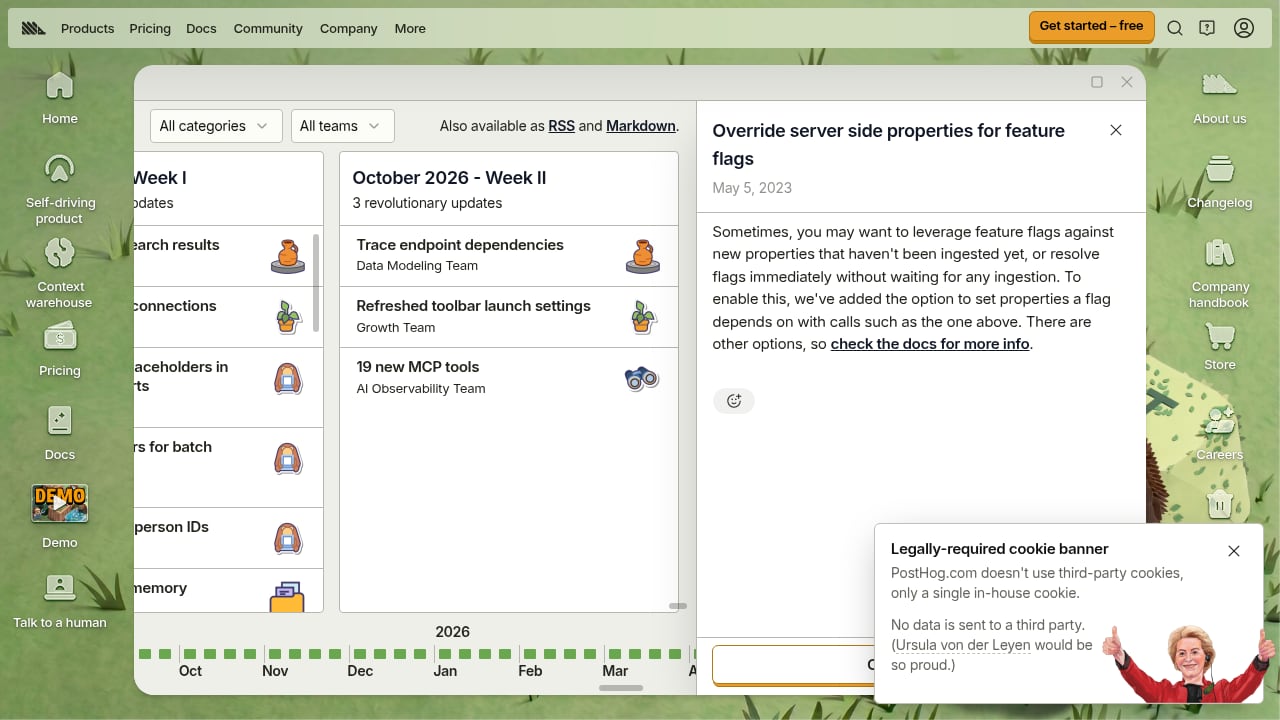
First viewport screenshot of Changelog - PostHog.
- Data4 is a website analytics platform focused on tracking website traffic and turning visitor data into clear, actionable insights. It is positioned as a simple and efficient Google Analytics alternative, with multi-language support including English, Chinese, and Japanese, and availability across multiple regional domains.
- Matomo is a privacy-first web analytics platform modeled closely on the classic Google Analytics experience. It emphasizes accurate, GDPR-compliant measurement and full data ownership, with both cloud and self-hosted options.
- PostHog is an all-in-one product analytics and AI-powered developer platform. It combines web and product analytics, session replay, feature flags, experiments, error tracking, and a data warehouse in one shared data model.
Where Matomo Is Strong
First viewport screenshot of Piwik 0.2.26 - Analytics Platform - Matomo.
Matomo has earned its reputation with teams that need control over their data without giving up familiar reporting.
- Data ownership and compliance. Matomo was designed around privacy from the start, with built-in GDPR, CCPA, and LGPD tooling, IP anonymization, consent management, and data export or deletion workflows. Self-hosting means no data leaves your infrastructure.
- Familiar web analytics. Its interface and reports closely mirror Universal Analytics, so marketing and content teams can migrate with minimal retraining.
- Marketing depth. Multi-channel attribution, form analytics, media analytics, and strong CMS and e-commerce integrations (WordPress, WooCommerce, Drupal, Joomla) make it a natural fit for traditional web properties.
- Lightweight self-hosting. A Matomo deployment typically needs only MariaDB or MySQL, which is simpler to operate than multi-service analytics stacks.
Trade-offs to weigh: the extensive feature set can mean a steeper learning curve for teams without dedicated analytics resources, and several advanced capabilities such as heatmaps, session recordings, funnels, cohorts, and A/B testing are premium add-ons on self-hosted deployments.
Where PostHog Is Strong
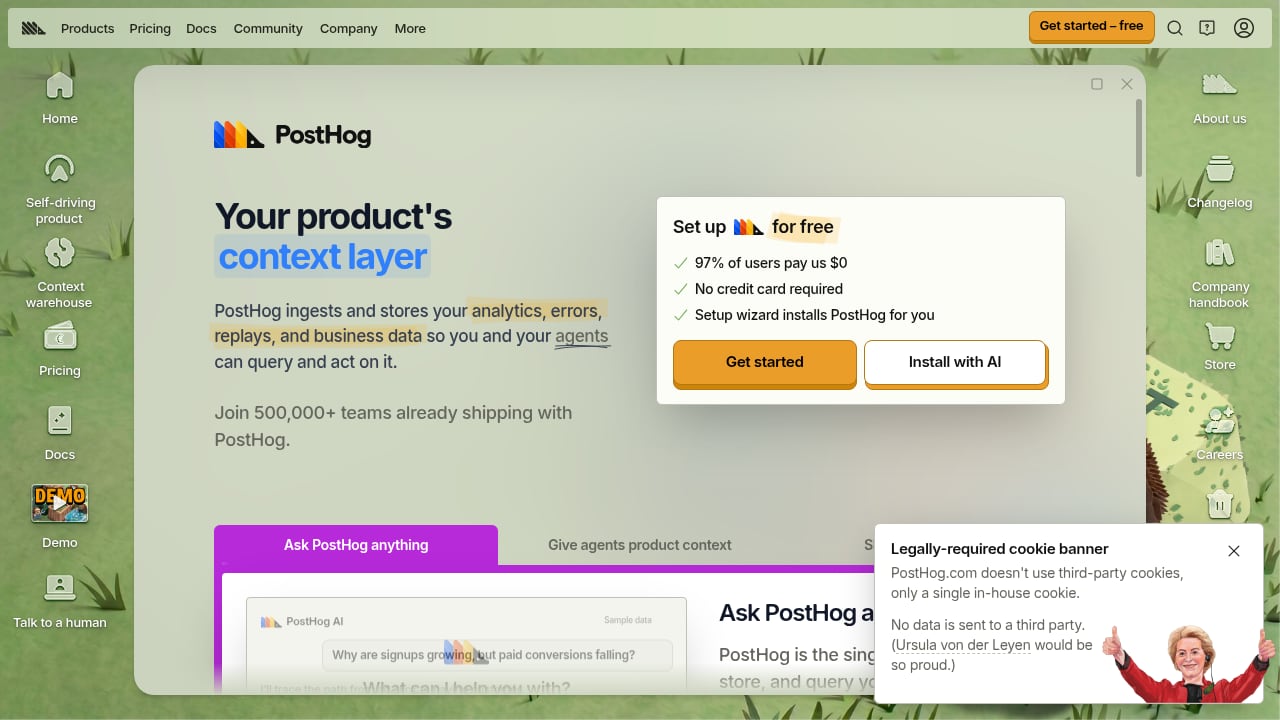
First viewport screenshot of PostHog - your product’s context layer.
PostHog is built for engineering-led product teams that want one platform instead of a stitched-together toolchain.
- All-in-one product stack. Analytics, session replay, feature flags, A/B testing, surveys, error tracking, logs, and a data warehouse share the same event data, so insights connect across tools from day one.
- Developer-first capabilities. Direct SQL access, an MCP server, SDKs across major platforms, and AI engineering products make it appealing to teams building and instrumenting software.
- Generous usage-based free tiers. Product analytics, session replay, surveys, and feature flag requests all include free monthly allowances, with billing limits to prevent surprise charges.
- Automation ambitions. PostHog positions itself as a context layer that can surface problems and even open pull requests, aimed at reducing manual triage work.
Trade-offs to weigh: PostHog's reporting is more focused than Matomo's for traditional marketing use cases, its self-hosted architecture involves several services (PostgreSQL, Redis, ClickHouse, Kafka), and its pricing scales with usage, which larger teams should model carefully.
Where Data4 Fits
Data4 is the straightforward option. It focuses on the core job most website owners actually have: tracking website traffic and analyzing website data without a heavy setup or a complex interface.
- Simplicity and speed. Data4 is designed for marketers, website owners, and analysts who want actionable website insights quickly, rather than a platform to configure and maintain.
- Website analytics focus. Traffic monitoring, visitor behavior, and performance tracking are the center of the product, which keeps the learning curve low.
- International usability. Support for multiple languages, including English, Chinese, and Japanese, plus multiple regional domains, makes it practical for global teams.
- Google Analytics alternative positioning. For teams that find traditional tools overwhelming, Data4 offers a simpler path to the same core questions: who is visiting, what they do, and how the site performs.
Data4 is not trying to be a product experimentation suite or a self-hosted data platform. If your needs are website traffic and visitor insight, that focus is a feature, not a limitation.
How to Choose: A Practical Decision Guide
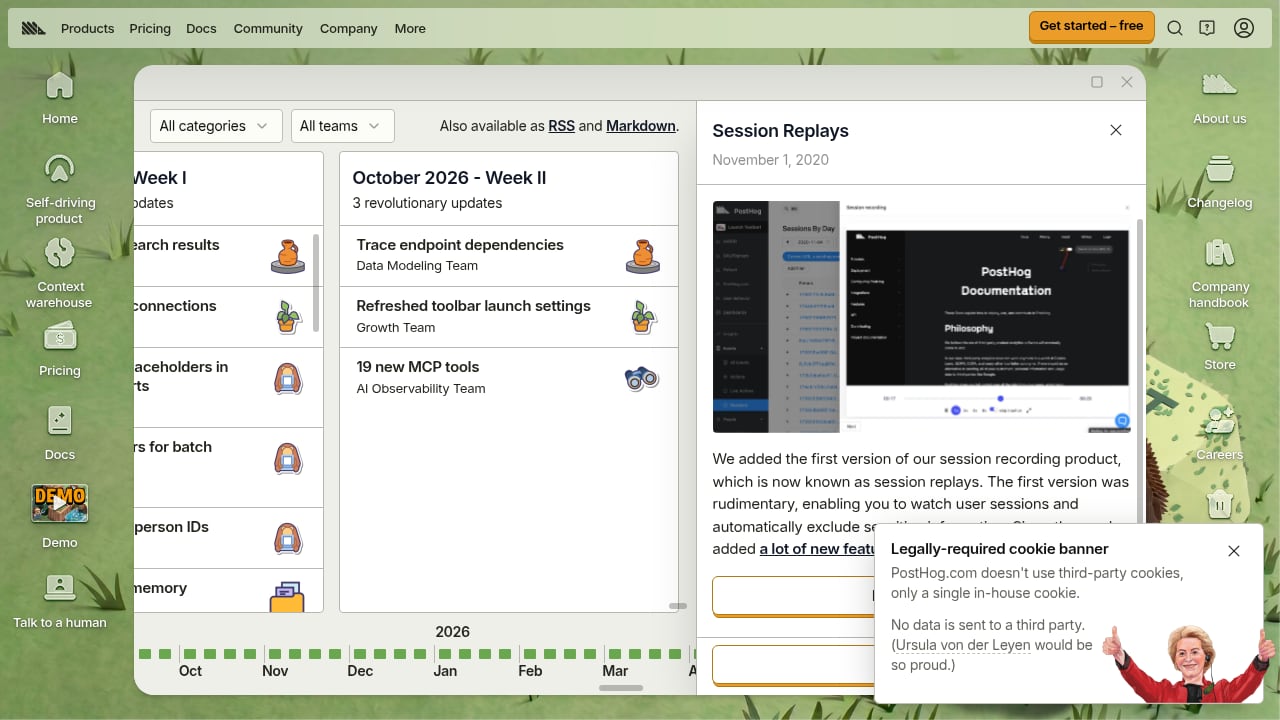
First viewport screenshot of Changelog - PostHog.
| If your priority is... | Consider |
|---|---|
| Fast setup and simple website traffic reporting | Data4 |
| Full data ownership, GDPR tooling, and marketing analytics | Matomo |
| Product analytics, session replay, feature flags, and developer workflows | PostHog |
| Multi-language website analytics for a global audience | Data4 |
| Self-hosting with minimal infrastructure | Matomo |
| One shared data model across product tools | PostHog |
A useful exercise: list the three questions your team asks most often about your website or product. If they are traffic and visitor questions, a focused website analytics platform will answer them faster. If they are product behavior and experimentation questions, you likely need a product analytics stack.
For a deeper look at privacy-focused options, see our Matomo review for 2026. If you are weighing simpler alternatives more broadly, the top user behavior analytics software comparison covers tracking depth, segmentation, and pricing across tools.
Common Questions
Is Data4 a good Google Analytics alternative?
Yes, for teams that mainly need website traffic tracking and visitor insights. Data4 is positioned as a simple, efficient alternative to traditional analytics tools, which suits marketers and site owners who want answers without a complex setup.
Does Matomo really capture more traffic than other tools?
Matomo's core claim is accuracy and compliance: popular analytics tools can miss a significant share of traffic, and Matomo aims to deliver accurate, GDPR-compliant measurement with full data ownership. It is a strong fit for regulated organizations and teams that need data sovereignty.
Is PostHog only for developers?
PostHog is built with engineering-led teams in mind, but its web analytics dashboard covers pageviews, sessions, traffic sources, conversions, bounce rate, and UTM tracking. Marketing teams can use it, though the broader platform is designed around product development workflows.
Can I self-host Matomo and PostHog?
Both offer self-hosted options. Matomo's deployment is comparatively lightweight, typically requiring only MariaDB or MySQL. PostHog's self-hosted architecture involves multiple services, which increases operational overhead but supports enterprise-grade scalability.
Which platform is easiest to start with?
For pure website analytics, Data4 is designed for quick, low-complexity onboarding. Matomo Cloud and PostHog Cloud both offer free or low-cost starting points, but each brings more configuration choices and a broader feature surface to learn.
Related reading
- Data4 vs Similarweb: AI Data Intelligence Compared - Data4 vs Similarweb compared: website analytics simplicity versus AI-powered market intelligence. See which digital data tool fits your team and use case.
- Microsoft Clarity Review: Free Heatmaps & Session Replays - An evidence-based Microsoft Clarity review covering heatmaps, session recordings, setup, privacy limits, pricing signals, and who should use it.
Sources and further reading
- PostHog vs Matomo in-depth tool comparison - Looking for the best web analytics platform? Compare PostHog vs Matomo on analytics, integrations, compliance, pricing, and more to find the right fit.
- Matomo vs PostHog: Which Analytics Tool Should You Use? - Explore the strengths and trade-offs of Matomo and PostHog in this detailed comparison to help you choose the right analytics tool for your needs.
- Countly vs PostHog vs Matomo — Self-Hosted Product Analytics Platforms (2026) -
Product analytics helps teams understand how users interact with their applications — which features are adopted, where users drop off in funnels, and what drives retention. While cloud services like Mixpanel and Amplitude dominate this space, three self-hosted alternatives give you full data ownership: Countly, PostHog, and Matomo.
Conclusion
There is no single winner here, because these platforms solve different problems. Matomo is the strongest choice when privacy compliance, data ownership, and familiar marketing reporting matter most. PostHog is the strongest choice when you need product analytics, experimentation, and developer tooling in one connected platform. Data4 is the strongest choice when you want simple, efficient website analytics that tell you how your traffic and visitors are behaving without asking you to manage a complex system.
Start with your team's primary questions, not the feature list. That is the fastest way to pick a platform you will actually use.
For related comparisons, see Data4 vs Heap vs Fathom Analytics and our guide to e-commerce visitor journey tracking.