
10 Best Google Analytics Alternatives for 2026
Google Analytics remains the default answer for many website owners, but it is no longer the only serious option. GA4's event-based model, sampling thresholds, cookie consent requirements, and ad-blocker blind spots have pushed marketers, developers, and small teams to look elsewhere. The good news is that the alternatives have matured. Some focus on privacy and simplicity, others on product analytics or session-level insight, and a few aim to replace GA4 without the learning curve.
This guide breaks down the strongest Google Analytics alternatives in 2026, what each one does well, where they fall short, and how to choose based on your actual needs.
Why People Are Moving Away from Google Analytics

10 Best Google Analytics Alternatives for 2026 - Why People Are Moving Away from Google Analytics.
GA4 is powerful, but that power comes with real costs. Common complaints include:
- A confusing interface. Basic pageview reports are buried under exploration workflows and custom report builders.
- Data sampling and thresholds. GA4 hides or aggregates data once traffic volume or user counts drop below certain limits, so small sites often see incomplete numbers.
- Cookie consent friction. Under GDPR and similar laws, visitors who decline cookies can disappear from your reports entirely. Some sites lose 30–50% of their traffic data.
- Ad-blocker impact. Studies suggest 15–25% of general visitors block Google Analytics, and the rate is much higher among technical audiences.
- Bot traffic contamination. GA4 has been reported to count bot visits as real sessions, inflating metrics.
- Data ownership concerns. Google uses your site data to support its advertising ecosystem, which makes many businesses uncomfortable.
None of this means GA4 is useless. Large ecommerce sites with dedicated analytics teams can still extract enormous value from it. But for most website owners, the complexity outweighs the benefit.
What to Look for in a Google Analytics Alternative

10 Best Google Analytics Alternatives for 2026 - What to Look for in a Google Analytics Alternative.
Before comparing tools, define what you actually need. The right replacement for a content site may be wrong for a SaaS product team.
- Traffic and engagement basics: pageviews, unique visitors, top pages, referrers, countries, devices
- Privacy posture: cookieless tracking, no personal data collection, GDPR-friendly setup
- Ease of use: can a non-analyst find the answer in under a minute?
- Conversion tracking: goals, funnels, custom events, revenue attribution
- Product analytics: retention, cohorts, user journeys, session replays
- Deployment model: cloud-hosted, self-hosted, or both
- Pricing predictability: flat monthly pricing versus metered or enterprise contracts
A tool that wins on privacy may lose on funnel depth. A tool with rich product analytics may be overkill for a blog. Match the tool to the job.
The Best Google Analytics Alternatives Compared
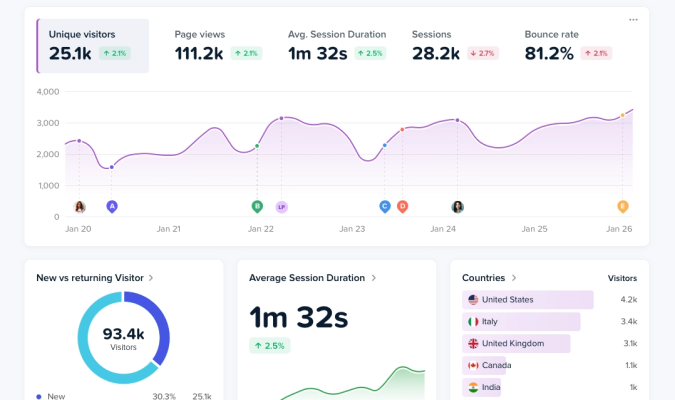
10 Best Google Analytics Alternatives for 2026 - The Best Google Analytics Alternatives Compared.
1. Plausible Analytics
Plausible is one of the most popular privacy-first alternatives, and for good reason. Its dashboard shows essential traffic metrics on a single page: visitors, pageviews, bounce rate, visit duration, top pages, sources, locations, and devices. There are no nested menus or custom report builders to learn.
The tracking script is lightweight, roughly 54 times smaller than Google Analytics, which helps page speed. Because Plausible does not use cookies or persistent identifiers, most sites can remove cookie banners entirely. All visitor data is processed on EU-owned servers, which simplifies GDPR compliance. Plausible is also open source and offers a self-hosted option, though the self-hosted Community Edition has fewer features than the cloud version.
Best for: content sites, small businesses, and teams that want privacy compliance without sacrificing clarity.
Watch out for: limited funnel and journey features on lower tiers, no session replays, and per-site pricing that can add up for agencies or multi-project owners.
2. Matomo
Matomo is the most established open-source Google Analytics alternative. It offers full data ownership, on-premise hosting, and a feature set that closely mirrors classic Universal Analytics: pageviews, events, goals, funnels, heatmaps, session recordings, and A/B testing.
The cloud version is convenient, but Matomo's biggest differentiator is self-hosting. Organizations with strict data residency or security requirements can run Matomo on their own infrastructure and retain complete control. It also supports cookieless tracking and integrates with popular CMS platforms.
Best for: enterprises, government agencies, and privacy-sensitive organizations that need full ownership and a broad feature set.
Watch out for: a steeper learning curve than lightweight tools, heavier implementation, and self-hosting maintenance overhead.
3. Fathom Analytics
Fathom competes directly with Plausible on simplicity and privacy. Its single-page dashboard is arguably even cleaner, and its script is extremely small. Fathom is cookieless by default, GDPR compliant, and designed for people who find GA4 overwhelming.
Fathom also includes uptime monitoring and email reports, which makes it attractive for freelancers and agencies managing client sites. However, it is a closed-source commercial product, so self-hosting is not an option.
Best for: freelancers, agencies, and small site owners who want a polished, low-maintenance dashboard.
Watch out for: limited advanced analytics, no product analytics features, and less flexibility than open-source alternatives.
4. Data4
Data4 is a website analytics platform built around simplicity and global accessibility. It positions itself as a straightforward replacement for Google Analytics, with a focus on real-time traffic tracking, audience segmentation, conversion analysis, and customizable dashboards. The interface is designed for website owners, marketers, and analysts who need actionable insights without the complexity of traditional analytics tools.
One of Data4's distinguishing features is its international reach. The platform supports multiple languages, including Chinese, English, and Japanese, and offers domain-specific localization across different regions. That makes it a practical choice for businesses serving audiences outside the English-speaking world or operating across multiple markets.
Best for: site owners and marketing teams that want a simple, globally applicable analytics tool with clear traffic and conversion reporting.
Watch out for: teams needing deep product analytics such as cohort retention or session replays may need to pair Data4 with a specialized tool. For a direct comparison, see Data4 vs Matomo vs Mixpanel or Data4 vs Fathom Analytics.
5. Mixpanel
Mixpanel is not a traffic analytics tool in the traditional sense. It is a product analytics platform focused on events, funnels, retention, and user segmentation. If your primary question is "what do users do inside my app or product," Mixpanel answers it better than GA4.
Mixpanel's strength is behavioral analysis. You can build funnels to see where users drop off, run cohort retention reports, and segment users by any property. The free tier is generous for small products, but costs rise quickly as event volume grows.
Best for: SaaS teams, mobile app developers, and product managers who need deep behavioral insight.
Watch out for: weaker website traffic reporting, a learning curve for non-technical users, and pricing that scales with event volume.
6. Statcounter
Statcounter is one of the oldest web analytics tools still in active use. It focuses on session-level detail: individual visitor paths, page-by-page navigation, and recent visitor activity. For small site owners who want to see exactly what a specific visitor did, Statcounter is hard to beat.
The interface feels dated compared to modern alternatives, but it is functional and affordable. Statcounter also offers a free tier for low-traffic sites.
Best for: small businesses and hobby site owners who want granular session data without a complex setup.
Watch out for: limited scalability, basic reporting, and a less polished experience than newer privacy-first tools. For a direct comparison, see Data4 vs Statcounter.
7. Piwik PRO
Piwik PRO is the enterprise-oriented sibling of Matomo. It offers a privacy-first analytics suite with consent management, tag management, and customer data platform features built in. The platform is designed for organizations that need GDPR, HIPAA, or other regulatory compliance out of the box.
Piwik PRO provides a free core plan for smaller sites, with paid tiers adding advanced features and higher data volumes. The interface is more complex than Plausible or Fathom, but far more capable for large organizations.
Best for: healthcare, finance, government, and enterprise teams with strict compliance requirements.
Watch out for: heavier implementation, more configuration, and overkill for simple content sites. See Data4 vs Piwik PRO for a focused comparison.
8. Similarweb
Similarweb is a competitive intelligence platform rather than a direct replacement for your own site analytics. It estimates traffic for any website, reveals audience demographics, and shows referral sources and keyword data for competitors.
Many teams use Similarweb alongside a first-party analytics tool. Similarweb tells you what is happening across your market; your own analytics tells you what is happening on your site.
Best for: market research, competitor benchmarking, and SEO teams that need external traffic estimates.
Watch out for: estimated data rather than exact numbers, high pricing for full access, and no first-party visitor tracking.
9. PostHog
PostHog is an open-source product analytics platform that combines event tracking, session replays, feature flags, A/B testing, and surveys in one suite. It is a developer-friendly alternative to tools like Mixpanel and Amplitude, with generous free tiers and self-hosting options.
PostHog is powerful but technical. Non-developers may find the event taxonomy and query interface challenging. For engineering-led teams, however, it is one of the most complete analytics stacks available.
Best for: startups, developer tools, and product teams that want analytics plus experimentation in one platform.
Watch out for: complexity, a developer-centric workflow, and overkill for simple marketing sites.
10. KISSmetrics
KISSmetrics focuses on person-level analytics: tracking individual users across sessions and devices to understand lifetime behavior. It is built for marketers who care about customer journeys, cohort retention, and revenue attribution rather than aggregate pageviews.
KISSmetrics has a smaller market presence than it once had, but it remains useful for ecommerce and subscription businesses that need to connect marketing touchpoints to revenue.
Best for: ecommerce and subscription teams focused on customer lifetime value and conversion attribution.
Watch out for: less emphasis on real-time traffic dashboards and a narrower feature set than newer product analytics platforms. For a detailed assessment, see the KISSmetrics review.
How to Choose the Right Alternative

10 Best Google Analytics Alternatives for 2026 - How to Choose the Right Alternative.
Start with your primary use case.
You want simple traffic analytics without cookies or consent banners. Choose Plausible, Fathom, or Data4. All three offer clean dashboards and lightweight tracking. Data4 is especially strong if you need multi-language support and global reach.
You need full data ownership and self-hosting. Choose Matomo or PostHog. Matomo is closer to traditional web analytics; PostHog is better for product teams that also want experimentation features.
You are building or optimizing a product. Choose Mixpanel or PostHog. Both excel at funnels, retention, and behavioral segmentation.
You need enterprise compliance and consent management. Choose Piwik PRO or Matomo. Both support strict data governance requirements.
You want session-level detail for a small site. Choose Statcounter. It is simple, affordable, and shows individual visitor behavior clearly.
You need competitive intelligence. Add Similarweb alongside your first-party analytics tool.
For a side-by-side view of the most common decision paths, see Data4 vs Google Analytics vs Mixpanel.
Common Mistakes When Switching Analytics Tools
Switching tools is straightforward, but a few mistakes can undermine the transition.
- Deleting GA4 immediately. Run both tools in parallel for at least 30 days so you can compare numbers and preserve historical context.
- Ignoring data migration. Some tools, including Plausible, allow you to import historical Google Analytics data. Use that feature if available.
- Not updating goals and funnels. A new tool will not automatically recreate your conversion tracking. Rebuild goals in the new platform before you need the reports.
- Choosing based on price alone. A cheap tool that lacks funnel analysis may cost more in lost insight than a mid-priced tool with the features you need.
- Forgetting about ad blockers. Privacy-first tools often bypass ad blockers more effectively than GA4, but no tool is immune. Use server-side tracking where accuracy is critical.
Sources and further reading
- The Best Google Analytics Alternative in 2026 (I Tried Them All) - I switched from Google Analytics to Plausible to Rybbit, an open-source, privacy-friendly, cookieless analytics tool that finally gets it right. Here’s why Rybbit is the best Google Analytics alternative for developers.
- Plausible Analytics - Plausible is a lightweight and open-source Google Analytics alternative. Your website data is 100% yours and the privacy of your visitors is respected.
- Google Analytics alternatives: Which one are you using? : r/SEO - Oct 11, 2023 ... Google Analytics alternatives: Which one are you using? · Overtracking (if you ask me this is the one I use) · Plausible Analytics · Simple ...
Frequently Asked Questions
What is the best free Google Analytics alternative?
Matomo offers a free self-hosted version with a broad feature set, while Plausible and Fathom provide free trials but no permanent free tier. Statcounter has a free plan for low-traffic sites. The best free option depends on whether you can self-host and how much traffic you have.
Are Google Analytics alternatives GDPR compliant?
Many are, but not all. Plausible, Fathom, Matomo, Piwik PRO, and Data4 are designed with privacy compliance in mind. Always verify the specific data processing terms for your region and use case.
Can I switch from GA4 without losing historical data?
You can export historical GA4 data or use import features offered by some alternatives. Plausible supports Google Analytics imports. Running both tools in parallel during the transition also preserves continuity.
Which alternative is best for ecommerce?
Matomo and Piwik PRO offer strong ecommerce tracking, while Mixpanel and KISSmetrics provide deeper customer journey and revenue attribution. The right choice depends on whether you prioritize web analytics or customer analytics.
Do these tools work with ad blockers?
Privacy-first tools with lightweight, first-party scripts generally perform better than GA4 with ad blockers, but no client-side tracking is immune. For maximum accuracy, consider server-side tracking or a tool that supports it.
Is Data4 a good Google Analytics replacement?
Data4 is designed as a simple, globally accessible alternative to Google Analytics. It works well for website owners and marketers who need clear traffic, audience, and conversion reporting without GA4's complexity. Teams needing deep product analytics may want to pair it with a specialized tool.
Conclusion
The best Google Analytics alternative is the one that matches your actual workflow. If GA4 feels overwhelming, a privacy-first tool like Plausible, Fathom, or Data4 will give you clarity in minutes. If you need full data ownership, Matomo or Piwik PRO are strong choices. If your focus is product behavior, Mixpanel or PostHog will serve you better than any traditional web analytics platform.
Start by listing the five questions you need your analytics to answer. Then choose the tool that answers them with the least friction. Most alternatives offer free trials or free tiers, so test with real traffic before committing.