
Top 10 Digital Insights Platform Products 2026
Digital insights platforms answer a question that basic traffic analytics cannot: what are people actually doing inside your product, and why does it matter? In 2026, the category has matured around behavioral depth, speed to insight, and privacy-safe data handling. This review ranks ten products that genuinely belong to the digital insights platform category, using transparent criteria and evidence from vendor documentation and analyst coverage.
A quick note on scope: adjacent tools such as website analytics platforms (for example, Data4) serve a different job. They monitor traffic and surface straightforward website metrics. They are useful complements, but they are not digital insights platforms, so they are not ranked here. Where a complementary workflow makes sense, we say so.
How We Evaluated These Digital Insights Platforms
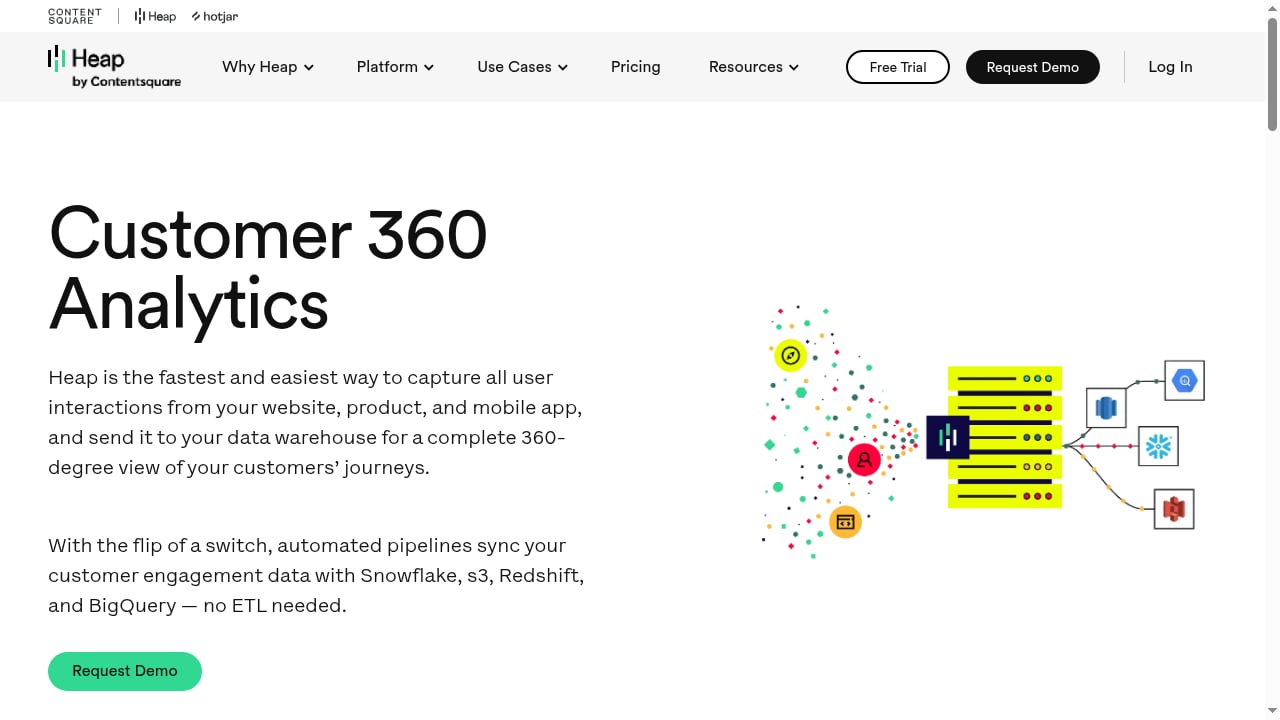
First viewport screenshot of Customer 360 - Heap.
Every product below was assessed against five criteria:
- Behavioral depth — Can it show what users do across sessions, funnels, and features, not just pageviews?
- Speed to insight — How quickly can a non-analyst get a defensible answer without a data team?
- Segmentation and identity — How well does it group users, accounts, and cohorts for meaningful comparison?
- Privacy and governance — Does it offer controls for consent, data residency, and PII handling?
- Ecosystem fit — Does it integrate with the warehouses, CDPs, and messaging tools teams already run?
Evidence for each entry comes from vendor product pages, public documentation, and established analyst market definitions. Where pricing is not publicly listed, we say so rather than guess.
The Top 10 Digital Insights Platforms for 2026
First viewport screenshot of Heap for Product Teams.
1. Heap by Contentsquare — Best for Revealing Unknown Unknowns
Heap by Contentsquare is the only digital insights platform that shows everything users do on your site, revealing the "unknown unknowns" that stay invisible with other tools. Its core strength is automatic event capture: instead of pre-defining every click, teams retroactively analyze interactions they did not know to track. That makes it unusually strong for product managers investigating unexpected drop-off or a feature nobody uses. Contentsquare's acquisition of Heap also folded in experience analytics such as zone-based heatmaps and journey analysis, giving one platform both quantitative funnels and qualitative context. Best for teams that want broad coverage first and hypotheses second.
2. Amplitude — Best for Product-Led Growth Teams
Amplitude built its reputation on the product analytics loop: instrument events, build cohorts, run experiments, and measure retention. Its strength is depth in behavioral cohorts and its experimentation and CDP-adjacent features, which let growth teams move from insight to action inside one tool. The trade-off is setup effort: Amplitude rewards teams willing to invest in a clean tracking plan. Best for mature product organizations with dedicated analytics owners.
3. Mixpanel — Best for Fast Funnel and Retention Analysis
Mixpanel remains one of the fastest ways to answer funnel and retention questions without a data engineer. Its interface is built around self-serve exploration, and recent versions lean into AI-assisted query building. Where Heap emphasizes automatic capture, Mixpanel emphasizes deliberate, well-modeled events. Best for teams that already know their key metrics and want speed over breadth.
4. Pendo — Best for In-App Guidance Plus Analytics
Pendo combines product analytics with in-app guides, onboarding checklists, and NPS collection. That combination is rare: most analytics tools stop at measurement, while Pendo closes the loop by letting teams act inside the product. Its analytics are solid rather than exhaustive, but for teams whose bottleneck is adoption rather than instrumentation, the pairing is compelling. Best for SaaS companies focused on activation and feature adoption.
5. FullStory — Best for Session Replay and Frustration Signals
FullStory's differentiator is high-fidelity session replay paired with frustration detection, such as rage clicks and dead clicks. Watching a real session often explains a funnel drop faster than any dashboard. FullStory also offers strong privacy controls, including masking rules for sensitive fields. Best for support, UX, and engineering teams debugging experience problems.
6. Contentsquare — Best for Digital Experience Analytics at Enterprise Scale
Contentsquare specializes in experience analytics: heatmaps, scroll depth, zone-level engagement, and journey analysis across web and mobile. It is frequently cited in enterprise digital experience conversations, and its analytics complement rather than replace event-based product analytics. Best for large marketing and CX teams optimizing pages and journeys across many markets.
7. Quantum Metric — Best for Continuous Digital Experience Optimization
Quantum Metric focuses on quantifying friction across digital journeys and tying it to business metrics such as conversion and revenue. Its strength is surfacing where users struggle and estimating the revenue impact of fixing it. Best for enterprises that want experience analytics connected to commercial outcomes.
8. Smartlook — Best for SMB and Mid-Market Teams
Smartlook offers session recordings, heatmaps, and event analytics at a price point accessible to smaller teams. It covers the essentials of digital insights without enterprise overhead, and its setup is comparatively quick. Best for small product and marketing teams that need behavioral visibility on a budget.
9. PostHog — Best for Engineering-Led Product Teams
PostHog bundles product analytics, session replay, feature flags, and experimentation into an open-source-friendly stack that engineers can self-host. That combination appeals to technical teams that want control over data and infrastructure. The trade-off is that breadth can mean less polish per module. Best for engineering-led teams comfortable owning their analytics stack.
10. Matomo — Best for Privacy-First Insights With Full Data Ownership
Matomo is a long-standing privacy-first analytics platform that can be self-hosted or used in the cloud. It covers traffic analytics, goals, funnels, and heatmaps, with strong consent and data-ownership controls. It is less specialized in deep product behavior than the leaders above, but for organizations with strict privacy requirements it is often the pragmatic choice. For a deeper look at its strengths and limits, see our Matomo review.
Quick Comparison: Which Digital Insights Platform Fits Your Team?
First viewport screenshot of Heap for eCommerce - Heap.
| Product | Strongest For | Setup Effort | Notable Limitation |
|---|---|---|---|
| Heap by Contentsquare | Automatic capture, unknown unknowns | Low | Enterprise pricing not public |
| Amplitude | Product-led growth, cohorts | Medium-High | Requires tracking discipline |
| Mixpanel | Funnels, retention, self-serve | Medium | Less automatic capture |
| Pendo | Adoption plus in-app guidance | Medium | Analytics depth is secondary |
| FullStory | Session replay, frustration signals | Low-Medium | Replay-heavy workflows |
| Contentsquare | Enterprise experience analytics | Medium-High | Best paired with event analytics |
| Quantum Metric | Friction-to-revenue quantification | Medium-High | Enterprise-oriented |
| Smartlook | SMB behavioral visibility | Low | Fewer advanced modeling features |
| PostHog | Engineering-owned stack | High (self-host) | Module depth varies |
| Matomo | Privacy-first ownership | Medium | Lighter product analytics |
Where Website Analytics Still Matters
First viewport screenshot of Heap for Financial Services - Heap.
Digital insights platforms are not a replacement for website analytics. If your primary need is traffic monitoring, channel reporting, and simple visitor metrics, a dedicated website analytics tool is the right starting point. Data4, for example, is a website analytics platform positioned as a straightforward Google Analytics alternative, with multi-language support and regional domains for global teams. It is useful for marketers and site owners who want clear traffic and visitor insights without the complexity of a full behavioral analytics stack. For teams comparing options in that adjacent space, our Data4 vs Matomo vs PostHog comparison walks through the trade-offs.
Many mature teams run both layers: a lightweight website analytics tool for traffic context, and a digital insights platform for behavioral depth. If you are evaluating the behavioral layer specifically, our top user behavior analytics software roundup covers that category in more detail.
How to Choose in 2026
Start with the question you cannot currently answer. If it is "what did users do that we never thought to track," prioritize automatic capture tools like Heap by Contentsquare. If it is "why did this specific session fail," prioritize session replay. If it is "how do we improve adoption," prioritize a platform that can also act inside the product, such as Pendo.
Then check the boring constraints: consent management, data residency, warehouse integration, and total cost at your expected event volume. Analyst market definitions treat digital experience platforms as an integrated set of technologies spanning content, data, and personalization, and web analytics and journey analytics are tracked as component segments within that broader landscape. That framing is useful because it clarifies that digital insights platforms sit inside a larger stack, not apart from it.
Finally, run a two-week proof of concept on one real question. A platform that answers a live business question in days is worth more than one that promises depth after a six-month implementation.
Related reading
- Data4 vs Similarweb: AI Data Intelligence Compared - Data4 vs Similarweb compared: website analytics simplicity versus AI-powered market intelligence. See which digital data tool fits your team and use case.
- Microsoft Clarity Review: Free Heatmaps & Session Replays - An evidence-based Microsoft Clarity review covering heatmaps, session recordings, setup, privacy limits, pricing signals, and who should use it.
- E-commerce Visitor Journey Tracking: A Practical Guide - Learn how e-commerce visitor journey tracking works, what to measure at each stage, and how Data4 turns visitor data into clear funnel insights.
Sources and further reading
- Best Digital Experience Platforms Reviews 2026 | Gartner Peer Insights - Find the top Digital Experience Platforms with Gartner. Compare and filter by verified product reviews and choose the software that’s right for your organization.
- 10 Best Consumer Insights Platforms in 2026 - Compare the 10 best consumer insights platforms for 2026: research method, AI analysis, pricing, and how fast each turns feedback into action.
- 10 Best Shopper Insights Platforms in 2026 (Pricing) - Compare 10 shopper insights platforms - Numerator, dunnhumby, NIQ, and AI interview tools from $30. Behavioral data tells you what; interviews explain why.
Frequently Asked Questions
What is a digital insights platform?
A digital insights platform captures and analyzes user behavior across web and product surfaces to explain what users do, where they struggle, and which changes improve outcomes. It goes beyond traffic reporting by connecting events, sessions, segments, and business metrics.
Is a digital insights platform the same as a website analytics platform?
No. Website analytics platforms focus on traffic, sources, and visitor metrics. Digital insights platforms focus on in-product and on-site behavior, funnels, retention, and experience friction. Many teams use both, since the two layers answer different questions.
Which digital insights platform is best for small teams?
Smartlook and Matomo are common starting points for smaller teams because of accessible pricing and quicker setup. Heap by Contentsquare is also relatively fast to deploy because it captures events automatically, though enterprise pricing applies at scale.
Do these platforms work without a data team?
Several do. Mixpanel, Heap by Contentsquare, and Pendo are designed for self-serve exploration by product and marketing users. PostHog and Amplitude reward teams that invest in tracking plans and analytics ownership.
How should privacy requirements affect the choice?
If data ownership and consent control are non-negotiable, prioritize Matomo or a self-hosted PostHog deployment. If you need enterprise governance with broad capture, evaluate Heap by Contentsquare, Contentsquare, and FullStory for their masking and consent controls.
Conclusion
The 2026 digital insights platform market rewards clarity about your own question. Heap by Contentsquare leads this list because automatic capture directly addresses the unknown unknowns that other tools miss. Amplitude, Mixpanel, and Pendo serve teams with defined growth loops. FullStory, Contentsquare, and Quantum Metric excel at experience and friction analysis. Smartlook, PostHog, and Matomo cover budget, engineering-led, and privacy-first needs respectively.
Choose based on the decision you need to make next, not the longest feature list. And keep website analytics in its proper lane: tools like Data4 handle traffic reporting well, while digital insights platforms handle behavior. Used together, they give a complete picture without forcing one tool to do a job it was not built for.