
Top 10 Privacy-Focused Web Analytics Products 2026
Privacy-focused web analytics stopped being a niche compromise years ago. In 2026, the strongest tools in this category combine cookieless measurement, EU or self-hosted data storage, and reporting depth that used to require a full product analytics suite. The hard part is no longer finding a privacy-friendly tracker — it is choosing between ten credible options that differ sharply on hosting model, event depth, retention, and price.
This review ranks ten products that genuinely belong to the privacy-focused web analytics category. Every entry is scored on the same criteria, and every claim is tied to published pricing, documentation, or vendor-stated compliance. If you already run a general website analytics platform for traffic reporting, a privacy-first tool usually sits beside it as a consent-free baseline rather than replacing it outright.
How We Evaluated These Tools
First viewport screenshot of Web Analytics Guides.
We did not rank on brand familiarity. Each product was assessed against six criteria:
- Privacy architecture — cookieless tracking, IP anonymization, and whether a consent banner is required under GDPR or ePrivacy.
- Data ownership and hosting — self-hosted options, EU data residency, and whether the vendor can access raw visitor data.
- Measurement depth — pageviews, events, funnels, retention, session replay, and revenue attribution.
- Script weight and performance — tracking script size and impact on Core Web Vitals, especially for static sites and single-page apps.
- Compliance evidence — published certifications, DPA availability, and recognized regulatory positions.
- Pricing transparency — public starting tiers, free plans, and per-site or per-event scaling.
Where a tool is open source, we treated self-hosting as a distinct advantage because it removes vendor access to raw data entirely.
The Top 10 Privacy-Focused Web Analytics Products in 2026
First viewport screenshot of Umami – Open-Source Web and Product Analytics.
1. Matomo — Best for Full Data Ownership
Matomo is the longest-running open-source analytics platform in this category, used on more than a million websites. Its standout credential is regulatory: in France, CNIL recognizes a correctly configured Matomo installation as capable of audience measurement without a consent banner.
You can run it on-premise for free with no hit limits, or use Matomo Cloud from roughly €22–29 per month depending on volume, hosted in Frankfurt. Cloud plans bundle advanced modules that on-premise users buy as plugins. Nothing is sampled, so reports reflect every visit. Funnels, heatmaps, session recordings, form analytics, and A/B testing sit alongside standard acquisition reports, and Roll-Up Reporting merges multiple properties for agencies.
Best for: Organizations that need behavioral depth plus complete control over where data lives.
2. Plausible Analytics — Best Simple Privacy-First Dashboard
Plausible puts every core metric on a single page: visitors, sources, top pages, locations, and devices. The tracking script is around 1 KB, and the platform estimates a site with 100,000 monthly visitors saves roughly 4 kg of CO₂ per year versus heavier scripts.
It is cookieless, EU-hosted on company-owned infrastructure, and typically removes the need for a consent banner. Pricing starts at $9 per month for 10,000 pageviews, with a free self-hosted option and a built-in importer for historical data. The trade-off is deliberate: no session replay, no A/B testing, no error tracking.
Best for: Content sites, documentation, and small teams that want clarity in under a minute.
3. Fathom Analytics — Best for Agencies Managing Many Sites
Fathom tracks pageviews, custom events, and UTM campaigns through a single 2 KB script. Its base plan covers 50 sites at $15 per month for 100,000 pageviews, with additional 50-site packs at $10 per month — an unusually low per-site cost for agencies.
Data retention is stated at a minimum of 20 years, which matters if you compare seasonal trends across long horizons. Automatic EU isolation routes European visitor data to EU infrastructure, and bot filtering runs without configuration. No cookies means no consent banner under GDPR, CCPA, ePrivacy, or PECR.
Best for: Freelancers and agencies running large client portfolios who want minimal setup per site.
4. Umami — Best Open-Source Web and Product Analytics
Umami is an open-source web and product analytics platform that covers acquisition, behavior, conversion, and retention without cookies. It is the strongest free starting point in this category: Umami Cloud's Hobby tier covers 100,000 events per month across three sites, and self-hosting is free with no event ceiling.
Beyond traffic reporting, Umami supports event tracking, session replays, and revenue attribution, which pushes it closer to product analytics than most lightweight privacy tools. Self-hosting gives you full ownership of raw data. For a direct feature comparison against a general website analytics platform and a product analytics suite, see Data4 vs Umami vs Mixpanel.
Best for: Developers and small teams that want product-level depth without paying per event.
5. PostHog — Best for Behavioral and Product Analytics
PostHog bundles web analytics with product analytics, session replays, feature flags, and A/B testing behind one JavaScript snippet. The free tier includes 1 million events and 5,000 replays per month, with usage-based pricing above that.
Its privacy controls support compliance workflows, and self-hosting is available under an open-source license for teams that need full control. Event autocapture, funnel analysis, and retention reporting make it the deepest behavioral option here, though that depth comes with more configuration than a single-page dashboard requires.
Best for: Product and engineering teams analyzing retention and feature adoption, not just traffic.
6. Simple Analytics — Best Independent Baseline Alongside GA4
Simple Analytics measures pageviews, events, referrers, and campaigns without cookies or persistent identifiers. Sessions are derived from pageview context rather than stored visitor IDs, so no consent banner is required under GDPR.
Its most practical use case is running alongside GA4: when visitors reject a consent prompt, GA4 stops recording, while Simple Analytics keeps capturing that traffic as an independent baseline. Data exports via API feed into Looker Studio, Power BI, or internal dashboards. The company operates from Amsterdam with EU hosting, and pricing starts around $9 per month billed yearly.
Best for: Privacy-conscious teams that want a consent-free second data source next to GA4.
7. Swetrix — Best Privacy-First Tool With Product Depth
Swetrix is fully cookieless, open-source, and GDPR-compliant without a consent banner. Its v5 release moved it toward product analytics: session analysis, anonymous user profiles, revenue analytics with Stripe and Paddle integration, feature flags, statistically rigorous A/B testing, error tracking, and real user monitoring.
The tracking script is under 5 KB, and single-page application routing is handled correctly out of the box — a persistent pain point with GA4. Cloud pricing starts at $19 per month for 100,000 events, with a free self-hosted Community Edition and a 14-day trial.
Best for: Developers who want experimentation and performance monitoring in the same privacy-first platform.
8. Pirsch — Best API-First Privacy Analytics
Pirsch is cookieless and made and hosted in Germany, with pricing from $6 per month for 10,000 pageviews and a 30-day trial. Its tracking script is under 1 KB, and it exposes a strong API for teams that want to pull metrics into their own tooling.
It handles virtual pageviews for client-side routing, which makes it viable for React, Vue, and other single-page applications. The feature set is intentionally focused on web analytics rather than product analytics, so it suits teams that want clean reporting plus programmatic access.
Best for: Developers who want a lightweight German-hosted tracker with a first-class API.
9. Vercel Web Analytics — Best for Teams Already on Vercel
Vercel Web Analytics is built into the Vercel platform and covers traffic reporting, pageview tracking, and custom events with no extra setup for teams already deploying there. Because it ships with the hosting layer, there is no separate script to manage or vendor to evaluate for data processing.
The trade-off is scope and portability: it is designed for the Vercel ecosystem, so it makes most sense when your site already lives there and you want privacy-friendly traffic insight without adding another tool.
Best for: Teams on Vercel that want simple, integrated website analytics.
10. TelemetryDeck — Best Lightweight App and Product Analytics
TelemetryDeck focuses on apps and digital products rather than classic websites. It tracks usage, engagement, and retention with a lightweight setup and anonymized signals, which suits mobile and desktop products where cookie-based web tracking never applied.
Event tracking and retention insights are the core of the product, and setup is fast for app teams. If your measurement need is app usage rather than page-level web reporting, it belongs on your shortlist even though it sits outside the typical website analytics workflow.
Best for: App and product teams that want privacy-friendly usage and retention metrics.
Quick Comparison Table
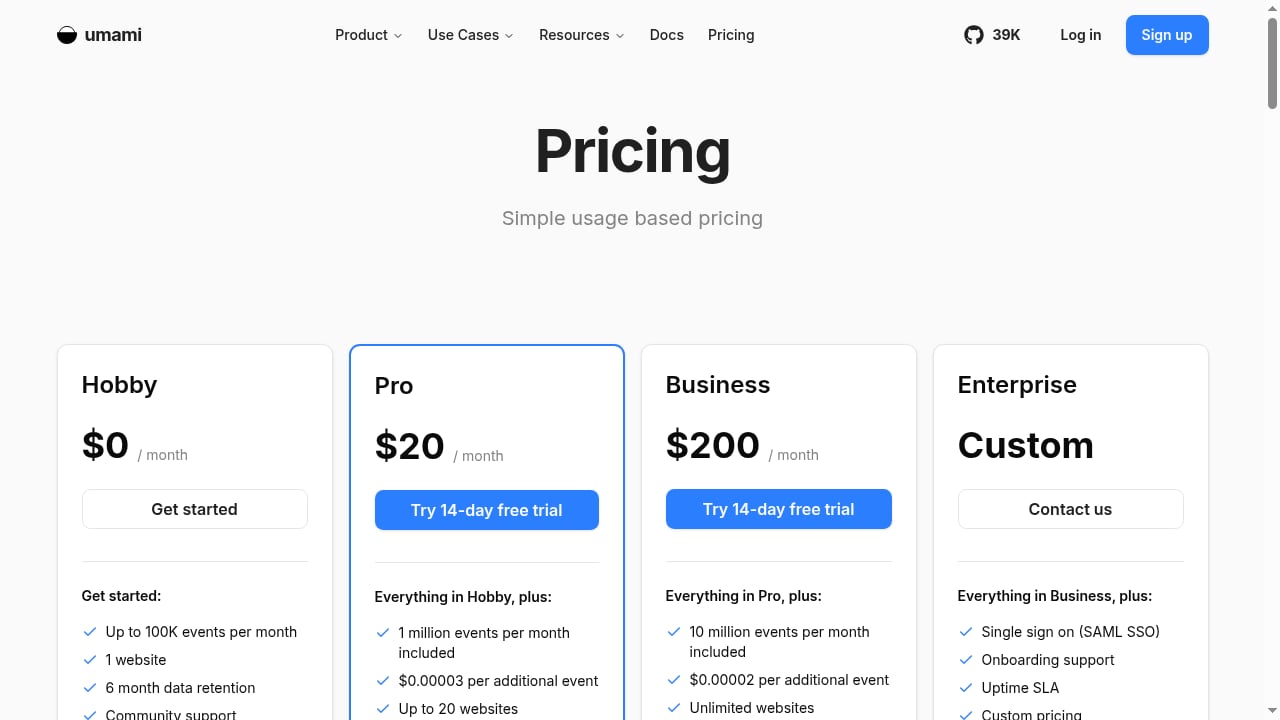
First viewport screenshot of Umami – Open-Source Web and Product Analytics.
| Tool | Free option | Starting price | Self-host | Cookieless | Best for |
|---|---|---|---|---|---|
| Matomo | Self-host free | ~€22/mo cloud | Yes | Yes | Full data ownership |
| Plausible | Self-host free | $9/mo | Yes | Yes | Simplest dashboard |
| Fathom | 7-day trial | $15/mo (50 sites) | No | Yes | Agencies, many sites |
| Umami | Cloud Hobby free | $9/mo cloud | Yes | Yes | Open-source product depth |
| PostHog | 1M events/mo | Usage-based | Yes | Yes | Behavioral analytics |
| Simple Analytics | 30-day trial | ~$9/mo yearly | No | Yes | GA4 baseline |
| Swetrix | Self-host free | $19/mo | Yes | Yes | Privacy plus experimentation |
| Pirsch | 30-day trial | $6/mo | No | Yes | API-first tracking |
| Vercel Web Analytics | With Vercel plan | Bundled | No | Yes | Vercel ecosystem |
| TelemetryDeck | Trial available | Varies | No | N/A (app) | App usage analytics |
How to Choose Between Them
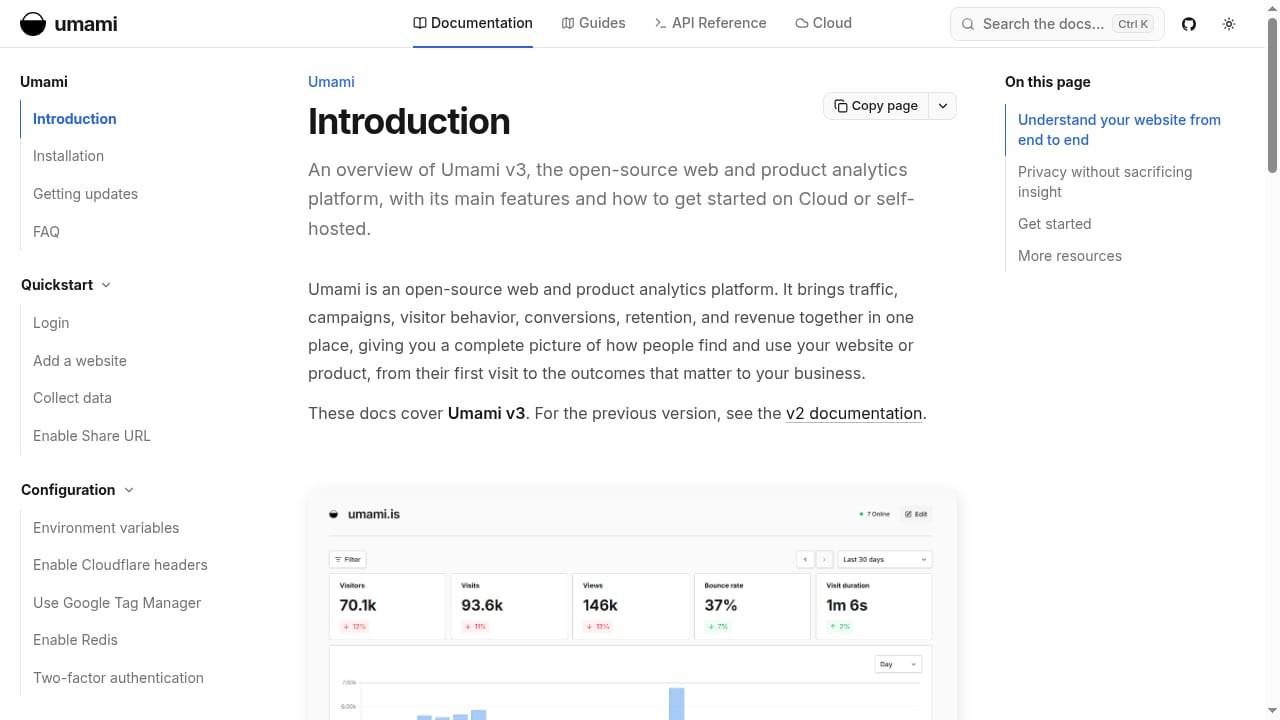
First viewport screenshot of Introduction – umami.
Start with the constraint that cannot be negotiated. If legal or procurement requires that no third party can access raw visitor data, self-hosting narrows the field to Matomo, Plausible, Umami, PostHog, and Swetrix. If you need a consent-free baseline next to an existing general analytics platform, Simple Analytics and Fathom are the most direct fits.
If measurement depth is the priority, the decision moves toward Umami, PostHog, and Swetrix, which cover funnels, retention, and replay without abandoning cookieless tracking. If you manage many client sites, Fathom's 50-site base plan usually wins on cost per property. And if your site is a single-page app, verify that the tool tracks virtual pageviews on route change before you commit — Plausible, Fathom, Pirsch, Umami, Swetrix, and Simple Analytics all support it.
One workflow worth planning for: many teams run a privacy-first tool for consent-free traffic measurement and a separate platform for campaign and conversion reporting. If you compare paid channels alongside analytics, the framework in How to Compare Ad Campaign Performance helps you connect UTM data from these tools to budget decisions. Teams that need deeper single-user journey analysis beyond aggregate dashboards can extend this with Individual Visitor Behavior Analysis.
Related reading
- How to Use Data4 with Optimizely: A Practical Integration Guide - Learn how to combine Data4 website analytics with Optimizely experimentation and personalization. Setup steps, workflow, examples, and key limitations.
Sources and further reading
- 8 Best Free Web Analytics Tools in 2026 - You just launched a new landing page, traffic is climbing, and now you need to understand what visitors actually do once they arrive. Picking an analytics tool means weighing privacy regulations, data ownership, feature depth and long-term cost against each other, often with incomplete information. Most tools in this space share a core promise (visitor...
- 10 privacy-first analytics tools worth exploring in 2026 - This article explains what privacy-first analytics tools are, why they matter as privacy regulations and browser restrictions evolve, and how they differ from traditional analytics. It compares ten privacy-first analytics platforms by primary use case, then outlines practical criteria for choosing a tool based on reporting needs, privacy approach, data durability, and ease of use.
- 10 Best Web Analytics Tools in 2026 (Tested and Compared) - A hands-on comparison of the 10 best web analytics tools: privacy-first Google Analytics alternatives, open-source platforms, and product analytics suites.
FAQ
What makes web analytics privacy-focused?
A privacy-focused tool avoids cookies and persistent identifiers, anonymizes or does not store IP addresses, minimizes collected data, and gives you control over hosting. The practical test is whether you can run it without a consent banner under GDPR and ePrivacy.
Do privacy-focused analytics tools need a cookie banner?
Most cookieless tools — Plausible, Fathom, Simple Analytics, Pirsch, Swetrix, and Umami — are designed to avoid consent banners. Matomo can also qualify when configured to CNIL's recognized settings. Always confirm your specific configuration with legal counsel, because banner requirements depend on implementation, not just the vendor.
Which privacy-focused analytics tool is best for a single-page app?
Swetrix, Plausible, Fathom, Pirsch, Umami, and Simple Analytics all expose a hashed or history-based mode that records virtual pageviews on route change. GA4 can do this too, but only after manual event wiring.
Can I self-host a privacy-focused analytics platform for free?
Yes. Matomo On-Premise, Plausible, Umami, PostHog, and Swetrix all offer free self-hosted editions with no hit or event limits. You cover server and maintenance costs instead of a subscription.
How do these tools compare with a general website analytics platform?
General platforms typically focus on traffic monitoring and reporting, while privacy-focused tools add cookieless measurement and data-ownership guarantees. Many teams run both: a general platform for consolidated reporting and a privacy-first tool as a consent-free baseline. Comparisons such as Data4 vs Fathom vs Piwik PRO and Data4 vs Clicky cover how those adjacent tools differ on privacy, event depth, and pricing.
Conclusion
The privacy-focused web analytics category in 2026 rewards specificity. Matomo wins on ownership and regulatory recognition, Plausible and Fathom win on simplicity and agency economics, Umami and Swetrix win on open-source depth, and PostHog wins when behavioral analysis matters more than a clean traffic dashboard. Pick the tool that matches your hardest constraint — hosting, consent, depth, or per-site cost — then verify the current pricing tier before you commit, because plans in this space change frequently.
For further reading on how privacy-first tools fit into a broader measurement stack, see Clicky Similar Tools: 9 Best Web Analytics Alternatives.