
What Is a Heap? Data Structure Guide with Examples
A heap is a specialized tree-based data structure that satisfies the heap property. It is one of the most efficient ways to implement a priority queue, a fundamental concept in computer science. Unlike a sorted array or a binary search tree, a heap does not impose a total order on its elements. Instead, it maintains a partial order that makes retrieving the highest or lowest priority element extremely fast. This guide explains how heaps work, the difference between max-heap and min-heap, common operations, practical use cases, and how to choose the right variant for your needs.
What Is a Heap Data Structure?
What Is a Heap? Data Structure Guide with Examples - What Is a Heap Data Structure?.
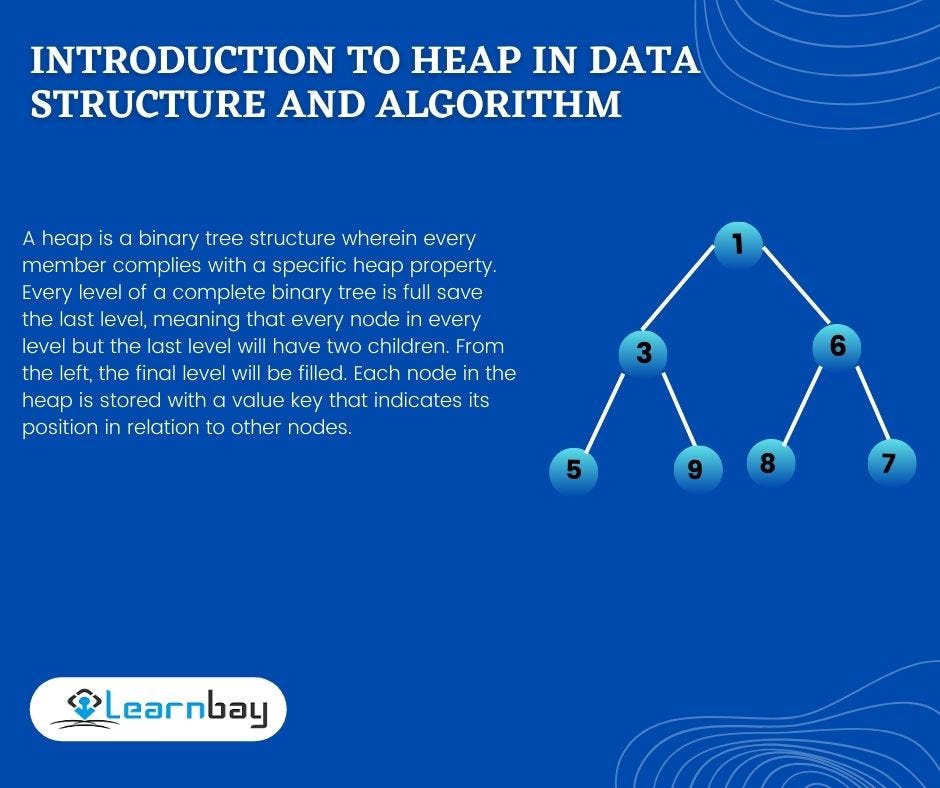
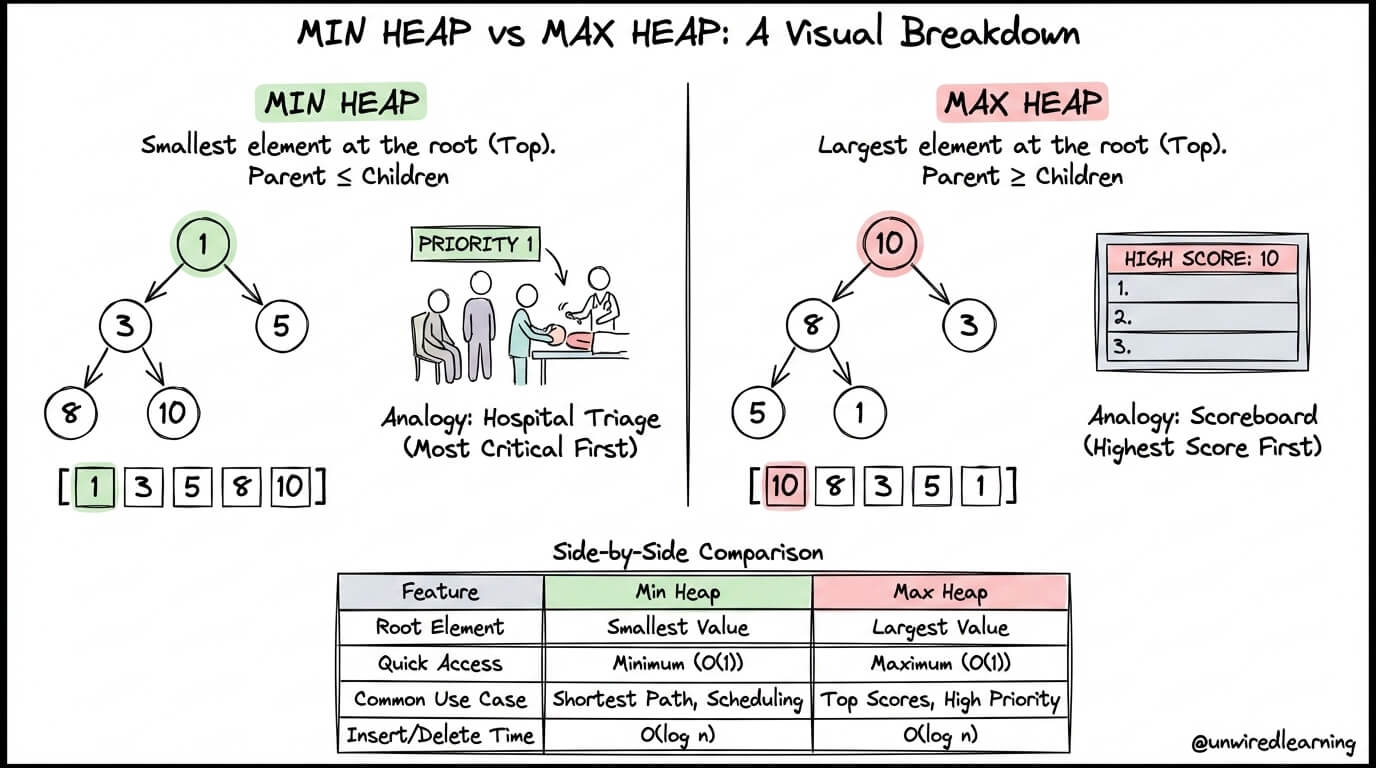
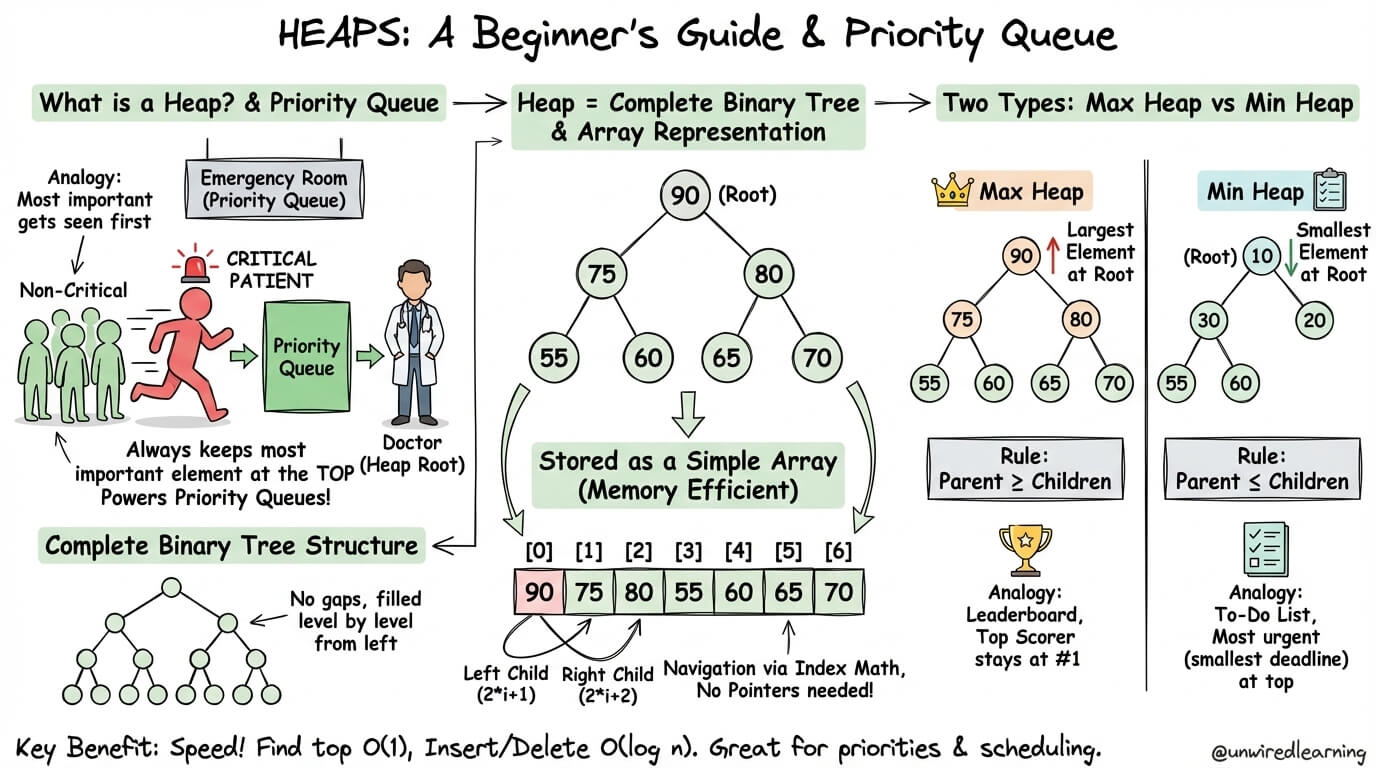
A heap is a complete binary tree where every node follows a specific ordering rule relative to its children. In a max-heap, the key of a parent node is always greater than or equal to the keys of its children. In a min-heap, the key of a parent node is always less than or equal to the keys of its children. The node at the top, called the root, holds the maximum or minimum value accordingly.
This structure does not enforce any ordering between siblings or cousins. It is partially ordered, not fully sorted. That partial ordering is what gives heaps their performance advantages: you can find the extreme value in constant time, O(1), and insert or remove elements in logarithmic time, O(log n).
Key Properties of a Heap
- Complete binary tree: All levels are fully filled except possibly the last, which is filled from left to right.
- Heap property: The parent-child relationship respects either the max-heap or min-heap rule.
- Implicit array storage: A heap is typically stored in an array, where the relationships between indices replace explicit pointers.
Max-Heap vs. Min-Heap
What Is a Heap? Data Structure Guide with Examples - Max-Heap vs. Min-Heap.
The choice between a max-heap and a min-heap depends entirely on whether you need quick access to the largest or smallest element.
- Max-heap: The root stores the maximum value. Useful for algorithms that repeatedly extract the largest element, such as heap sort or a job scheduler that prioritizes high-importance tasks.
- Min-heap: The root stores the minimum value. Ideal for Dijkstra's shortest path algorithm, event simulation, or any system that processes the smallest timestamp first.
Both variants support the same core operations with identical time complexities. The only difference is the direction of the comparison during sift-up and sift-down steps.
Common Heap Operations
What Is a Heap? Data Structure Guide with Examples - Common Heap Operations.
Understanding heap operations is essential for implementation and for recognizing when a heap is the right tool. Here are the fundamental actions you can perform on a heap.
Basic Operations
- find-max / find-min (peek): Return the root element without removing it. Time complexity: O(1).
- insert (push): Add a new element to the heap while preserving the heap property. The element is placed at the next available position in the array and then sifted up. Time complexity: O(log n).
- extract-max / extract-min (pop): Remove and return the root element. The last element moves to the root and is sifted down to restore the heap property. Time complexity: O(log n).
- replace: Remove the root and immediately insert a new element. This is more efficient than a pop followed by a push because it requires only one rebalancing pass.
Internal and Inspection Operations
- heapify: Build a heap from an unsorted array in O(n) time using Floyd's algorithm.
- increase-key / decrease-key: Update a key and then sift up or down to restore order.
- delete: Remove an arbitrary node, typically by swapping it with the last element and sifting.
- merge (union): Combine two heaps into one. The complexity varies by heap variant.
- size and is-empty: Return the number of elements or check if the heap is empty, both in O(1).
How a Binary Heap Is Implemented
What Is a Heap? Data Structure Guide with Examples - How a Binary Heap Is Implemented.
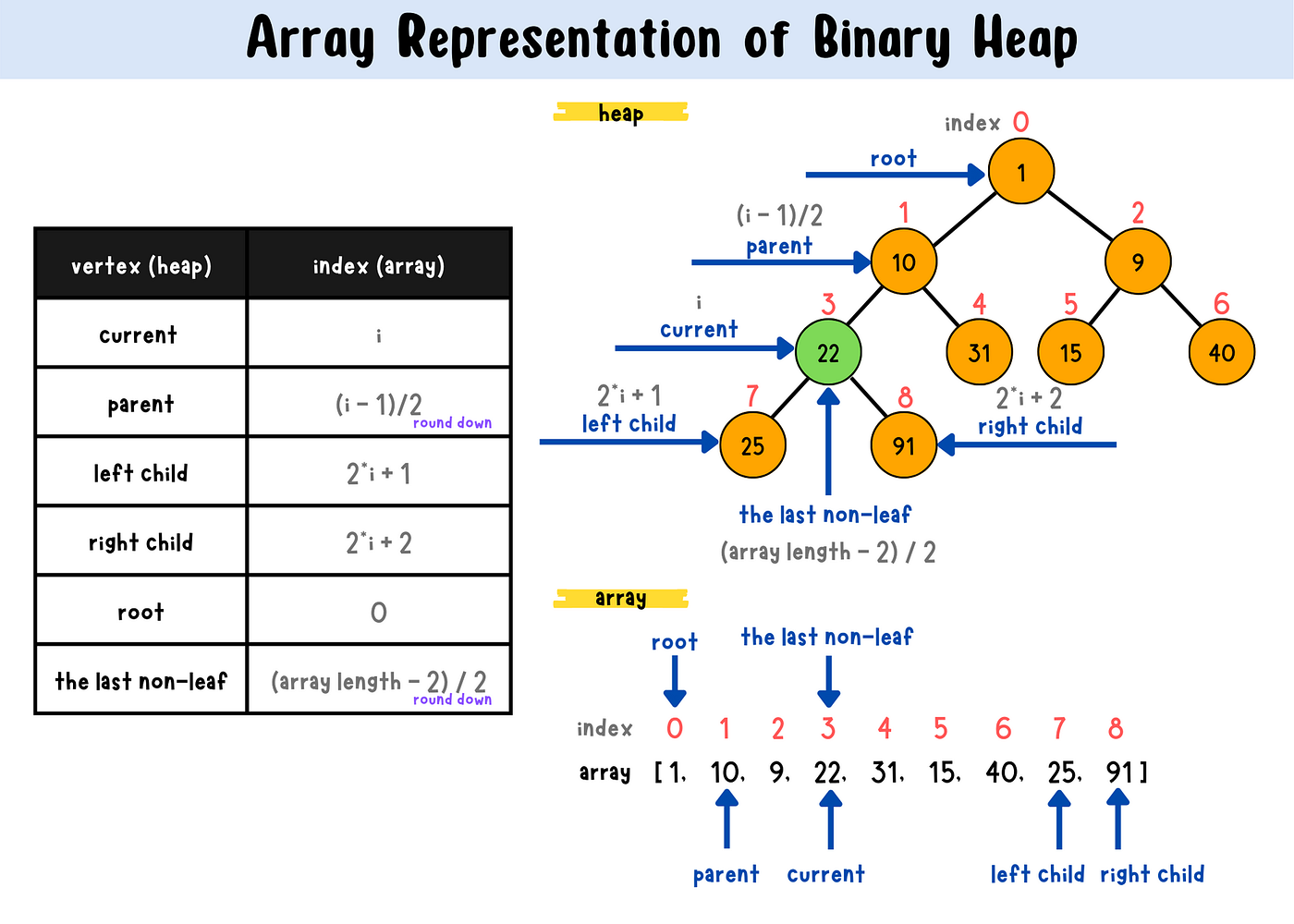
The binary heap is the most common implementation. It uses an array where the root is at index 0. For any node at index i:
- Its left child is at index
2i + 1 - Its right child is at index
2i + 2 - Its parent is at index
Math.floor((i - 1) / 2)
This implicit structure eliminates the need for child pointers and keeps memory overhead low. Insertion appends the new element to the end of the array and sifts it up. Extraction replaces the root with the last element and sifts it down. Both sift operations compare the element with its parent or children and swap when the heap property is violated.
Real-World Applications of Heaps
Heaps power many systems and algorithms that developers rely on daily. Here are some of the most important use cases.
- Priority queues: Operating system schedulers, network packet routing, and task queues all use heaps to process the highest-priority item first.
- Heap sort: An in-place, O(n log n) sorting algorithm that builds a max-heap and repeatedly extracts the maximum.
- Graph algorithms: Dijkstra's shortest path and Prim's minimum spanning tree algorithms use min-heaps to select the next node efficiently.
- Event simulation: Discrete event simulators store pending events in a min-heap keyed by event time.
- Median maintenance: Two heaps—a max-heap for the lower half and a min-heap for the upper half—can track the median of a stream in real time.
- External sorting: When data exceeds memory, a k-way merge uses a min-heap to merge sorted runs from disk.
Types of Heaps and Their Performance
Beyond the binary heap, several variants offer different trade-offs. The table below summarizes the time complexities of common heap types for key operations.
| Operation | Binary Heap | Fibonacci Heap | Pairing Heap | Brodal Queue |
|---|---|---|---|---|
| find-max | Θ(1) | Θ(1) | Θ(1) | Θ(1) |
| delete-max | Θ(log n) | O(log n) am. | O(log n) am. | Θ(log n) |
| increase-key | Θ(log n) | Θ(1) am. | o(log n) am. | Θ(1) |
| insert | Θ(log n) | Θ(1) | Θ(1) | Θ(1) |
| meld | Θ(n) | Θ(1) | Θ(1) | Θ(1) |
am. = amortized complexity
Binary heaps are simple, cache-friendly, and fast in practice for most workloads. Fibonacci heaps offer theoretically optimal amortized bounds and excel when decrease-key operations are frequent, such as in advanced graph algorithms. Pairing heaps are simpler than Fibonacci heaps and perform well in practice, though their exact bounds are more nuanced. Brodal queues achieve optimal worst-case complexities but are largely of theoretical interest due to implementation complexity.
Heap vs. Other Data Structures
Choosing between a heap and alternatives depends on the operations you need to optimize.
- Heap vs. sorted array: A sorted array gives O(1) access to the maximum or minimum and O(n) insertion. A heap gives O(1) max/min access and O(log n) insertion. Use a heap when insertions and deletions are interleaved with min/max queries.
- Heap vs. binary search tree (BST): A BST supports full sorting, range queries, and predecessor/successor searches in O(log n) on average. A heap cannot answer those queries efficiently but has better constant factors and simpler rebalancing. Use a heap when you only need the extreme value.
- Heap vs. stack: The stack data structure follows LIFO order and is used for function call management, undo operations, and expression evaluation. A heap data structure is unrelated to the memory region also called "heap." The data structure heap serves priority-based access, not temporal order.
When to Use a Heap in Your Code
A heap is the right choice when your application requires repeated access to the minimum or maximum element from a dynamically changing collection. If you are building a job queue where tasks have different priorities, implementing a cache eviction policy based on access frequency, or processing real-time streaming data to maintain a top-K list, a heap provides an elegant and efficient solution.
For analytics platforms that process large volumes of event data, similar principles apply. Tools that track user behavior and website performance often need to aggregate metrics like top pages, top referrers, or most active user segments. While the underlying implementation of platforms like Data4 abstracts away these data structures, the concept of efficiently querying the highest-value records from a large dataset mirrors how a max-heap operates. Data4's focus on simple, actionable website analytics means users get fast access to key performance indicators without needing to understand the computational mechanics behind the scenes. For teams evaluating analytics tools, understanding whether you need real-time priority-based data retrieval can guide your choice between a streamlined platform like Data4 and more complex product analytics suites. You can explore how Data4 compares to tools like Heap and Clicky in this detailed comparison.
Related reading
- Data4 vs Contentsquare vs Mixpanel: Which Analytics Fits? - Compare Data4, Contentsquare, and Mixpanel for website and product analytics. See strengths, use cases, and which tool matches your team's needs.
- Data4 vs Plausible Analytics: Which Fits Your Site? - Compare Data4 and Plausible Analytics on simplicity, data accuracy, global reach, and privacy. See which website analytics tool matches your business needs.
- Amplitude Review 2026: Strengths, Limits, and Who It’s For - Evidence-based Amplitude review covering behavioral analytics, AI features, pricing signals, and ideal users. See how it compares to Heap and Mixpanel for product teams.
Sources and further reading
- Home Energy Assistance Program (HEAP) | OTDA - NY.Gov - The Home Energy Assistance Program (HEAP) can help eligible New Yorkers heat and cool their homes. If you are eligible, you may receive one regular HEAP ...
- Home Energy Assistance Program (HEAP) | Ohio Department ... - The Home Energy Assistance Program (HEAP) is a federally funded program that provides eligible Ohioans assistance with their home energy bills.
- Heap (data structure) - From Wikipedia, the free encyclopedia
Frequently Asked Questions
What is the difference between a heap and a priority queue?
A priority queue is an abstract data type that supports insertion and extraction of the minimum or maximum element. A heap is one concrete, efficient implementation of a priority queue. In practice, the terms are often used interchangeably.
Can a heap have duplicate values?
Yes. A heap can store duplicate keys. The heap property only requires that a parent is greater than or equal to (max-heap) or less than or equal to (min-heap) its children. Duplicates do not violate this rule.
Why is heapify O(n) when inserting n elements is O(n log n)?
Building a heap from an unsorted array using Floyd's algorithm works from the bottom up. Most nodes are at lower levels and require few sift-down steps. The sum of all sift-down operations converges to O(n), which is more efficient than inserting elements one by one.
Is a heap stable?
No. Heaps are not stable data structures. The relative order of equal elements is not preserved during insertion and extraction.
When should I use a Fibonacci heap over a binary heap?
Use a Fibonacci heap when your algorithm performs many decrease-key operations, such as in some implementations of Dijkstra's algorithm with dense graphs. For most practical applications, a binary heap is simpler and has lower constant factors.
How does a heap relate to website analytics?
While a heap is a low-level data structure, its principles of efficient priority retrieval are foundational to many systems that process large-scale data. Analytics platforms may use heap-like structures internally to compute top-N reports, real-time leaderboards, or anomaly detection. When choosing an analytics tool, understanding your data processing needs helps you decide between platforms built for simplicity, like Data4, and those designed for deep event-level analysis. For a broader view of available options, see this expert review of the top 10 website analytics platforms for 2026.
Conclusion
The heap data structure is a cornerstone of efficient algorithm design. Its ability to provide constant-time access to the extreme element and logarithmic-time updates makes it indispensable for priority queues, sorting, graph algorithms, and streaming data problems. Whether you implement a simple binary heap or reach for a more advanced variant like a Fibonacci heap, understanding the heap property, the sift-up and sift-down operations, and the trade-offs between different heap types will help you write faster, more elegant code. For developers working with large datasets or real-time systems, mastering heaps is a skill that pays dividends across countless applications.