
PostHog Review 2026: Is the Free Tier Too Good to Be True?
PostHog has earned a reputation that feels almost mythical among developer circles: an all-in-one product analytics platform with a free tier so generous that over 90% of its 500,000+ teams reportedly never pay a cent. The platform bundles product analytics, session replay, feature flags, A/B testing, and even AI-powered error fixing into a single toolkit. But does this “self-driving product OS” live up to the hype, or is the pricing model a landmine waiting to explode once you’re entrenched? This review digs into the evidence from real users, technical deep-dives, and competitive comparisons to help you decide.
Who Is PostHog Really For?
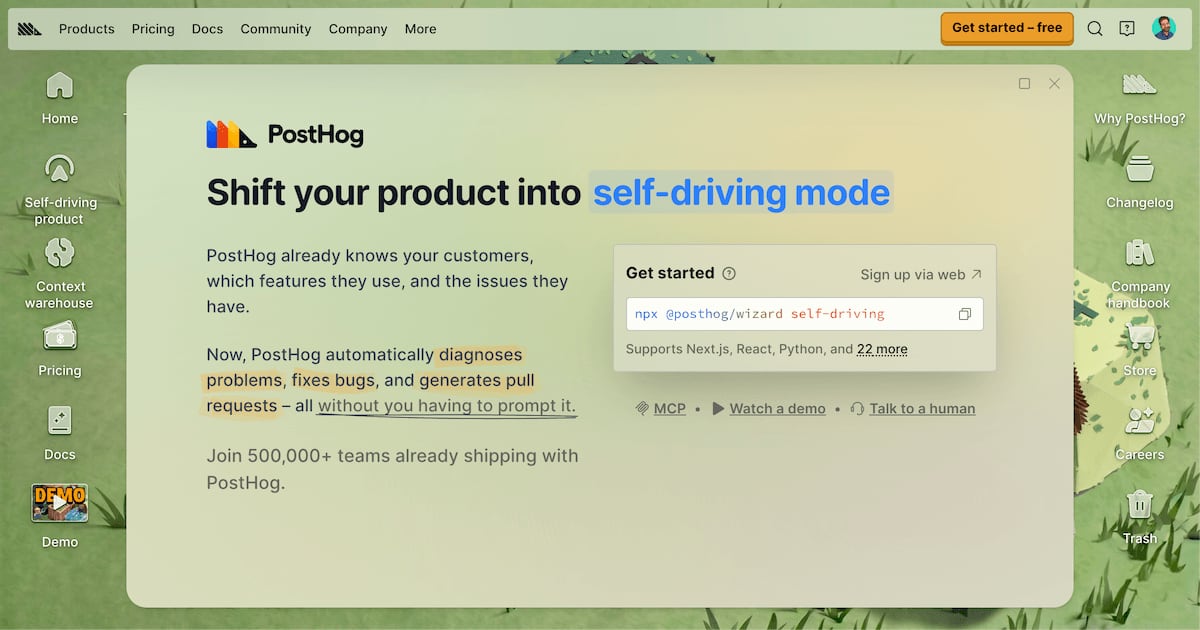
PostHog product interface.
PostHog is built first and foremost for engineers and product teams who want full context without stitching together five different SaaS subscriptions. It’s not a lightweight analytics dashboard for marketers who just need pageview counts. The ideal user profile includes:
- Startups and scale-ups that need to move fast with feature flags, experiments, and user behavior insights in one place.
- Developer-heavy product teams that value SQL access, a managed data warehouse, and the ability to query raw events directly.
- Privacy-conscious organizations that require self-hosting or EU data residency for GDPR compliance.
- Teams evaluating alternatives to Amplitude or Mixpanel who find those tools either too expensive or too siloed from engineering workflows.
If your primary need is simple website analytics with minimal setup, a tool like Plausible or our Data4 vs Plausible Analytics comparison might be a better fit. But if you need a platform that can replace your analytics, feature flagging, and session replay tools simultaneously, PostHog deserves a serious look.
Core Capabilities: What You Actually Get
Product Analytics and Event Tracking
PostHog’s event tracking is the backbone of the platform. Unlike tools that require extensive upfront instrumentation, PostHog offers autocapture of clicks, pageviews, and form submissions out of the box. Users on Reddit consistently highlight this as a key advantage: “We were sold just on feature flags alone, but the event tracking is so good for many of our use cases.” The ability to define custom events retroactively means you don’t need to predict every question you’ll ask before shipping.
Session Replay with AI Vision
Session replay captures pixel-perfect reconstructions of user sessions, complete with console logs and network activity. The newer “Replay Vision” feature applies AI to summarize sessions and surface rage clicks, dead clicks, and error states automatically. This turns hours of manual review into a focused troubleshooting session.
Feature Flags and Experiments
Feature flags in PostHog support percentage rollouts, user targeting by properties, and integration with experiments for A/B testing. The platform handles the statistical analysis behind experiments, showing confidence intervals and recommended winners. For teams practicing continuous deployment, this removes the need for a separate feature management tool.
AI-Powered Error Tracking and Fixes
PostHog’s AI capabilities go beyond surface-level suggestions. The platform can automatically diagnose problems, fix bugs, and generate pull requests without prompting. This “self-driving” approach is still maturing, but early adopters report significant time savings in identifying root causes of errors captured during session replays.
The Context Warehouse
A managed data warehouse underpins everything, allowing teams to query raw event data with SQL. This appeals to data engineers who want to join product data with external sources—PostHog integrates with 120+ external tools—without exporting data to a separate warehouse.
The Free Tier: Generous or a Trap?
The free tier includes 1 million events per month, unlimited feature flags, and session replays. For early-stage startups, this is genuinely enough to run full product analytics without paying. Multiple Reddit users confirm they’ve “still haven’t had to pay for anything” after significant usage. PostHog’s business model is transparently land-and-expand: as your event volume grows, you move into paid tiers with usage-based pricing.
Spike detection is built in to prevent surprise bills—a thoughtful touch that addresses a common pain point with usage-based pricing. The paid plans start at $0.00031 per event after the free tier, with volume discounts available. Compared to Amplitude’s opaque enterprise pricing, PostHog’s transparency is refreshing. If you’re comparing analytics platforms, our Amplitude review breaks down how the two stack up on pricing and features.
Self-Hosting: The Hidden Complexity
PostHog is open source, but self-hosting comes with caveats that the marketing page glosses over. A Hacker News discussion reveals that self-hosting is “buried in their GitHub repo as a footnote” with indications of “vague issues past 100K events/month.” The primary repository is not fully FOSS, and the “100% FOSS” repo requires digging through documentation.
For teams that need self-hosting for compliance or cost reasons, scaling PostHog beyond 100,000 events per month requires significant infrastructure investment. ClickHouse, Kafka, and Redis are all part of the stack. One user noted: “Tried PostHog self-hosted, did not work quite well.” If your primary motivation for self-hosting is simplicity, a lightweight alternative like Umami or Plausible may be more appropriate.
For teams that can use the cloud version, EU data residency is available by choosing the Frankfurt data center, which addresses GDPR concerns about data leaving the EU. However, features like session replay still require user consent under GDPR, which can limit the completeness of analytics data.
Where PostHog Falls Short

PostHog product interface.
No tool is perfect, and PostHog has several limitations to consider:
- Complexity for non-engineers: The platform assumes SQL knowledge and a developer mindset. Marketers and product managers without technical support may find the interface overwhelming compared to tools like Mixpanel or our Data4 vs Heap vs Clicky comparison.
- Self-hosting friction: As noted above, self-hosting is not a first-class experience. The company is “very pushy towards using their SaaS,” according to one HN commenter.
- Open source ambiguity: While PostHog markets itself as open source, the licensing and repository structure require careful reading to understand what’s truly free and what’s proprietary.
- Event volume costs at scale: For high-traffic products, usage-based pricing can become expensive. Teams should model their projected event volume against PostHog’s pricing calculator before committing.
How PostHog Compares to Alternatives

PostHog product interface.
| Feature | PostHog | Amplitude | Mixpanel | Plausible |
|---|---|---|---|---|
| Free Tier | 1M events/month | 50K MTUs/month | 20M events/month (limited) | Self-hosted only |
| Session Replay | Included | Add-on | Add-on | Not available |
| Feature Flags | Included | Not available | Not available | Not available |
| Self-Hosting | Available (complex) | Not available | Not available | Available (simple) |
| SQL Access | Yes | No | No | No |
| Best For | Engineers, full-stack teams | Enterprise PMs | Mobile-first products | Privacy-first websites |
For a deeper comparison between developer-focused and marketer-focused analytics, see our Data4 vs PostHog breakdown. If you’re evaluating multiple enterprise options, the Data4 vs Contentsquare vs Mixpanel comparison offers additional context.
Setup and Onboarding Experience
Getting started with PostHog’s cloud version is straightforward: install the JavaScript snippet or one of the SDKs (Python, Node.js, Go, Ruby, and more), and autocapture begins immediately. The documentation is frequently praised as “great” by users. For teams migrating from other tools, PostHog offers importers for Amplitude, Mixpanel, and Google Analytics data.
Self-hosted setup is significantly more involved. The recommended deployment uses Docker Compose for small instances, but production deployments require Kubernetes and careful resource allocation for ClickHouse. Teams considering self-hosting should budget at least a week of engineering time for a stable production setup.
Decision Criteria: Should You Choose PostHog?

PostHog product interface.
Choose PostHog if:
- You’re an engineering-led team that wants analytics, flags, and replays in one platform.
- You value SQL access and the ability to query raw event data.
- You’re cost-sensitive at the early stage and want a generous free tier.
- You need EU data residency without self-hosting complexity.
Look elsewhere if:
- You need a simple, privacy-first analytics dashboard for marketing sites.
- Your team lacks SQL skills or developer resources.
- You require a fully open source, self-hosted solution without scaling headaches.
- You’re already heavily invested in an alternative ecosystem like Amplitude or Mixpanel and switching costs are high.
Related reading
- What Is a Heap? Data Structure Guide with Examples - Learn what a heap data structure is, how max-heap and min-heap work, their operations, real-world uses, and how they compare to other data structures.
Sources and further reading
PostHog seems to good to be true, is it? : r/nextjs - I use them at work for eventing and flagging across a wide set of apps. We are big fans; trying not to sound like a shill: we were sold just on feature flags
alone, but the event tracking is so good for many of our use cases (quick evaluation of features that lets us ship iterations faster and gather quick feedback)
Posthog is pretty good but very pushy towards using their SaaS (understandably).... - Posthog is pretty good but very pushy towards using their SaaS (understandably). Self hosting is not really advertised on their main site however is buried in their gh repo as a footnote [1] with indications of vague issues past 100K events/month. Haven’t delved into how to scale it past that though and they do provide some docs that I have yet to review.
PostHog Reviews 2026: Details, Pricing, & Features - Users consistently praise PostHog for its ease of use and comprehensive features, which allow for effective product analytics and user insights.
Frequently Asked Questions
Is PostHog really free?
Yes, the free tier includes 1 million events per month, unlimited feature flags, and session replays. Over 90% of teams use PostHog for free. Paid plans kick in when you exceed the event limit or need advanced features like the data warehouse.
Is PostHog GDPR compliant?
PostHog offers EU data residency via its Frankfurt data center. However, features like session replay require user consent under GDPR. The platform provides cookie-less tracking options and data deletion APIs to support compliance.
Can I self-host PostHog?
Yes, but it’s complex. The self-hosted version requires managing ClickHouse, Kafka, and Redis. Scaling beyond 100,000 events per month demands significant infrastructure. The company prioritizes its cloud offering, and self-hosting documentation is less polished.
How does PostHog compare to Amplitude?
PostHog offers a broader feature set (feature flags, session replay, error tracking) at a lower price point with transparent pricing. Amplitude has more advanced behavioral analytics and a more polished interface for non-technical users. See our full Amplitude review for details.
Does PostHog work for mobile apps?
Yes, PostHog provides SDKs for iOS, Android, React Native, and Flutter. Autocapture works on mobile with some limitations compared to web.
Conclusion: A Developer’s Dream, With Caveats
PostHog delivers on its promise of an all-in-one product analytics platform for engineering teams. The free tier is genuinely usable for early-stage products, the feature set eliminates the need for multiple tools, and the transparent pricing is a breath of fresh air in a market dominated by opaque enterprise sales.
The trade-offs are real: self-hosting is an afterthought, the platform can overwhelm non-engineers, and the open source licensing requires careful scrutiny. But for the right team—one that values SQL access, wants feature flags and analytics in one place, and can accept the cloud-first approach—PostHog is as good as the hype suggests. Just model your event volume growth against the pricing calculator before you get too comfortable on that generous free tier.